
Disclosure: this review contains affiliate links. If you buy through one I may earn a commission at no extra cost to you. I do not own, work for, or get paid by Timberland PRO, and no brand buys its position on this site. See our affiliate disclosure.
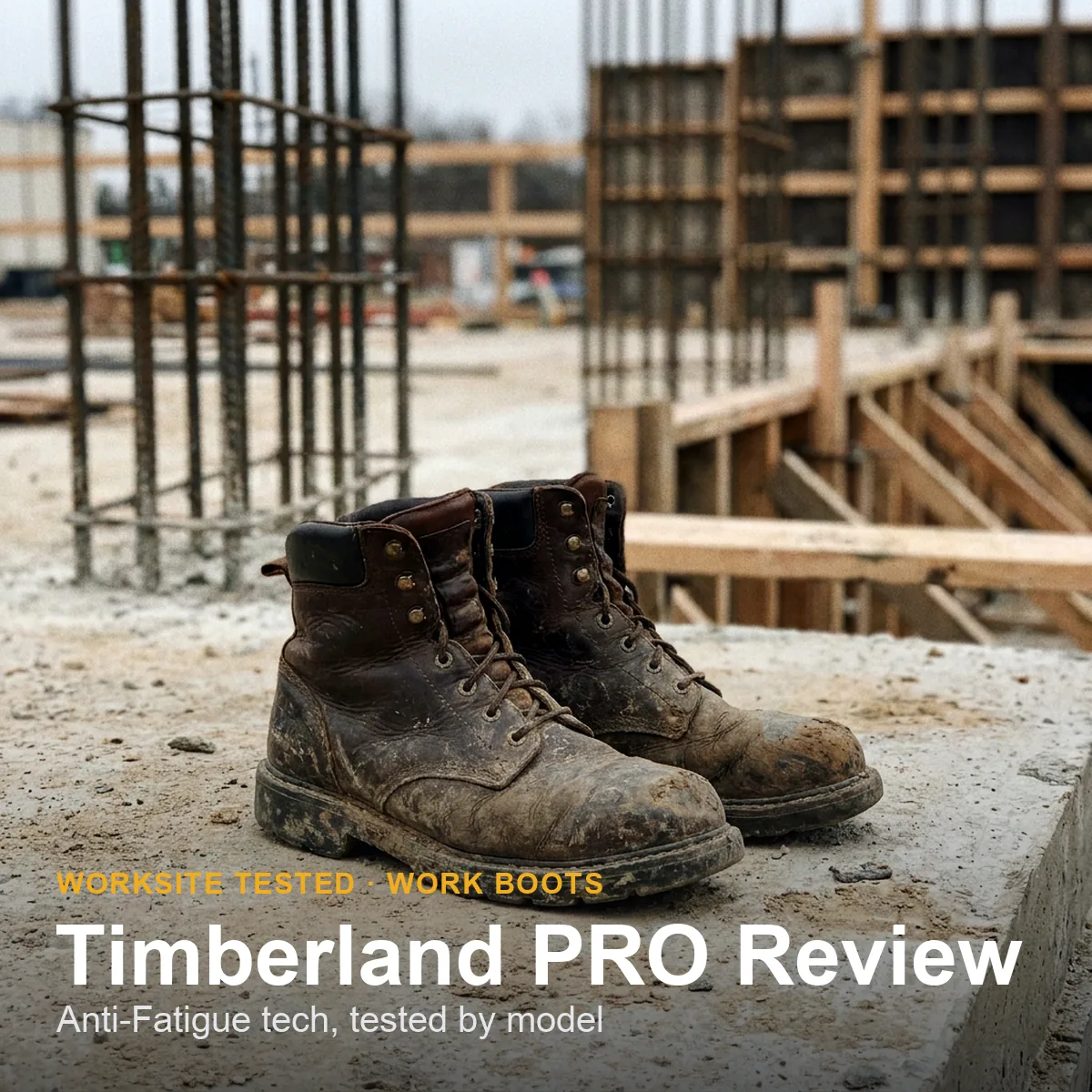
Short answer: Timberland PRO is worth buying, but not for the reason the marketing sells you. The Anti-Fatigue Technology on the label is a manufacturer comfort claim with no independent test data behind it that I could find — and the brand will happily sell you the Anti-Fatigue footbed as a separate $30 insole. What actually justifies the money is duller and more useful: Goodyear welt construction on the Pit Boss line at $155-$160, guaranteed waterproof membranes on the Boondock and Hyperion, and a women's TiTAN at $134.95 that undercuts the men's boots instead of taxing them.
I pulled eight Timberland PRO models live from Working Person's Store on July 12, 2026 — every price, spec, ASTM line and review count below comes off those listings. Where a listing does not state something, I say so rather than filling the gap. That matters more than usual here, because one of the eight boots in this review is not a safety-toe boot at all, and its listing is the one with the most reviews.
Key Takeaways
- The Pit Boss 33046 is a SOFT TOE. Its listing states no ASTM F2413 marking. It sits in the same product family, at a similar price, with the most reviews of any model here (4.4/5 from 39) — and it will not satisfy a safety-toe requirement. Read the toe type before you read the stars.
- Seven of eight state the identical protection line: ASTM F2413-05 M I/75 C/75. Steel, alloy and composite all carry it. The marking does not differentiate the toe materials on impact or compression — the trade-offs are weight, thermal conductivity and metal detection, and no listing here states a weight, so I publish none.
- The edition on every listing is 2005. Every Timberland PRO safety-toe listing captured says "ASTM F2413-05," while ASTM's own store lists F2413-18 and Tyndale's standards library references F2413-18 as operative. Treat a retailer's stated edition year as retailer copy — check the marking stitched inside the boot you actually receive.
- Only three models state waterproofing: Boondock 92615, Boondock 89628 and Hyperion 90646 each state "Guaranteed Waterproof- Membrane." Both Pit Boss steel-toe models, the soft-toe Pit Boss and both TiTANs are stated NOT waterproof.
- Anti-Fatigue is a claim, not a measurement. The retailer describes an inverted cone design with shock-absorbing, energy-returning technology. No independent fatigue-reduction test data turned up in this research, so nobody — including me — should be quantifying the benefit for you.
- Adding aftermarket insoles can invalidate the ASTM marking. ASTM's own F2413-18 scope says modifications to original components could cause failure to any or all parts of the standard. That includes dropping the $30 Anti-Fatigue footbed into a certified boot.
- Read up: ASTM F2413 explained | What EH rating actually protects you from | Best work boots across all brands
Who Timberland PRO actually is
Timberland PRO is the industrial line of a company whose public identity is a fashion boot, and it helps to know that before you read any of its marketing.
The heritage story is genuinely old and, honestly, genuinely muddled across sources. Wikipedia states the Abington Shoe Company was established in 1933 in South Boston, and that Nathan Swartz — a shoemaker from Odesa, Ukraine — bought half-interest in the company in 1952, eventually acquiring the remaining shares with his sons. Timberland's own newsroom says Swartz acquired Abington in 1955. VF Corporation's brand page lists the founding year as 1952. Three sources, three framings — so I am not going to hand you one tidy date as settled fact.
What the sources agree on: the Timberland boot was introduced in 1973 (the newsroom describes it as an 8-inch work boot with the yellow colorway and tree logo; VF calls them the Original Yellow Boots), Abington was renamed and incorporated as The Timberland Company in 1978, and the company is headquartered in Stratham, New Hampshire. The newsroom credits the Swartz family with using injection molding technology and silicone-infused nubuck leathers to build truly waterproof leather work boots — which is the actual technical thread running to the Boondock's membrane today.
In June 2011, per Wikipedia, Timberland signed a definitive takeover agreement with VF Corporation at $43 per share, or approximately $2 billion. It has been a VF brand ever since. Here is the detail I find telling: VF's own Timberland brand page categorizes the brand as "Outdoor Lifestyle Footwear, Apparel & Accessories" and makes no mention of Timberland PRO at all. The corporate energy is on the yellow boot. PRO is the work line running quietly underneath it.
Working Person's Store's Timberland PRO brand page describes the brand as offering premium workwear and footwear that is durable, protective and comfortable, credits the company with 65 years of experience in workwear manufacturing, and lists four featured attributes: safety toe, water resistant uppers, anti-fatigue technology and insulation. Note that "water resistant uppers" is a brand-level marketing attribute — it is not a per-model waterproof claim, and I would not treat it as one on any boot whose listing states NOT waterproof.
Anti-Fatigue Technology: what is actually claimed
This is the phrase on the hangtag, so let's be precise about what it is and is not.
Working Person's Store's listing for the standalone Timberland PRO 91621 Anti-Fatigue insole describes it as an inverted cone design that delivers lightweight but durable support with shock-absorbing, energy-returning technology to reduce the impact of terrain on your feet. The same listing states the footbed uses an OrthoLite top layer for padded support, comfort and moisture management, an anatomically-contoured footbed, a dynamic arch design, and an Outlast top cover with temperature regulation and antimicrobial odor control. It is listed at $30.00, in stock, rated 4.8/5 from 4 reviews.
Those are the manufacturer's and retailer's stated claims. No independent fatigue-reduction test data surfaced in this research. There is no ASTM or ANSI designation for "less tired at hour ten," so there is no third-party number to check the claim against. Anyone quantifying the benefit for you — "reduces fatigue by X percent" — is making it up. I am not going to.
What I can tell you is which boots state anti-fatigue construction in the boot itself rather than in a separate insole. Two of the eight: the Boondock 92615 (dual-density anti-fatigue sole) and the Hyperion 90646 (anti-fatigue technology with an EVA foam midsole). Everything else in this lineup, if you want the Anti-Fatigue footbed, you are buying it separately.
And there is a catch on doing that, which almost nobody mentions. ASTM's published scope for F2413-18 states that modifications to original footwear components — aftermarket footbeds or inserts specifically — could cause failure to any or all parts of the standard, rendering the ASTM marking invalid. A safety toe cap is certified with a specific internal clearance above your toes. Adding a thicker footbed lifts your foot into that clearance. So: dropping a $30 aftermarket insole into a $160 certified boot is not automatically free. If your site enforces ASTM-marked footwear, that is a conversation to have with your safety officer, not a decision to make in the parking lot.
Check price at Working Person's Store
The ASTM F2413-05 line on every listing — and why the year matters
Seven of the eight boots here state the same marking: ASTM F2413-05 M I/75 C/75. Broken down:
- ASTM F2413 is the Standard Specification for Performance Requirements for Protective (Safety) Toe Cap Footwear. Per ASTM's own scope, the standard covers impact and compression resistance in the toe area, metatarsal protection, conductive and static dissipative properties, electric shock resistance, dielectric insulation, sole puncture resistance and chainsaw cut resistance.
- -05 is the stated edition year — the 2005 edition. Hold that thought.
- M is the gender designation. Tyndale's standards library describes the label as a three- or four-line structure: line 1 is the standard designation and year, line 2 is gender plus the core impact/compression (I/C) designations, and lines 3-4 carry the additional hazard protections (Mt, EH, SD, Cd, PR).
- I/75 and C/75 are, per Tyndale, the highest classification levels under ASTM F2413 — impact protection at a 75-pound force level, and compression protection against 2,500-pound loads.
Now the year. Every single Timberland PRO safety-toe listing captured on Working Person's Store states F2413-05, the 2005 edition. Meanwhile ASTM's own store page lists F2413-18 as a published edition, and Tyndale's technical library references F2413-18 as the operative edition at time of publication. That is a real discrepancy, and I am not going to paper over it or invent an explanation for it.
The practical read: a retailer's stated edition year is retailer copy. It is not proof of what edition the physical boot in the box is currently certified and marked to. If your employer's PPE policy specifies an edition — and some do — check the marking stitched inside the tongue of the boot you actually receive, not the spec block on a product page. Our ASTM F2413 explainer walks the full stamp line by line.
One more piece of context from ASTM itself, worth quoting because it applies to every boot on this page: the F2413-18 scope states that controlled laboratory tests "shall not be deemed as establishing performance levels for all situations to which individuals may be exposed." A rating is a lab result, not a promise about your specific accident. Also worth knowing: F2413-18 does not apply to overshoes with safety toes, or to strap-on toe devices — if your site uses those, they are outside this standard entirely.
All 8 Timberland PRO models compared
| Model | Toe / ASTM line as stated | Construction | Waterproof | Listing rating | Price |
|---|---|---|---|---|---|
| Pit Boss 33032 (black) | Steel — F2413-05 M I/75 C/75 | Goodyear welt / stitch down | No | 4.7/5 (38) | $160.00 |
| Pit Boss 33034 (brown) | Steel — F2413-05 M I/75 C/75 | Goodyear welt / stitch down | No | 4.4/5 (35) | $160.00 |
| Boondock 92615 | Composite — F2413-05 M I/75 C/75 | Goodyear welt / stitch down, waxed thread | Yes (guaranteed membrane) | 4.4/5 (15) | $230.00 |
| TiTAN 26388 (women's) | Alloy — F2413-05 M I/75 C/75 | Cement (flexible) | No | 4.7/5 (24) | $134.95 |
| TiTAN 26064 | Alloy — F2413-05 M I/75 C/75 | Cement (flexible) | No | 4.7/5 (18) | $154.95 |
| Boondock 89628 (8", 600g) | Composite — F2413-05 M I/75 C/75 | Three-quarter welt + cement | Yes (guaranteed membrane) | 4.0/5 (5 — small sample) | $265.00 |
| Hyperion 90646 | Alloy — F2413-05 M I/75 C/75 | Cement (flexible) | Yes (guaranteed membrane) | 4.2/5 (6 — small sample) | $215.00 |
| Pit Boss 33046 (soft toe) | SOFT TOE — no ASTM F2413 marking stated | Goodyear welt / stitch down | No | 4.4/5 (39) | $155.00 |
Eight models, eight rows. Every cell above is read off the listing; where a listing does not state a spec (heights on the 92615 and 26064, weights on all of them), it is not in the table and it is not in this article.
1. Pit Boss 33032 (black) — the default Timberland PRO buy
Goodyear welt construction at $160 with a steel toe, EH rating and the strongest owner evidence in the lineup (4.7/5 from 38 reviews). The welt is the reason this ranks first: when the outsole is gone, the boot is not — you resole it. That changes the multi-year math against every cement-construction boot below.
The build list is plain and durable: leather upper, rubber outsole, padded collar, metal hooks and eyelets, Cambrelle lining with Agion antimicrobial treatment, abrasion, slip and oil resistant. Sizes run 7-15 in both medium and wide.
- Pros: resole-capable welt at a mid price; best review evidence in the range; EH rated; wide sizing to 15.
- Cons: not waterproof — the listing is explicit; no insulation; no stated weight to compare against alloy or composite alternatives.
Check price at Working Person's Store
2. Pit Boss 33034 (brown) — same boot, brown, more detail on the listing
Same $160, same 6-inch welt-built steel-toe chassis, same ASTM F2413-05 M I/75 C/75 line, same nylon shank, EH rated, not waterproof. The brown listing additionally itemizes a removable contoured sock liner and the Timberland PRO Comfort Suspension system.
Honest caveat: that extra detail is listing copy, not evidence of a different build — both listings describe the same welt-built Pit Boss chassis in two colorways, and I am not going to sell you a spec difference I cannot demonstrate. It rates 4.4/5 from 35 reviews — a step under its black twin on a comparable sample.
- Pros: welt construction; nylon shank and removable footbed stated; large review base; brown wears jobsite dirt better than black.
- Cons: not waterproof; scores below the black 33032 at the same price; no functional advantage over the black twin — this is a color choice.
Check price at Working Person's Store
3. Boondock 92615 — the one to buy if you work wet
At $230 the Boondock is the most equipped boot in this lineup and the only non-hiker model whose listing states anti-fatigue construction inside the boot: a dual-density anti-fatigue sole. Add a guaranteed waterproof membrane, a composite (non-metallic) safety toe carrying the F2413-05 M I/75 C/75 line, Goodyear welt construction sewn with waxed thread, a fiberglass shank, a toe bumper and a polyurethane outsole.
The composite toe is the strategic difference. Non-metallic matters if you pass through metal detection daily, or if you are outdoors in cold where a metal cap conducts. On impact and compression the marking says composite and steel are equals here — the difference is everything except the rating.
- Pros: guaranteed waterproof membrane; non-metallic toe; welt construction; toe bumper and fiberglass shank; anti-fatigue sole stated in the boot itself.
- Cons: $70 over a Pit Boss; no insulation (get the 89628 for cold); the listing does not state boot height, so shaft height is unknown until it arrives.
Check price at Working Person's Store
4. Women's TiTAN 26388 — the cheapest safety-toe boot here, and it's the women's one
$134.95 for an alloy safety toe, EH rating, 6-inch height, a 90-degree heel for ladder rungs, and sizes from 5.5 to 11 in both medium and wide. It rates 4.7/5 from 24 reviews. It is the only women-specific SKU in the models captured for this review, and it is also the lowest-priced boot on the page — which is the opposite of how women's safety footwear is usually priced, and it deserves saying out loud.
The 90-degree heel is not a styling choice. A defined heel shelf catches a ladder rung instead of rolling off it, which matters if your day includes climbing.
- Pros: lowest price on this page; genuine women's sizing down to 5.5 with wide widths; alloy toe with the full I/75 C/75 line; 90-degree heel.
- Cons: cement construction — not resole-capable; not waterproof; no insulation; the only women's option, so there is no alternative within the brand if the fit is wrong for you.
Check price at Working Person's Store
5. TiTAN 26064 — alloy toe, flexible build, no resole
$154.95, full-grain leather upper, rubber outsole rated slip, oil and abrasion resistant, cement (flexible) construction, 90-degree heel, padded collar, metal hooks and eyelets. Alloy safety toe with the same F2413-05 M I/75 C/75 line as everything else. 4.7/5 from 18 reviews.
The thing everyone wants to know about alloy is how much lighter it is than steel. The listing does not state a weight — not for this boot and not for any other boot in this review — so I am not publishing a number. The listing also does not state boot height. Buy this if you want a flexible-feeling boot out of the box and a non-steel toe; buy the Pit Boss if you would rather have the welt.
- Pros: alloy toe at the same rated protection level; full-grain leather; strong 4.7/5 rating; slip, oil and abrasion resistant outsole.
- Cons: cement construction cannot be resoled; not waterproof; the listing states neither height nor weight; the welt-built Pit Boss costs only $5 more.
Check price at Working Person's Store
6. Boondock 89628 — the winter boot, on thin review evidence
Eight-inch shaft, 600 grams of Thinsulate, a guaranteed waterproof membrane, a composite safety toe with the F2413-05 M I/75 C/75 line, EH protection, and what the listing calls a dual-density cold temperature TPU lug outsole. Construction is a combination three-quarter Goodyear welt and cement build. Toe bumper, padded collar, metal hooks and eyelets, bloodborne pathogen protection.
If you work outdoors through a real winter, that is the correct spec sheet and there is no substitute for insulation in the boot. Two things to be straight about: $265 is the top of this range, and the 4/5 rating comes from just 5 reviews. Five is not a sample. Buy this boot on its specification, not on its star average — and if you want more insulation options across brands, our insulated work boot guide covers the wider field.
- Pros: 600g Thinsulate plus waterproof membrane — genuine cold-weather build; 8-inch shaft; composite toe; cold-temperature outsole compound; partial welt.
- Cons: $265, the most expensive here; only 5 reviews, so owner evidence is effectively absent; insulation is dead weight and heat in any three-season job.
Check price at Working Person's Store
7. Hyperion 90646 — interesting boot, not enough evidence yet
A hiker-style safety boot: leather and nylon upper, a Vibram rubber outsole with a Ladder Lock radius, a guaranteed waterproof membrane, an alloy toe on the F2413-05 M I/75 C/75 line, anti-fatigue technology with an EVA foam midsole, a fiberglass shank and a toe bumper. Listed as abrasion, oil and chemical resistant with bloodborne pathogen protection. $215.
On paper this is the most interesting boot Timberland PRO makes for anyone covering distance on uneven ground, and the Ladder Lock radius is a real design answer to rung work. Two reasons it ranks here anyway: cement construction at $215 means you cannot resole a boot that costs more than two of the welt-built options, and the 4.2/5 average rests on 6 reviews. I will not rank a 6-review average above boots with 20 to 40 owners behind them.
- Pros: Vibram outsole with Ladder Lock radius; waterproof membrane; anti-fatigue EVA midsole stated in the boot; chemical resistant; hiker profile for walking work.
- Cons: cement construction at $215 — no resole; only 6 reviews; nylon panels are a wear point that full-leather boots do not have.
Check price at Working Person's Store
8. Pit Boss 33046 — read this before you buy it
This is a soft-toe boot. Its listing states no ASTM F2413 marking, and it should not be treated as meeting a safety-toe requirement. It sits at $155 in the same Pit Boss family, next to the $160 steel-toe versions, with 4.4/5 from 39 reviews — the largest review base on this page. That combination is exactly how people end up buying the wrong boot.
Taken for what it is, it is good. Goodyear welt construction, gaucho oiled full-grain leather, a rubber outsole with improved slip, abrasion and oil resistance, nylon shank, removable contoured footbed, Cambrelle lining with antimicrobial treatment and the Timberland PRO 24/7 Comfort Suspension System. It also carries the clearest EH statement of the group: the listing states protection for open circuits up to 600 volts under dry conditions.
- Pros: welt-built at $155; premium oiled full-grain leather; the most explicit EH statement in the lineup; largest review base; no toe cap means no cap clearance to worry about.
- Cons: no safety toe and no stated ASTM F2413 marking — it will not satisfy a site safety-toe requirement; not waterproof; easily confused with the safety-toe Pit Boss models.
Check price at Working Person's Store
Who Timberland PRO is NOT for
An honest brand review has to name the people it does not serve. Based only on what these listings state:
- You need metatarsal protection. Not one of the eight models captured states an Mt designation. If your hazard assessment calls for met-guard coverage, no boot in this review answers it — look at brands that build it, and see our met-guard boot guide.
- You need puncture resistance (PR). Same story — no PR designation is stated on any of these listings. Demo work with scattered fasteners underfoot needs a boot that states it.
- You need a static-dissipative (SD) boot. Not stated on any model here. EH and SD are different protections; do not substitute one for the other.
- You want a spec sheet with weights and heights. Two models here state no height and none state a weight. If you compare boots on grams, Timberland PRO's listings will frustrate you.
- You need documented edition compliance. Every listing states the 2005 edition while ASTM publishes F2413-18. If your PPE policy specifies an edition, verify the physical boot's marking before committing a crew order.
- You want a resolable boot under $200 with waterproofing. The welt-built models here are not waterproof and the waterproof models are $215 and up. That combination does not exist in this lineup — our waterproof roundup covers brands where it does.
Frequently Asked Questions
What is Timberland PRO Anti-Fatigue Technology, and does it actually do anything?
Working Person's Store's listing for the Timberland PRO 91621 insole describes it as an inverted cone design delivering lightweight but durable support, with shock-absorbing, energy-returning technology, topped by an OrthoLite layer for padded support, comfort and moisture management, plus an anatomically-contoured footbed, a dynamic arch and an Outlast top cover for temperature regulation and odor control. Those are manufacturer and retailer claims. No independent fatigue-reduction test data surfaced in this research, so the benefit cannot honestly be quantified. Two boots here state anti-fatigue construction in the boot itself: the Boondock 92615 and the Hyperion 90646.
What does the ASTM F2413-05 M I/75 C/75 marking on Timberland PRO boots mean?
ASTM F2413 is the Standard Specification for Performance Requirements for Protective (Safety) Toe Cap Footwear. Tyndale's standards library describes I/75 and C/75 as the highest classification levels — impact protection at a 75-pound force level and compression protection against 2,500-pound loads — and describes the label as three or four lines: standard and year, then gender plus the I/C designations, then additional protections such as Mt, EH, SD, Cd and PR. Note the edition mismatch: every Timberland PRO listing captured states F2413-05, while ASTM's store lists F2413-18 and Tyndale references F2413-18 as operative. Check the marking inside the boot you receive.
Which Timberland PRO boots are actually waterproof?
Of the eight models captured, three state "Guaranteed Waterproof- Membrane": the Boondock 92615, the Boondock 89628 and the Hyperion 90646. The Pit Boss 33034, 33032 and 33046 and both TiTAN models (26064 and 26388) are stated NOT waterproof. Working Person's Store's Timberland PRO brand page lists "water resistant uppers" as a brand-level feature, but that is not a per-model claim and I would not treat a boot whose own listing says NOT waterproof as water resistant.
Steel toe, alloy toe, or composite toe — which Timberland PRO should I get?
Steel: Pit Boss 33034 and 33032. Alloy: TiTAN 26064, women's TiTAN 26388, Hyperion 90646. Composite (non-metallic): Boondock 92615 and 89628. All seven safety-toe models state the same ASTM F2413-05 M I/75 C/75 line, so the marking does not differentiate them on impact or compression. The real trade-offs are weight, thermal conductivity and metal detection — and because no listing here states a boot weight, this review publishes no weight numbers and no "lighter by X ounces" claims. Composite if you pass metal detection or work cold; steel on the welt-built Pit Boss if you want resole-ability.
Do Timberland PRO EH-rated boots protect me from electrical shock?
Partly, and within stated limits. Working Person's Store states EH protection on the Pit Boss 33046 is rated for open circuits up to 600 volts under dry conditions. Read both limits: open circuits, dry conditions. EH footwear is secondary protection — it is not a substitute for proper electrical PPE, de-energizing, or lockout/tagout. ASTM's own F2413-18 scope also cautions that controlled laboratory tests "shall not be deemed as establishing performance levels for all situations to which individuals may be exposed." Wet, worn or contaminated boots are outside the condition the rating was earned in.
Does swapping in aftermarket insoles void the boot's safety rating?
It can. ASTM's F2413-18 scope states that modifications to original footwear components — aftermarket footbeds or inserts included — could cause failure to any or all parts of the standard, rendering the ASTM marking invalid. This matters directly here because Timberland PRO sells the 91621 Anti-Fatigue insole as a separate $30.00 product. A toe cap is certified with a specific internal clearance; a thicker footbed raises your foot into it. If your site enforces ASTM-marked footwear, clear insole swaps with your safety officer first.
Are work boots required by OSHA, and does Timberland PRO meet the requirement?
OSHA 29 CFR 1910.136 requires employers to ensure affected employees use protective footwear when working in areas where there is a danger of foot injuries due to falling or rolling objects, or objects piercing the sole, or when protective footwear will protect the employee from an electrical hazard. OSHA incorporates ASTM F-2412-2005 and F-2413-2005, ANSI Z41-1999 and ANSI Z41-1991 by reference, and permits footwear at least as effective as those. The seven safety-toe models here state an F2413 line; the soft-toe Pit Boss 33046 states none and should not be presented as meeting a safety-toe requirement.
What's the difference between Pit Boss, Boondock, TiTAN and Hyperion?
Pit Boss: 6-inch, Goodyear welt / stitch down, leather upper, rubber outsole, not waterproof, $155-$160. TiTAN: alloy toe, cement (flexible) construction, 90-degree heel, not waterproof, $134.95-$154.95, and the only line here with a women's SKU. Boondock: waterproof membrane, polyurethane outsole, composite toe, welt or welt-and-cement combination, $230-$265, with the 89628 adding 600g Thinsulate and an 8-inch shaft. Hyperion: hiker style, leather and nylon, Vibram outsole, cement construction, waterproof, $215.
How much do Timberland PRO boots cost?
From the Working Person's Store listings captured on July 12, 2026, all in stock at the time: women's TiTAN 26388 $134.95, TiTAN 26064 $154.95, Pit Boss 33046 $155.00, Pit Boss 33032 and 33034 $160.00 each, Hyperion 90646 $215.00, Boondock 92615 $230.00, Boondock 89628 $265.00. The broader Timberland PRO catalog captured on that retailer spans roughly $135 to $300. Prices move — check the live listing before you plan a crew order around any of these numbers.
Are Timberland PRO boots comfortable enough for 12-hour shifts?
This research surfaced no independent wear-testing, so here is the evidence that does exist. Listing star ratings: Pit Boss 33032 4.7/5 from 38 reviews, TiTAN 26064 4.7/5 from 18, women's TiTAN 26388 4.7/5 from 24, Pit Boss 33034 4.4/5 from 35, Pit Boss 33046 4.4/5 from 39, Boondock 92615 4.4/5 from 15, Hyperion 90646 4.2/5 from 6, Boondock 89628 4.0/5 from 5. Stated comfort features include the Comfort Suspension system (33034), the 24/7 Comfort Suspension System (33046), the anti-fatigue sole (92615) and the anti-fatigue EVA midsole (90646). Treat the Hyperion and 89628 averages as weak evidence — 6 and 5 reviews are not samples.
Why Trust This Guide
This review is written by Marco Reyes, an independent bilingual (EN/es-US) work-safety-gear reviewer who covers PPE from the tradesman's side of the job. Every product here was pulled live from Working Person's Store on July 12, 2026, confirmed in stock, and verified against the listing specs — no spec was inferred, extrapolated, or borrowed from a neighboring model, and where a listing states no height, weight or ASTM line, this review states none. Standards facts were taken from OSHA 29 CFR 1910.136, ASTM's published scope for F2413-18, and Tyndale's protective-footwear standards library. Timberland's corporate history was cross-checked across Wikipedia, VF Corporation's brand page and Timberland's own newsroom, and where those sources disagree, the disagreement is shown rather than resolved. Recommendations are built on published standards, manufacturer spec sheets and product labels, and what tradespeople actually report — and we tell you when a number is a manufacturer claim versus an independent standard, and when a boot is rated for one hazard but not another. We earn an affiliate commission if you buy through some of our links, at no extra cost to you, and we never rank by commission over safety — see our affiliate disclosure.