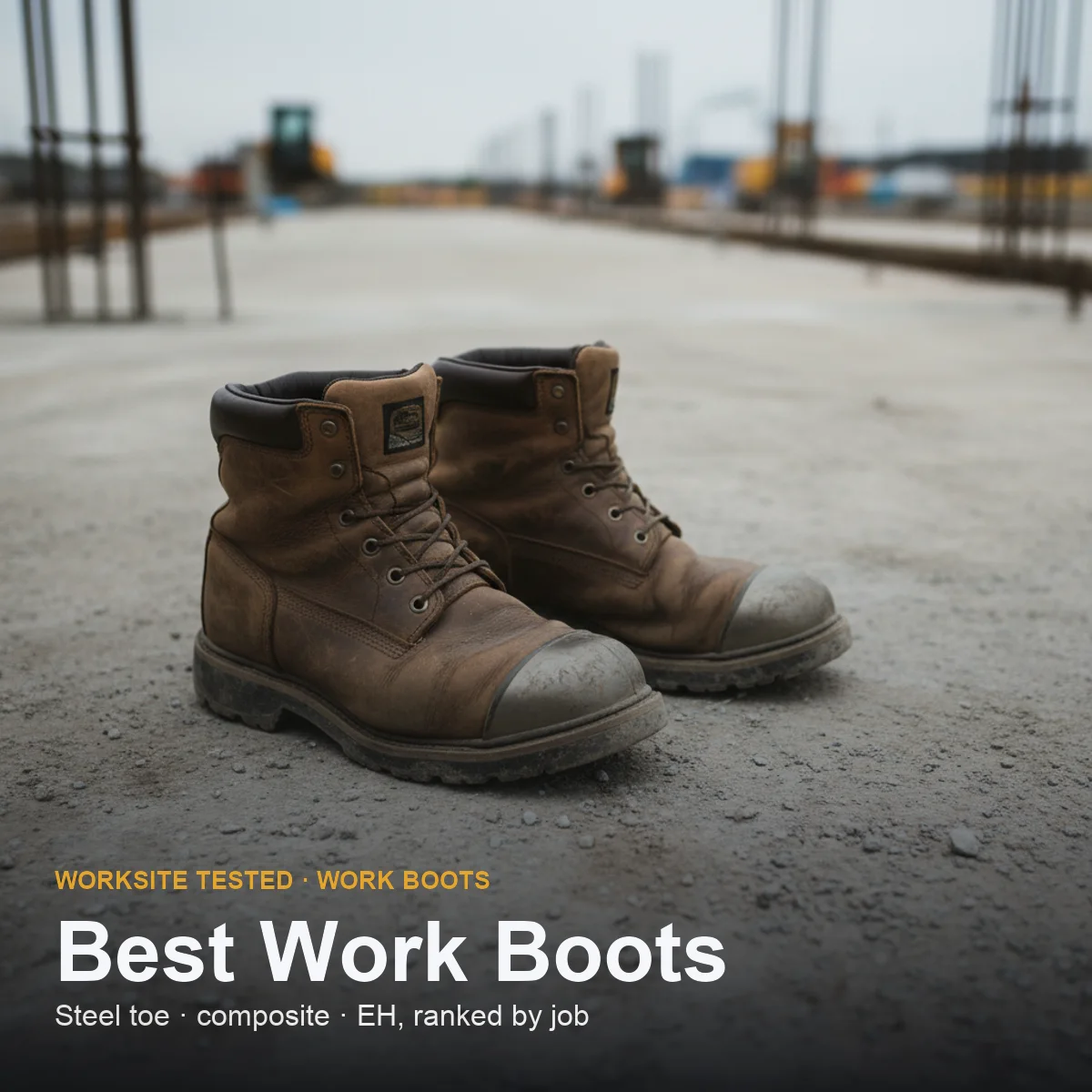
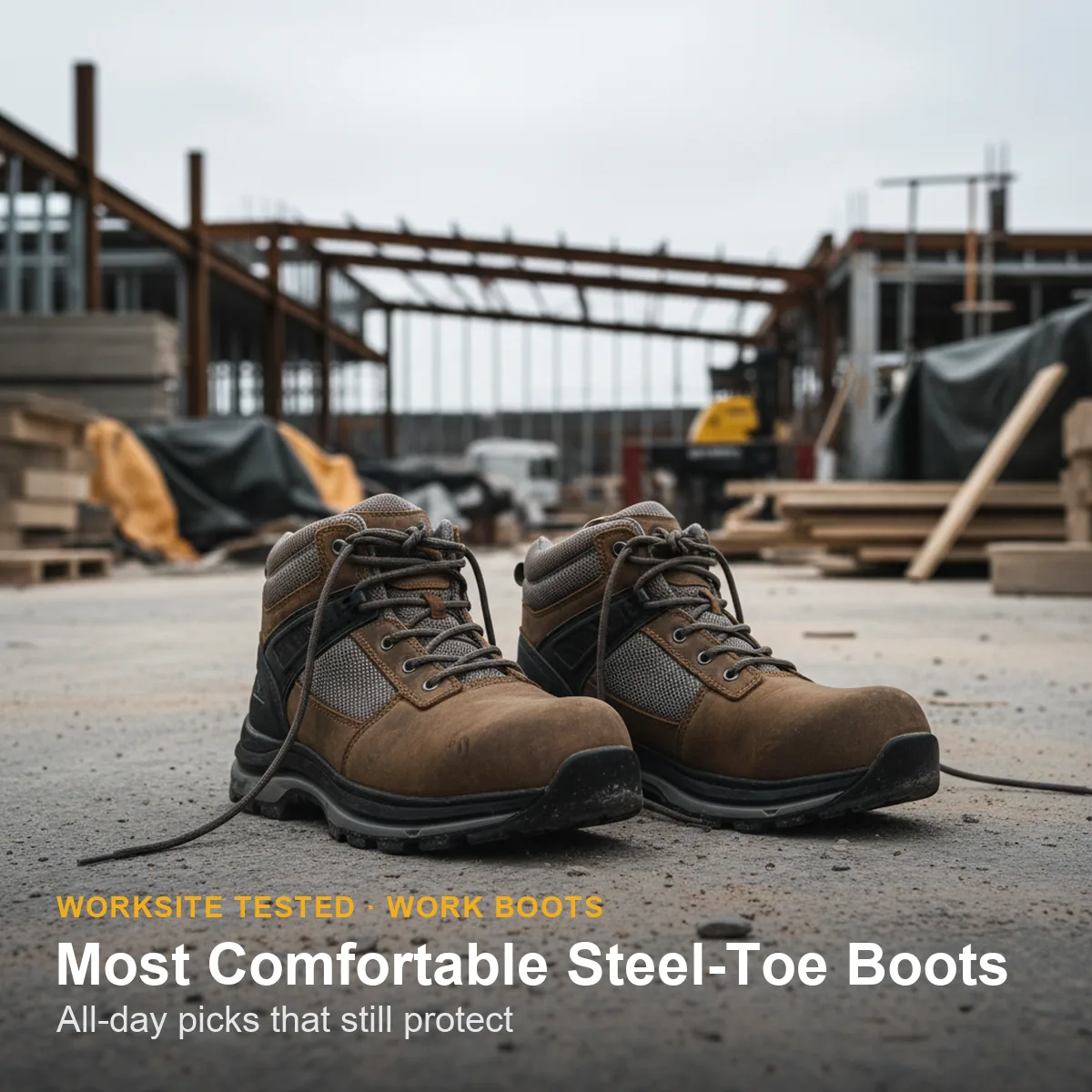
Short answer: the most comfortable steel-toe pick here that is still a real boot is the Timberland PRO Pit Boss 33032 — its 24/7 Comfort Suspension System is the fatigue-reduction stack that put it there, and it is the only pick you can resole. If you want a work shoe that feels like a trainer, the Reebok RB2211 with its removable MemoryTech Massage footbed is the one to try first. And the Skechers 77108 at $84.99 is the cheapest way in. Every pick in this guide is EH-rated and in stock at Working Person's Store as of July 6, 2026, with prices and specs pulled straight from each listing.
One rule in a safety category: every spec in here traces back to the actual listing. If the listing does not say it, I do not say it. That includes weight — none of these seven listings state a boot weight, so I will not tell you which is "lighter" as if it were a fact. What I can do is line up the cushioning tech each brand actually names and tell you which build suits your shift. And I do not rank by commission — the $85 shoe and the $205 boot both had a fair shot at the top slot.
Key Takeaways
- "Comfortable" here means named cushioning tech, not opinion. Every pick lists a real footbed/midsole system — Air-Cooled or gel-infused Memory Foam, MemoryTech Massage + ASTROFOAM, metatomical dual-density EVA, the 24/7 Comfort Suspension System, Rugged Flex, or a full-cushion footbed. I rank on what the listing states, not on how a boot "feels" to a tester I don't have.
- Steel-toe does not have to mean stiff. All seven carry a steel safety toe and are still built around a comfort system. None of the fetched listings state a boot weight, so I make no "steel is heavier" claim here.
- Every pick is EH-rated. Per ASTM F2413-24 documentation, an EH sole/heel is tested to withstand 18,000 volts at 60 Hz for one minute with no more than 1.0 milliampere of current flow under dry conditions. EH is secondary, dry-condition protection only — it degrades with wear and moisture and never replaces primary electrical PPE.
- Only one pick can be resoled. The Timberland PRO Pit Boss uses Goodyear welt construction (repairable). The rest are cement / flexible or hiker/shoe builds — lighter, but when the sole goes, the footwear goes.
- Shoe vs boot is a real fork. Three low shoes (Skechers 200140, Reebok RB2211) versus a 4-3/4" hiker (Skechers 77108) and three 6-inch boots. Pick the height your job's ankle and splash hazards require, then optimize comfort within that.
- Internal links: Best work boots overall | Composite toe vs steel toe | What ASTM F2413 means
What actually makes a steel-toe boot comfortable
Comfort in a steel-toe boot is not one thing — it is a stack of named features, and every brand here markets its own. Rather than trust a vague "comfy" label, here is the cushioning each pick actually lists, verified against its product page:
- The footbed (insole): the layer your foot sits on. Skechers 200140 uses an Air-Cooled Memory Foam insole; Skechers 77108 a gel-infused Memory Foam insole; Reebok RB2211 a removable MemoryTech Massage footbed; KEEN 1015401 a removable metatomical dual-density EVA footbed; Wolverine W10633 a removable full-cushion footbed. Removable is a plus — you can swap in your own orthotic.
- The midsole: the cushioning layer beneath the footbed. Skechers 200140 has the Skech-Air visible airbag midsole; Reebok RB2211 an ASTROFOAM cushion midsole; KEEN 1015401 a compression-molded EVA midsole; Skechers 77108 a shock-absorbing midsole.
- The comfort/flex system: a brand's whole-boot fatigue approach. Timberland PRO's 24/7 Comfort Suspension System with contoured shock-diffusion, and Carhartt's Rugged Flex flexibility technology, both target the same goal — less fatigue and a boot that moves with your foot instead of fighting it.
- Fit and toe shape: KEEN's asymmetrical steel toe caps follow the natural left/right shape of the foot, and its metatomical footbed is shaped rather than flat. Skechers uses a Relaxed Fit last on the 77108. A roomier, better-shaped toe box is often the difference between a boot you tolerate and one you forget you're wearing.
None of these features change the protection rating — that comes from the ASTM F2413 steel toe, covered next. They change how the boot feels over a 10-hour shift, which is the whole point of this list.
What ASTM F2413 I/75 C/75 EH means on the label
Every pick here carries a steel safety toe and an EH rating, and most listings show the marking I/75 C/75. Here is what that means, verified against independent standards sources:
- I/75 (impact): I/75-rated footwear protects the toes from an impact of up to 75 foot-pounds. In the test, a 50-pound weight is dropped from a specified height to deliver 75 ft-lbs of force onto the toe cap, which must pass without crushing test clay below clearance thresholds (source: Gemplers ASTM footwear guide).
- C/75 (compression): C/75-rated footwear protects the toes from compressive loads up to 2,500 pounds; the toe cap must withstand 2,500 pounds of static compression force without deforming below clearance thresholds (source: Gemplers).
- M: the footwear is designed for (built on) a male last (source: Gemplers).
- Built-in toe cap + label: ASTM F2413 requires compression- and impact-resistant footwear to have built-in (non-removable) toe caps, and one shoe of each pair must be clearly and legibly marked — stitched in, stamped, or with a pressure-sensitive label — on the tongue, gusset, shaft, or quarter lining (source: Gemplers).
- EH (Electrical Hazard): the sole and heel are tested to withstand 18,000 volts at 60 Hz for one minute with no current flow exceeding 1.0 milliampere under dry conditions (source: sturdyboot.com).
A note on the "I/75 C/75" format itself: ASTM F2413-18 eliminated the older "I/75 C/75" and "I/50 C/50" class designations, so modern labels show only "I" and "C" without numerical class indicators. The "I/75 C/75" format you see on these listings appears mainly on footwear certified to F2413-11 and earlier versions (source: sturdyboot.com). A separate, newer update — ASTM F2413-24 — formally integrated slip-resistance testing (SR/SRO performance designations, referencing ASTM F3445-21) into the primary safety-toe footwear specification for the first time (source: sturdyboot.com). Several of these listings note slip resistance separately.
OSHA does not certify or approve specific boot models — compliance is demonstrated by the manufacturer's marking on the boot.
All 7 comfortable steel-toe picks at a glance
| Pick | Style / build | Named comfort tech | Waterproof | EH | Price |
|---|---|---|---|---|---|
| Skechers 77108 Holdredge-Rebem | 4-3/4" hiker (non-welt) | Gel-infused Memory Foam insole | No (not stated) | Yes | $84.99 |
| Skechers 200140 Skech-Air Envoy | Low work shoe | Air-Cooled Memory Foam + Skech-Air airbag midsole | No (not stated) | Yes | $93.99 |
| Reebok RB2211 Astroride | Low work shoe | Removable MemoryTech Massage footbed + ASTROFOAM midsole | No (not stated) | Yes | $99.95 |
| Wolverine W10633 Floorhand | 6" boot, cement (flexible) | Removable full-cushion footbed | Yes | Yes | $104.95 |
| Carhartt FF6213 Rugged Flex | 6" boot, cement (flexible) | Rugged Flex flexibility technology | Yes (guaranteed membrane) | Yes | $139.99 |
| Timberland PRO Pit Boss 33032 | 6" boot, Goodyear welt (resole-able) | 24/7 Comfort Suspension System + shock-diffusion | No (not stated) | Yes | $160.00 |
| KEEN Utility Louisville 1015401 | 6" boot (non-welt) | Removable metatomical dual-density EVA footbed + EVA midsole | Yes (KEEN.Dry membrane) | Yes | $205.00 |
1. Timberland PRO Pit Boss 33032 — most comfortable boot you can actually resole
The Pit Boss earns the top slot because it is the one pick here that pairs a named comfort system with Goodyear welt construction — meaning when the tread wears out, you resole it instead of buying a new boot. The comfort itself comes from Timberland PRO's 24/7 Comfort Suspension System plus contoured shock-diffusion for impact reduction and comfort insoles the listing says support arches and help decrease fatigue. A Cambrelle lining with Agion antimicrobial helps keep odor down over long shifts, and there's a nylon shank for torsional support. Steel toe, EH-rated, slip-resistant, oil-resistant. One honest gap: this listing does not state waterproofing, so treat it as a dry-environment or covered-work boot.
- Pros: the only resole-capable (Goodyear welt) pick; named 24/7 comfort + shock-diffusion system; antimicrobial lining; best cost-per-year if you keep and resole them.
- Cons: not stated as waterproof; heavier welt build than the low shoes; no weight listed.
Check price at Working Person's Store →
2. Reebok RB2211 Astroride — most comfortable work shoe
If your job does not require ankle coverage, this is the pick I'd try first for pure underfoot comfort. The RB2211 stacks a removable MemoryTech Massage footbed — which the listing says adapts to your foot contours — on top of an ASTROFOAM cushion midsole, with a PwrZone forefoot design and dual-layer stretch mesh uppers that breathe far better than leather. That breathability is the trade-off: great in a hot plant, but the mesh upper is not the pick for water or heavy splash on the top of the foot (the listing does note oil/metal-chip/abrasion/chemical resistance on the shoe). Steel toe, EH-rated, slip-resistant, and a removable footbed so you can drop in your own orthotic.
- Pros: deepest comfort stack of the low shoes (removable molding footbed + ASTROFOAM); breathable mesh; removable footbed for custom orthotics; oil/metal-chip/abrasion/chemical resistant.
- Cons: low shoe — no ankle support; mesh upper is not built for water/splash coverage; not waterproof.
Check price at Working Person's Store →
3. KEEN Utility Louisville 1015401 — best fit and footbed if budget is no object
KEEN's whole comfort argument is fit, and the Louisville is where it shows. It uses a removable metatomical dual-density EVA footbed over a compression-molded EVA midsole, and its asymmetrical steel toe caps follow the natural left/right shape of your foot so your toes aren't crammed into a symmetrical cap — the single most common complaint about steel-toe boots. Add a KEEN.Dry waterproof membrane, a flexible TPU shank, and a rubber toe guard for scuff protection, and this is the most feature-loaded comfort boot in the group. At $205 it is the price ceiling. One honest flag: the listing writes the ASTM line oddly — "ASTM F2412-11 and F2413011 I/75 C.75 EH" — which reads as a typo for the standard I/75 C/75 EH marking every other boot here carries.
- Pros: shaped metatomical EVA footbed + asymmetrical toe caps for a roomier, natural fit; KEEN.Dry waterproof; removable footbed; rubber toe guard; meets the ASTM F1677-96 Mark II non-slip standard per listing.
- Cons: most expensive pick at $205; not resole-capable (non-welt); listing's ASTM marking is written oddly (reads as a typo).
Check price at Working Person's Store →
4. Carhartt FF6213 Rugged Flex — most comfortable name-brand everyday boot
When people say a boot is "comfortable," they usually mean it isn't stiff and boardy out of the box — and that is precisely what Carhartt's Rugged Flex technology is built to fix, letting the boot move with the foot. The FF6213 pairs that with a Guaranteed Waterproof membrane, a FastDry technology lining to help manage sweat, a padded collar, and the Carhartt name a lot of buyers search for directly. It's a 6-inch cement flexible-construction boot with an oil/slip-resistant outsole, steel toe, and EH rating. Cement construction keeps it light and flexible but means no resoling. At $139.99 it sits right in the comfort-and-trust middle of this list.
- Pros: Rugged Flex reduces break-in stiffness; Guaranteed Waterproof membrane + FastDry lining; trusted brand; oil/slip-resistant outsole.
- Cons: cement construction — not resole-capable; comfort tech is a flex system, not a deep-cushion footbed like the shoes; no weight listed.
Check price at Working Person's Store →
5. Wolverine W10633 Floorhand — most comfortable waterproof boot under $110
The Floorhand is the value story: a removable full-cushion footbed inside a genuinely waterproof, EH-rated 6-inch boot for $104.95 — the cheapest waterproof pick here. The removable footbed lets you swap in your own orthotic, and the moisture-wicking mesh lining plus a padded collar handle the daily comfort basics. A nylon shank gives arch support without steel weight. It's cement (flexible) construction, so it's lighter and easier to break in than a welt boot, but it can't be resoled — when the aggressive-tread rubber outsole wears, you replace the boot. Best budget boot for a wet general-construction site where you still want a cushioned footbed you can customize.
- Pros: cheapest waterproof boot here; removable full-cushion footbed (orthotic-friendly); nylon shank arch support; slip-resistant; flexible cement build breaks in easily.
- Cons: cement construction — not resole-capable; comfort is a solid footbed, not a named brand cushioning system; no weight listed.
Check price at Working Person's Store →
6. Skechers 200140 Skech-Air Envoy — most sneaker-like cushioning
If you want a steel-toe work shoe that feels closest to a trainer, this is it. The Skech-Air Envoy Arcket combines an Air-Cooled Memory Foam insole with the Skech-Air visible airbag midsole — the most sneaker-style cushioning in this group — under a leather/synthetic/mesh upper treated with 3M Scotchgard for some stain and water shedding. The Goodyear Performance Outsole (a tread name, not welt construction) has aggressive lugs and a 1-1/2" heel. Steel toe, EH-rated. It's a low shoe with no stated waterproof membrane and no ankle coverage, so match it to your hazards and your surface.
- Pros: most sneaker-like cushioning (Air-Cooled Memory Foam + Skech-Air airbag); 3M Scotchgard-treated upper; aggressive tread; low weight of a work shoe.
- Cons: low shoe — no ankle support; not stated as waterproof; the "Goodyear Performance Outsole" is a tread name, not a resole-able welt.
Check price at Working Person's Store →
7. Skechers 77108 Holdredge-Rebem — cheapest way into a comfort steel-toe
At $84.99 the Holdredge-Rebem is the budget entry, and it earns its place with a gel-infused Memory Foam cushioned comfort insole, shock-absorbing midsole, and a Relaxed Fit design with padded collars and tongues. Unlike the two low Skechers/Reebok shoes above, this is a 4-3/4" hiker-style boot, so you get more ankle wrap without a big weight penalty, plus a soft fabric breathable lining. Steel toe, EH-rated, slip-resistant. It's a hiker build, not a welt boot — treat it as a lightweight all-day boot you replace rather than resole. Best pick for a helper or anyone who wants cushioning and a bit of ankle coverage on a budget.
- Pros: cheapest pick at $84.99; gel-infused Memory Foam insole + Relaxed Fit last; 4-3/4" shaft adds ankle wrap over the low shoes; breathable lining.
- Cons: hiker build — not resole-capable; not stated as waterproof; lightest-duty of the boots here.
Check price at Working Person's Store →
Work shoe or 6-inch boot: which comfort build is right for you
The most comfortable footwear is the one that matches your hazards, so decide the build before you shop for cushioning:
- Low work shoe (Skechers 200140, Reebok RB2211): lightest, most breathable, most trainer-like underfoot. No ankle support and — on these listings — no waterproofing. Right for warehouse, plant floors, and jobs without splash, ladder ankle-roll, or debris-in-the-boot risk.
- Hiker (Skechers 77108, 4-3/4"): a middle ground — more ankle wrap than a shoe, still light and flexible. A good budget compromise if you want some ankle coverage without a full boot.
- 6-inch boot (Wolverine, Carhartt, Timberland PRO, KEEN): ankle support and, on most of these, waterproofing or a membrane. The Timberland PRO Pit Boss is the only resole-capable option (Goodyear welt); the Carhartt, Wolverine, and KEEN are cement/non-welt, so lighter but replaced when the sole goes.
Comfort tech only helps once the build is right. A deep memory-foam footbed in a low shoe does nothing for you if your job actually needs a waterproof 6-inch boot with a shank.
Frequently Asked Questions
What does the ASTM F2413 I/75 C/75 marking on a steel-toe boot actually mean?
I/75 means the toe cap withstands 75 foot-pounds of impact — a 50-lb weight dropped to deliver 75 ft-lbs — and C/75 means it withstands up to 2,500 pounds of compression. "M" means the boot is built on a male last (source: Gemplers ASTM footwear guide). Note the "I/75 C/75" class-number format is from F2413-11 and earlier; ASTM F2413-18 dropped the numbers and shows only "I" and "C" (source: sturdyboot.com).
Are steel-toe boots less comfortable than composite-toe boots?
Not necessarily — the comfort comes from the cushioning system, not the toe material. Several steel-toe picks here pair the cap with cushioning the listings actually name: Skechers Air-Cooled and gel-infused Memory Foam, Reebok's MemoryTech Massage footbed + ASTROFOAM midsole, KEEN's removable metatomical dual-density EVA footbed, Timberland PRO's 24/7 Comfort Suspension System, and Wolverine's full-cushion footbed. None of the fetched listings state a boot weight, so I make no "steel is heavier" claim here. For the full trade-off, see our composite toe vs steel toe guide.
Do these steel-toe boots also protect against electrical hazards?
Yes — every pick in this roundup is listed as EH (Electrical Hazard) rated. Per ASTM F2413-24 documentation, an EH sole and heel are tested to withstand 18,000 volts at 60 Hz for one minute with no more than 1.0 milliampere of current flow under dry conditions (source: sturdyboot.com). EH is a secondary, dry-condition-only feature — it degrades with wear and moisture and never replaces primary electrical PPE like insulated gloves or lockout/tagout.
Which comfort footbed technology is in each boot?
From the listings: Skechers 200140 = Air-Cooled Memory Foam insole + Skech-Air airbag midsole; Skechers 77108 = gel-infused Memory Foam insole; Reebok RB2211 = removable MemoryTech Massage footbed + ASTROFOAM midsole; KEEN 1015401 = removable metatomical dual-density EVA footbed + EVA midsole; Timberland PRO 33032 = 24/7 Comfort Suspension System; Wolverine W10633 = removable full-cushion footbed; Carhartt FF6213 = Rugged Flex technology.
How much do the most comfortable steel-toe boots cost?
Using confirmed in-stock Working Person's Store prices: Skechers 77108 $84.99, Skechers 200140 $93.99, Reebok RB2211 $99.95, Wolverine Floorhand W10633 $104.95, Carhartt Rugged Flex FF6213 $139.99, Timberland PRO Pit Boss 33032 $160.00, and KEEN Utility Louisville 1015401 $205.00. Prices verified July 2026 and subject to change.
Are steel-toe boots OSHA-compliant for work?
OSHA (29 CFR 1910.136) requires protective footwear where there is a danger of foot injury, and it references ASTM F2413 as the recognized performance standard. All picks here carry an ASTM F2413 safety-toe marking, so each meets the recognized consensus standard — but your employer's or site's hazard assessment determines what's actually required for your job. OSHA does not certify individual boot models; the manufacturer's marking is the proof of compliance.
Why Trust This Guide
This guide is written and reviewed by Marco Reyes, an independent work-safety-gear reviewer. Every recommendation is built on the published standards (ASTM F2413 for footwear, ANSI Z359 for fall protection, ANSI/ISEA 107 for hi-vis, the OSHA rules), manufacturer spec sheets and product labels, hands-on handling, and what tradespeople actually report — and we tell you when a number is a manufacturer claim versus an independent standard, and when a boot is rated for one hazard but not another. Every product here was pulled live from Working Person's Store on July 6, 2026, confirmed in stock, and verified against the listing specs — no numbers were inferred, extrapolated, or borrowed from other models. We earn an affiliate commission if you buy through some of our links, at no extra cost to you, and we never rank by commission over safety — see our affiliate disclosure.