
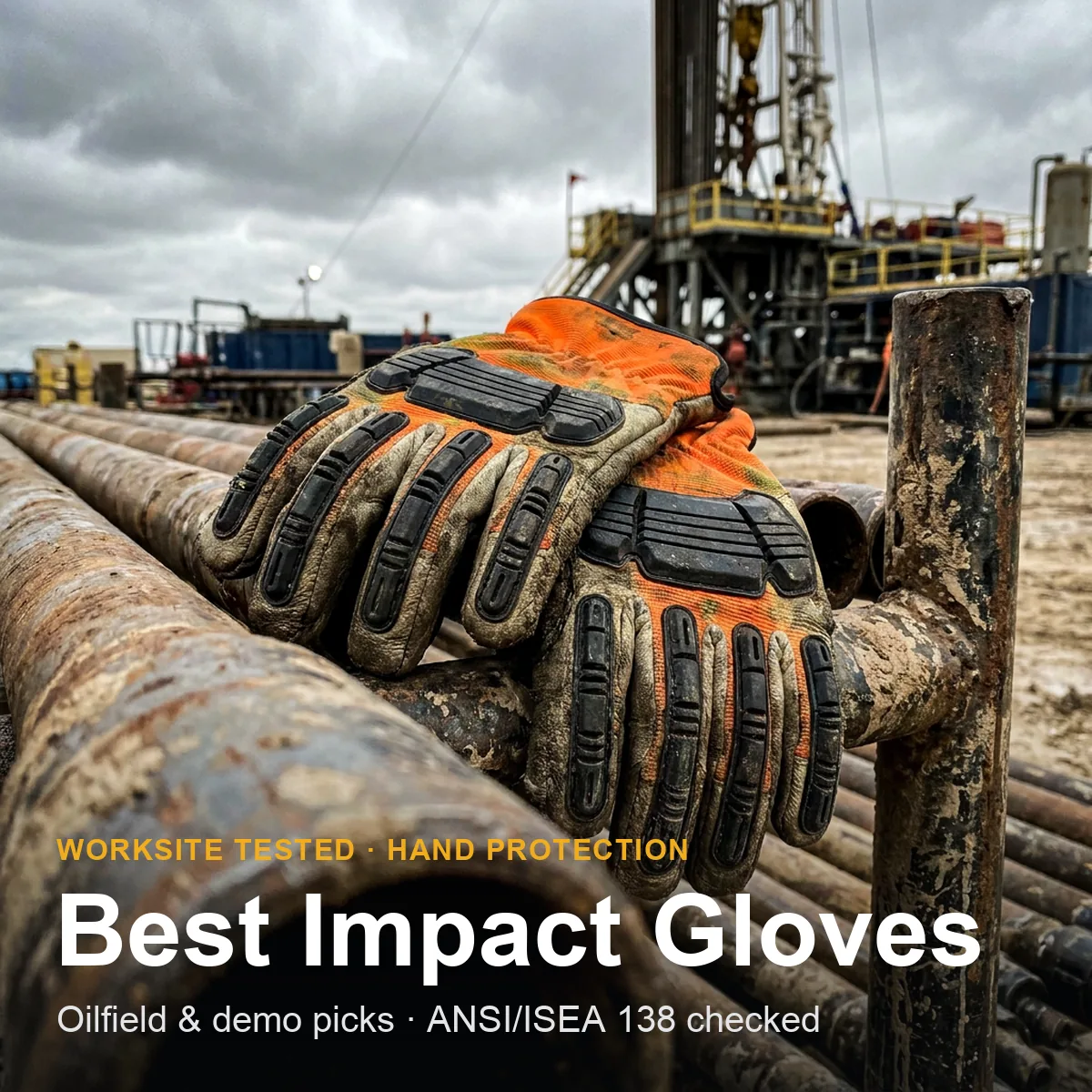
Short answer: the Black Stallion GR5040 HR at $15.99 is the impact glove I would buy for oilfield or demolition work — it carries the highest documented cut rating in this group (ANSI A6), it has TPR impact backing on the back of the hand, and it is the cheapest glove here. The Radians RWG603 at $22.00 is the only glove in the group whose manufacturer makes any impact claim at all, with an A5 cut rating confirmed on both the retail listing and the manufacturer's page. The Impacto WGRIGG at $72.99 has the most TPR coverage of anything on the list if you are rigging dry. Five gloves you can buy today, all pulled live from Working Person's Store on July 12, 2026, plus one discontinued glove I am including only as a reference point.
Here is the thing nobody selling impact gloves wants to lead with, so I will. Not one of the five in-stock gloves in this guide carries a documented ANSI/ISEA 138 impact level — not on the retail listing, and not on the manufacturer's page either. The closest any of them gets is Radians, whose own page says "Impact Level 2" without ever naming ANSI/ISEA 138, which means you cannot cite it as a 138 rating. All five are marketed for oil and gas and built with real TPR armor. That is not me calling them bad gloves. It is me telling you that "impact glove" is a description, not a rating, and if your job hazard analysis calls for a documented level you need to check the marking on the glove itself.
Key Takeaways
- ANSI/ISEA 138 measures force that gets THROUGH the glove, so a higher level is better. Level 1 allows a mean of 9 kN or less through, Level 2 allows 6.5 kN or less, Level 3 allows 4 kN or less. Less force reaching your metacarpals = higher level.
- The overall level is set by the worst zone, not the best. A steel striker of about 5.5 lb is released with 5 ±0.02 J onto the knuckles (bar gripped) and onto the finger and thumb sites — index, ring and thumb measured 25 mm from the fingertip, pinky and middle at 50 mm. The glove's stated level is the LOWEST recorded result of those zones, and performance levels are displayed directly on the glove.
- ZERO of the 5 in-stock gloves here carry a documented 138 level. Radians states "Impact Level 2" for the RWG603 on its own product page but never names ANSI/ISEA 138 there, so it is an unattributed claim, not a citable 138 rating. The Working Person's Store listing for the same glove states only the A5 cut level. The other four state no impact level anywhere.
- Impact and cut are separate, independently-rated properties. TPR armor on the back of the hand handles impact (ANSI/ISEA 138); the shell and coating handle cuts (ANSI/ISEA 105, scale A1–A9). A glove can be excellent at one and unrated for the other.
- Cut levels are grams of force to cut through: A1 ≥200 g, A2 ≥500 g, A3 ≥1000 g, A4 ≥1500 g, A5 ≥2200 g, A6 ≥3000 g, A7 ≥4000 g, A8 ≥5000 g, A9 ≥6000 g (ANSI/ISEA 105 classification table). The best cut number in this roundup is the Black Stallion GR5040 HR at A6.
- Do not take a TPR mechanic glove near heat. Synthetic shells and rubber armor are not flame-rated. If you need knuckle protection plus sparks and slag, that is a leather welding glove problem — see pick 5.
- Related reading: ANSI cut levels A1–A9 explained | Best cut-resistant gloves | All hand protection guides
What ANSI/ISEA 138 actually measures
ANSI/ISEA 138 is the North American standard for back-of-hand impact protection on work gloves. It rates a glove on the mean force transmitted through the dorsal armor to your hand, on three levels. That "through" is the part people get backwards, so read the numbers slowly:
- Level 1: the glove allows an average of 9 kN or less of force through.
- Level 2: 6.5 kN or less through.
- Level 3: 4 kN or less through.
Lower transmitted force means better protection, so Level 3 is the strongest and Level 1 is the weakest. The scale runs the opposite direction to the force number. (Source: Ergodyne's breakdown of the ANSI/ISEA 138-2019 standard.)
The test itself is straightforward. A steel striker weighing about 5.5 lb is released with 5 ±0.02 J of force onto the glove. It hits two kinds of sites: the knuckles, with the glove gripped over a bar of 1–1.5 in. diameter, and the finger and thumb sites — the index, ring finger and thumb measured 25 mm (±1.25 mm) back from the fingertip, and the pinky and middle finger at 50 mm (±2.5 mm). Then comes the rule that makes the rating honest — the glove's overall impact performance level is determined by the LOWEST recorded performance level. A glove with fat knuckle pads and thin finger armor gets rated on the finger armor. (Source: Mechanix Wear's impact-resistant glove reference.) Under the standard, performance levels are displayed directly on the glove as a visual indicator of the level of performance (Ergodyne, linked above).
That marking is your practical check in the field. If a glove is sold on impact protection and carries no level on it and none in the manufacturer's literature, treat the claim as undocumented until someone produces a test report.
TPR: the part that gets tested
TPR stands for thermoplastic rubber — the molded rubber armor across the knuckles, finger backs, thumb and back of the hand on an impact glove. It absorbs and disperses a blow and guards against pinch injuries, while flex zones between the pads keep the glove usable for actual work. On the Radians RWG603, the retail listing describes dense hi-vis TPR overlays over a cut-resistant HPPE shell that cushion the metacarpal bones from impact.
TPR is the exact component ANSI/ISEA 138 measures. No dorsal TPR, no impact glove — a padded knit back is not armor. And TPR does nothing for your palm side: impact (ANSI/ISEA 138) and cut (ANSI/ISEA 105) are separate, independently-rated properties, which is why a glove can carry an A6 cut level and no impact level at all, or the reverse.
All 5 in-stock picks at a glance
| Glove | ANSI/ISEA 138 level | Cut level | Shell / palm | Sizes | Best for | Price |
|---|---|---|---|---|---|---|
| Black Stallion GR5040 HR | None stated | ANSI A6 + EN 388 cut level 5 (4544) | 13-ga HPPE w/ steel + fiberglass / sandy nitrile | S–2XL | Highest documented cut number here, at the lowest price here | $15.99 |
| Radians RWG603 | None documented (Radians states "Impact Level 2" without naming 138) | ANSI cut level 5 (A5) | 13-ga HPPE / sandy foam-nitrile | M–XL here (S–2XL from Radians) | Cut level confirmed on two pages + only manufacturer impact claim | $22.00 |
| Impacto WGRIGG | None stated (EN 388:2003 / EN 420:2003 only) | None stated | PVC-nitrile underlay / ultra-suede + silicone dots | S–3XL | Maximum TPR coverage, dry rigging | $72.99 |
| Black Stallion GX1010-HB | None stated | None stated | Synthetic leather + PVC reinforcement | M–2XL | Hi-vis reflective knuckles, mechanic work | $20.99 |
| Black Stallion GS1715 BT | None stated | None stated | Cowhide leather, flame-resistant liner patches | L, XL | Knuckle protection around heat and sparks | $65.99 |
All five rows come up empty in the impact column. That is the real state of this category at retail, and it is the single most useful thing in this guide.
1. Black Stallion GR5040 HR — highest documented cut level, at the lowest price
ANSI A6 is ≥3000 g of force to cut through, a full step above the Radians A5 at ≥2200 g. The listing also states EN 388 Cut Level 5 (4544). Black Stallion gets there with a 13-gauge HPPE knit blended with steel and fiberglass fibers — that is literal steel in the yarn — with sandy-nitrile dipped palms and thumb-patch reinforcements at the spot gloves usually fail first. It is sold specifically into material handling and oil and gas, it comes in hi-vis yellow, and it runs S through 2XL.
It has impact-resistant TPR backing on the back of the hand for flexible cushion. What it does not have is a number for it: the listing states no ANSI/ISEA 138 impact level. So I can tell you there is armor there and that it is built to flex; I cannot tell you how much of a 5-joule strike reaches your knuckles, and neither can the page. Nothing else in this guide is documented on the 138 scale either, so no pick here can beat it on impact paperwork. What it wins on is the two things that ARE published: A6 beats A5 on cut, and $15.99 is the lowest price of the five. It also runs S through 2XL at this retailer, where the Radians stops at XL. That is why it is first. The one thing pick 2 has that this does not is a manufacturer impact claim in writing — unattributed as that claim turns out to be.
- Grab these if: sharp scrap, banding or thin sheet metal is your primary hazard and impact is secondary — A6 is the best cut protection in this guide, at the lowest price in this guide.
- Skip if: your site requires a documented ANSI/ISEA 138 level on the PPE you select.
Check price at Working Person's Store
2. Radians RWG603 — the only manufacturer impact claim in the group
This is a $22.00 glove that does what the $72.99 glove cannot: give you a cut number that two independent pages agree on. Radians, a PPE manufacturer headquartered in Memphis, TN, rates the RWG603 at ANSI cut level A5 on its own product page, and the retail listing states cut level 5 as well. Radians also says "Impact Level 2" in its product description — and here is where you have to be careful, because Radians never names ANSI/ISEA 138 anywhere on that page. "Level 2" on the 138 scale would mean a mean transmitted force of 6.5 kN or less, but nothing published tells you the claim is on that scale. Do not carry the kN figure over to this glove. For rig-floor tongs, pipe handling, and demolition pinch points, what you actually have documented here is the cut resistance.
The build supports it. A 13-gauge HPPE shell is what gets you to A5 (≥2200 g to cut through), the sandy foam-nitrile palm coating grips wet and dry, and the dense TPR overlays sit over the knuckles and back of the hand where the metacarpals are.
The honest catch, and it is a real one: neither page gives you a citable ANSI/ISEA 138 rating. The retail listing states only the A5 cut level and EN 388 testing. The manufacturer page adds an "Impact Level 2" that is not tied to any named standard. If you are documenting PPE selection for a JSA, verify the level marked on the glove itself or ask Radians for the test report — and do not cite either web page for a 138 number that neither one prints. Judge for yourself on the Radians RWG603 product page.
So why second and not first? Because an unattributed "Impact Level 2" is not something you can put on a JSA, and once you set it aside, the published numbers decide it: pick 1 is rated a full cut step higher at A6, costs less at $15.99, and covers a wider size run. Take the Radians when you want the cut rating that two pages agree on, or when the manufacturer's own impact language is worth something to your safety manager as a starting point for a records request.
- Grab these if: you want confirmed A5 cut resistance plus real dorsal TPR for oilfield or demo work without spending $70 a pair.
- Skip if: you need a documented ANSI/ISEA 138 level on paper, you need a cut level above A5, or you need bigger than XL — this retailer stops at XL, though Radians lists up to 2XL elsewhere.
Check price at Working Person's Store
3. Impacto WGRIGG — most TPR coverage, built for dry rigging
If you laid all five of these on a bench, the WGRIGG has visibly the most armor: heavy-duty TPR across the knuckles, the thumb, the finger backs and the whole back of the hand, over a PVC-nitrile underlay. Impacto builds it as a dry-rigger glove and the details show it — a soft ultra-suede oil- and water-resistant palm with silicone grip dots on the palm and fingertips, 100% Kevlar thumb patches, Kevlar stitching, and neoprene cuffs. Kevlar stitching matters more than people expect on a rigging glove, because the seams are usually what let go before the material does. It also has the widest size run in the guide, S through 3XL.
And then the documentation stops. The listing states EN 388:2003 (mechanical risks) and EN 420:2003 (general requirements) — no ANSI/ISEA 138 impact level and no ANSI/ISEA 105 cut level. At $72.99 you are paying more than three times the Radians price for more coverage and better construction, while getting less on paper. For a rigging crew that has worn these for years and knows what they do, that is a fair trade. For a new PPE spec that has to survive a safety audit, it is not, and that is why a glove I like this much lands third.
- Grab these if: you rig dry, you want maximum TPR coverage plus Kevlar thumb patches and stitching, and you need sizes up to 3XL.
- Skip if: you need a documented ANSI impact or cut level, or you are buying on price.
Check price at Working Person's Store
4. Black Stallion GX1010-HB — hi-vis reflective knuckles for night work
This one is a mechanic glove first and an impact glove second. Synthetic leather palms with PVC reinforcements handle tool work better than a coated knit does, and there are heavy-duty dorsal guards plus thick foam for finger protection. The feature that earns it a spot is the padded, reflective hi-vis knuckles over padded hi-vis spandex backs — on a night turnaround, or anywhere a spotter or an equipment operator needs to see where your hands are, reflective dorsal padding is a legitimately useful thing. Slip-on neoprene cuffs, unisex sizing M through 2XL, stated for mechanic and oil and gas work.
Documentation is the thinnest here: no ANSI/ISEA 138 impact level and no ANSI/ISEA 105 cut level on the listing. Nothing but the construction description. That is fine for wrenching where the hazards are bumps, pinches and abrasion. It is not the glove for breaking out tongs, running a jackhammer, or anything where a documented level belongs on the JSA. It ranks where it does because it is honest about being a mechanic glove.
- Grab these if: you want a hi-vis synthetic-leather mechanic glove with dorsal guards and reflective knuckles for night or low-light work.
- Skip if: impact or cut is your primary documented hazard — pick 1 or pick 2 instead, both of which cost about the same or less.
Check price at Working Person's Store
5. Black Stallion GS1715 BT — the right answer when there is heat
This is in the roundup because guys keep trying to solve a heat problem with a rubber glove. Synthetic TPR mechanic gloves are not flame-rated and the rubber and synthetic materials can melt. If your hazard is knuckle impact and sparks, slag or hot metal, you need leather.
The GS1715 BT is a cowhide welding glove with a leather palm and knuckle protection, flame-resistant liner patches, and DragPatch and RestPatch features — the reinforcement points that let a stick welder drag and rest a hand on hot plate without cooking the glove. The listing states it is fire-resistant.
Same honesty note as most of this list: no ANSI/ISEA 138 impact level and no ANSI/ISEA 105 cut level are stated on the listing. Buy it for the heat-plus-knuckle-protection combination, which nothing else here can do at all, not for a documented impact number. Sizes are only L and XL, which is a genuine limitation if your crew has small hands.
- Grab these if: you weld, cut, or work around sparks and hot metal and still need knuckle protection.
- Skip if: there is no heat exposure — a leather welding glove is heavier and less dexterous than it needs to be for cold work. See our welding glove guide for the full heat-and-dexterity breakdown.
Check price at Working Person's Store
Reference only: Ergodyne ProFlex 921 LM (discontinued, out of stock)
Not a buy pick — it is discontinued by the manufacturer and out of stock, with no price listed. I am including it because it shows what a cold-weather impact glove is supposed to look like, and because people still search for it.
The 921 LM was a thermal acrylic fleece seamless knit with molded TPR armor sewn from the base of the hand all the way to the fingertips, with armor flex zones for dexterity and pinch and blow protection, over a foam-rubber palm dip, insulated, with a knit cuff. Ergodyne listed it for cold weather, construction, mechanic, mining, oil and gas, outdoor and tool work. The listing states EN 388:2242 and EN 420, and no ANSI/ISEA 138 impact level. The retailer page shows 4.5 out of 5 from 2 customer reviews — that is the retailer's number from a very small sample, not our score, and two reviews is not enough to conclude anything.
The takeaway worth keeping: TPR armor running all the way to the fingertips is the design detail that matters, because under ANSI/ISEA 138 the finger sites are tested near the fingertips — 25 mm back on the index, ring and thumb, 50 mm on the pinky and middle — and the worst zone sets the glove's level. Armor that stops at the knuckles leaves the zone that can decide your rating unprotected.
How to pick one for your job
Three questions, in this order:
- Does your JSA require a documented impact level? If yes, none of the five gloves in this guide clears that bar on published information alone — you will need to check the level marked on the glove itself, or shop specifically for a glove that prints an ANSI/ISEA 138 level on the product and the spec sheet. Most gloves marketed for oil and gas do not.
- What is actually cutting you? Sharp scrap, banding and thin sheet metal in demolition and oilfield work usually call for the A4–A6 band — for reference, A5 is ≥2200 g and A6 is ≥3000 g. Below that band, a coated glove without a cut rating may be plenty.
- Is there heat? If yes, none of the TPR gloves apply. Go leather.
And check the fit before you commit to a case. TPR armor changes how a glove closes around a tool — a glove that measures right can still fight you on a wrench. If dexterity is the whole job, our mechanic glove guide covers the snugger end of the category. If you are speccing out a full PPE kit, the work boot guides cover the other end of the body, and the standards explainers cover how to read the labels.
Frequently Asked Questions
What do ANSI/ISEA 138 Level 1, 2 and 3 actually mean for impact gloves?
It is the North American back-of-hand impact standard. It measures the mean force transmitted THROUGH the glove's dorsal TPR armor: Level 1 = 9 kN or less through, Level 2 = 6.5 kN or less, Level 3 = 4 kN or less — so a higher level lets less force reach your hand. A steel striker of about 5.5 lb is released with 5 ±0.02 J onto the knuckles and the finger and thumb sites — 25 mm from the fingertip on the index, ring and thumb, 50 mm on the pinky and middle — and the glove's overall level is set by the worst-scoring zone. Performance levels are displayed directly on the glove.
What impact level do I need for oilfield or demolition work?
Rig-floor tongs, pipe handling, jackhammer and demolition pinch points, and heavy-equipment work are exactly where the higher dorsal ratings pay off — Level 2 or Level 3 TPR armor keeps more force off the metacarpals. The honest caveat: several hi-vis TPR gloves marketed for oil and gas, including some on Working Person's Store, publish a cut rating but do NOT print an ANSI/ISEA 138 level. If a documented impact level matters to your JSA, verify the marking on the glove or the manufacturer's spec sheet rather than trusting the retail page.
Do impact gloves also protect against cuts?
Impact and cut are two separate, independently-tested properties. The TPR armor handles impact (ANSI/ISEA 138); the shell and coating handle cuts (ANSI/ISEA 105, scale A1–A9). Many oilfield gloves combine both — the Black Stallion GR5040 HR lists ANSI A6 cut plus TPR impact backing, and the Radians RWG603 lists A5 cut with TPR back-of-hand overlays. But one rating never implies the other, so read both.
How do ANSI/ISEA 105 cut levels A1–A9 work?
They rate the grams of force needed to cut through the fabric: A1 ≥200 g, A2 ≥500 g, A3 ≥1000 g, A4 ≥1500 g, A5 ≥2200 g, A6 ≥3000 g, A7 ≥4000 g, A8 ≥5000 g, A9 ≥6000 g. Hands handling sharp scrap, banding or thin sheet metal in demolition and oilfield work usually want the A4–A6 band — for reference A5 is ≥2200 g and A6 is ≥3000 g. Our ANSI cut levels guide breaks the full scale down.
What is TPR on a work glove, and why does it matter?
TPR (thermoplastic rubber) is the molded rubber armor across the knuckles, finger backs, thumb and back of the hand. It absorbs and disperses blows and guards against pinch injuries, while flex zones keep the glove dexterous enough to work in. It is the exact component ANSI/ISEA 138 measures — a glove with no dorsal TPR is not an impact glove, no matter what the product name says.
Can I use TPR impact gloves for welding?
No. Synthetic TPR mechanic gloves are not flame-rated and the rubber and synthetic materials can melt. If you need impact protection AND heat or spark exposure, choose a leather impact welding glove such as the Black Stallion GS1715 BT — cowhide, leather palm, knuckle protection, flame-resistant liner patches — rather than a synthetic-shell TPR mechanic glove.
Why Trust This Guide
This guide is written and reviewed by Marco Reyes, an independent work-safety-gear reviewer. Every recommendation is built on the published standards (ANSI/ISEA 138 for back-of-hand impact, ANSI/ISEA 105 for cut resistance, EN 388 where a listing cites it), manufacturer spec sheets and product labels, hands-on handling, and what tradespeople actually report — and we tell you when a number is a manufacturer claim versus an independent standard, and when a glove is rated for one hazard but not another. Products in this guide were pulled live from Working Person's Store on July 12, 2026, with prices, specs and stock status read off each listing; where a listing does not state a rating, this guide says so instead of filling the gap. We earn an affiliate commission if you buy through some of our links, at no extra cost to you, and we never rank by commission over safety — see our affiliate disclosure.