
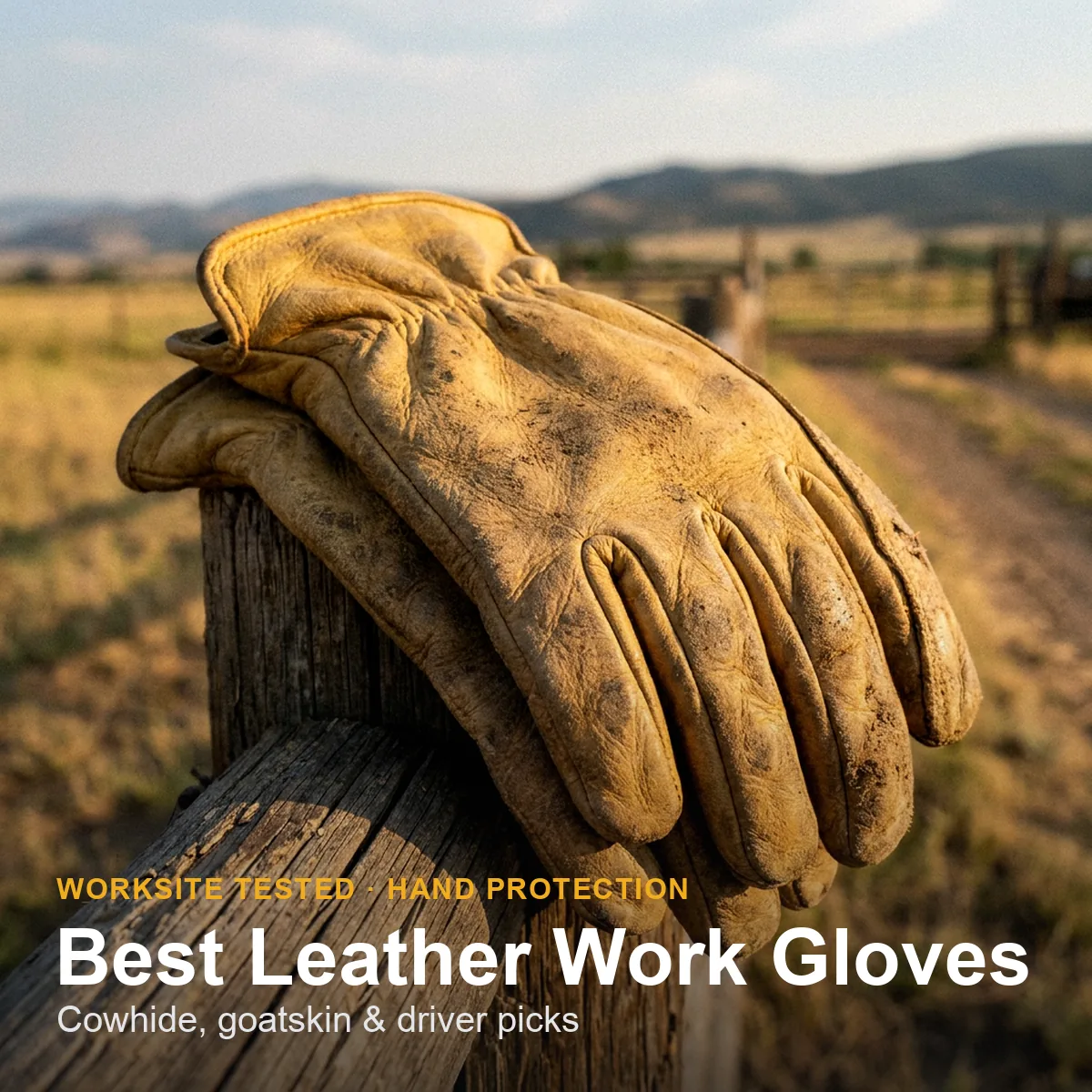
Short answer: the Revco 17 elkskin driver ($34.00) is the leather glove I would buy for myself — elk stays soft after it gets wet, which is what eventually kills every cheap cowhide glove. The Black Stallion GD1611 cowhide driver ($5.99) is the value play and it is not close. And if you are stocking a crew rather than a hand, the MCR 1935 case of six works out to $20.00 a pair for top-grain leather palms. Every glove in this guide is a real, in-stock listing at Working Person's Store as of July 12, 2026, with prices and specs pulled directly from each product page.
One thing to get straight before you scroll: not one of these eight gloves carries an ANSI cut level or an impact rating. That is not a knock on them — general-purpose leather gloves usually do not, because a manufacturer has to specifically test and mark a glove before it can claim one. It just means that if your site requires a rated glove, none of these are it, and any guide that hands a leather driver an "A3" it never earned is making it up. I will explain what the ratings mean so you know what to look for, then rank these eight on what they actually are: hide, cuff, seams, and price.
Key Takeaways
- All 8 gloves here are unrated. None of the Working Person's Store leather-glove listings captured for this guide stated an ANSI/ISEA or ASTM rating. Leather work gloves typically carry no ANSI/ISEA 105 cut level and no ANSI/ISEA 138 impact level unless the manufacturer specifically tested and marked them.
- Cut resistance runs A1 to A9. ANSI/ISEA 105 is the U.S. hand-protection classification standard. The level is set by the cut force in grams needed to cut through on the TDM-100 test: A1 = 200g at the bottom, A9 = 6,000g and up. If you need a rated glove, look for that letter on the glove.
- Impact runs Level 1 to Level 3. ANSI/ISEA 138-2019 rates back-of-hand protection with a 5-Joule striker hit to the knuckles and fingers. Lower transmitted force is better, and the weaker of the two regions sets the glove's overall rating. Leather knuckle straps on an $11 glove are not this.
- Grain beats split for abrasion; split costs less. The MCR 1935 listing makes the point directly — top-grain leather resists abrasion better than split leather. Grain cowhide is also smoother and more dexterous; shoulder split is tougher and cheaper.
- Cuff type is a job decision, not a quality decision. Knit cuff seals out debris (Carhartt A551), safety cuff comes off fast and vents (Carhartt A519, MCR 1935), elastic driver cuff gives the snuggest and most dexterous fit (Black Stallion GD1611, Revco 17).
- Internal links: ANSI cut levels explained (A1–A9) | All hand-protection guides | Best cut-resistant gloves | Work boot guides
Do leather work gloves carry ANSI ratings? Almost never — and that matters
This is the single most useful thing I can tell you about buying leather gloves, so it goes first instead of last.
ANSI/ISEA 105 is the U.S. hand-protection classification standard. It rates cut resistance on a nine-level scale, A1 at the low end through A9 at the high end, and separately classifies abrasion resistance, puncture resistance, and where applicable heat and chemical resistance. The cut level is not a marketing tier — it is tied to a measured number. On the TDM-100 tomodynamometer test, the level is set by the minimum cut force, in grams, required to cut through the material:
- A1 — 200g
- A2 — 500g
- A3 — 1,000g
- A4 — 1,500g
- A5 — 2,200g
- A6 — 3,000g
- A7 — 4,000g
- A8 — 5,000g
- A9 — 6,000g and up
Back-of-hand impact is a separate standard. ANSI/ISEA 138-2019 uses a striker that delivers a 5-Joule impact to knuckle and finger locations and classifies the glove Level 1 (lowest protection) through Level 3 (highest), where lower transmitted force to the hand is the better score. The detail most people miss: the lower-performing of the knuckle and finger regions determines the glove's overall rating, so a glove with armored knuckles and bare fingers gets scored on the fingers. In the test itself, the finger region is struck 10 times and all four knuckles 8 times, with peak transmitted force recorded. For scale, unprotected metal-to-metal impact measures roughly 45 kN.
Now the honest part. None of the eight gloves in this guide states an ANSI/ISEA or ASTM rating on its listing. Not one. That is normal for general-purpose leather: a manufacturer has to pay to test and then mark a glove before it can claim a level, and most leather work gloves are sold on hide, pattern, and cuff instead. So when you see the Revco 6B's leather knuckle straps or the Carhartt A519's "Knuckle Protection" feature line, read those as what they are — leather in the right place to keep you from skinning a knuckle on a pallet rail — and not as ANSI/ISEA 138 impact protection. Those are different things.
Watch the feature tags especially closely. Both Carhartt gloves here (the A551 and the A519) carry a "Cut Resistant" tag in their listing feature list, with no level attached to it — no A1, no A2, no ANSI/ISEA 105 reference anywhere on the page. That tag is a merchandising label, not a rating. Leather does resist a slice better than bare skin, which is presumably what it is gesturing at, but an untested, unmarked glove gives you no number to plan around, and you cannot put it on a job hazard analysis. Treat "Cut Resistant" without a letter the same way you would treat "heavy duty": a description, not a specification. If your job hazard analysis calls for a rated glove, buy a glove with the letter or level printed on it, and start with our cut-resistant glove guide or the impact glove guide instead.
Cowhide, goatskin, elkskin: what the hide actually changes
Every glove below is defined more by its leather than by its brand. Short version:
- Cowhide is the all-round default — durable and abrasion resistant. It comes two ways. Grain cowhide is the smoother outer layer: more dexterous, better feel (Black Stallion GD1611 palm). Split cowhide is the fibrous inner layer: tougher and cheaper, less dexterous (Revco 6B palm, and the backs of both Black Stallion pairs). Top-grain resists abrasion better than split — that is straight off the MCR 1935 listing, and it is what the MCR palm is charging for.
- Goatskin is strong, with high tensile strength, and it keeps good dexterity. That combination is why it shows up on welding palms where you have to feel the work (Black Stallion GM1510).
- Pigskin is breathable and stays soft after it gets wet. None of the eight gloves here use it, but it is the other hide worth knowing if you work wet.
- Deerskin and elkskin are the supple ones, and they stay soft when wet — the property that decides whether a glove survives a rainy week or turns into a board. Revco bills its grain elkskin driver as more durable than deer hide.
Driver, leather palm, rigger: the three shapes
Glove listings use these words like everybody already knows them, so here they are:
- Driver — a one-piece slip-on leather glove with a keystone or winged thumb and a snug elastic or shirred wrist. Maximum dexterity, minimum wrist coverage. The Black Stallion GD1611 and the Revco 17 elkskin are drivers.
- Leather palm — a cowhide palm mated to a fabric back, usually with a safety cuff, built for heavier abrasion work at a lower price. The MCR 1935 (2.5 inch rubberized safety cuff) and the Revco 6B (split cowhide palm, rubberized short cuff) are leather palms.
- Rigger — a heavy gauntlet-cuff glove for rope and material handling. None of the eight gloves in this guide is a rigger, so I am not going to point you at one.
All 8 leather gloves at a glance
| Glove | Leather | Cuff | ANSI rating stated? | Best for | Price |
|---|---|---|---|---|---|
| Black Stallion GD1611 PG | Grain cowhide palm / split cowhide back | Driver slip-on (type not specified) | No | Cheapest real leather driver | $5.99 |
| Revco 6B | Shoulder split cowhide palm | Rubberized short cuff | No | Budget leather palm with knuckle straps | $11.00 |
| Carhartt A551 BRN | Suede palm, cowhide knuckles, cotton duck body | Knit cuff | No | Keeping dirt and debris out | $15.29 |
| Carhartt A519 BRN | Suede cowhide palm and knuckles, cotton duck | Safety cuff with side vents | No | Quick on/off plus hot-weather venting | $18.89 |
| MCR Safety 1935 | Premium top-grain cowhide palm (gunn pattern) | 2.5 in. rubberized safety cuff | No | Stocking a crew (case of 6) | $119.99 / 6 pairs ($20.00 a pair) |
| Black Stallion GM1510 WT | Grain goatskin palm / split cowhide back, fully lined | Not specified (welding gauntlet) | No | MIG welding | $20.99 |
| Carhartt GW0553-M BRN | Sueded cowhide | Double-elastic cuff | No | Fencing, ranch work, rough lumber | $24.99 |
| Revco 17 | Premium grain elkskin | Elastic wrist, shirred elastic back | No | All-day comfort, survives getting wet | $34.00 |
1. Black Stallion GD1611 PG — the cheapest glove here that is still a real leather glove
Five ninety-nine. At that price the question is not whether it is the best glove, it is whether it is a real one, and this one is. Grain cowhide goes on the palm where the smoother, more dexterous hide earns its keep, and cheaper split cowhide goes on the back where it does not matter. The winged thumb with no seams across it is the tell that Black Stallion did not cut the corner everyone cuts — a seam on the thumb is what splits first and what rubs a hot spot into the web of your hand by hour six. Double-stitched seams elsewhere. The listing calls it All Purpose and Construction, and that is exactly right: lumber, loading, material handling, grab-and-carry.
- Grab these if: you want a leather driver you can buy three pairs of and stop worrying about losing one.
- Skip if: you need wrist coverage, a stated lining, or any rating — this glove has none of the three.
Check price at Working Person's Store →
2. Revco 6B — the classic leather palm, with the two details that matter
Everybody has worn this shape: shoulder split cowhide palm, fabric back, short rubberized cuff. The bargain versions fail in two predictable places, and Revco addressed both. Reinforced fingertips, because fingertips are where a leather palm opens up first. And leather knuckle straps across the backs, which keep you from skinning a knuckle on a form edge, a rail, or a pallet stringer. Be clear about what those straps are not: they are not ANSI/ISEA 138 impact protection, nobody tested them to 5 Joules, and the listing does not claim they were. They are leather in the right place. The shirred elastic back keeps the glove snug without a closure. Split hide means tougher and cheaper than grain, and less dexterous — that is the trade you are making at eleven dollars.
- Grab these if: you want the traditional leather-palm shape for chores, ranch, gardening, or general outdoor work at a price that does not sting when they wear out.
- Skip if: you need fine dexterity — split hide on the palm is the least dexterous option in this guide.
Check price at Working Person's Store →
3. Carhartt A551 — best knit cuff for keeping debris out
Buy this one for the cuff. If your work sends material at your wrists from above — shoveling, mulch, insulation, anything with fines and dust — a knit cuff closes the gap and a slip-on driver funnels the mess straight down your sleeve. Carhartt's build is comfort-first: fuzzy suede leather on the palm, tough cowhide across the knuckles, and a 100% cotton duck body doing the rest, with reinforced fingertips. Be honest about the tradeoff — duck fabric will not take abrasion the way an all-leather back will, so this is a glove for dirty work rather than sharp or grinding work. The listing shows a 5/5 customer rating, but that is from three reviews; it is a nice signal, not evidence.
- Grab these if: debris getting inside the glove is your actual daily problem.
- Skip if: you need abrasion resistance on the back of the hand, or you need to get the glove off fast.
Check price at Working Person's Store →
4. Carhartt A519 — best safety cuff, and the only vented glove here
Same suede cowhide palm and knuckle coverage as the A551 with a completely different mouth. A safety cuff flares away from the wrist, which does two things: it gets the glove off your hand in a hurry if something catches it, and it covers the wrist gap that a knit cuff seals from the other direction. The feature I would actually pay for is the side vents. Leather-and-duck gloves get swampy by early afternoon in summer heat, and a swampy glove is a glove that lives on the tailgate instead of on your hands. Vents keep it in play. Between this and the A551 you are not choosing a better glove, you are choosing a cuff — knit if debris is the enemy, safety cuff if heat and snag risk are.
- Grab these if: you work hot, or around anything that could snag a glove and pull.
- Skip if: fine debris is your problem — the open cuff lets it in. Buy the A551 instead.
Check price at Working Person's Store →
5. MCR Safety 1935 Mustang — best glove to stock a crew with
Read the listing before you click: this one sells by the case, six pairs for $119.99, which comes out to $20.00 a pair. Wrong purchase for one guy, right purchase for whoever fills the gang box. What the money buys is premium top-grain cowhide on the palm rather than split — the listing makes the point itself that top-grain resists abrasion better than split leather, and that is the difference between a palm that wears and one that opens. It runs a full-feature gunn pattern, the seam layout that moves seams off the working surface of the palm and lets the fingers curl naturally instead of fighting a flat cut. A 2.5 inch rubberized safety cuff covers the wrist and comes off fast. The store ships free on orders over $99, so the case clears that on its own. If a crew is chewing through leather palms, this is the version worth buying in bulk.
- Grab these if: you are buying for more than one pair of hands and want top-grain rather than split on the palm.
- Skip if: you need one pair — you cannot buy one, and $119.99 up front is not a single-glove decision.
Check price at Working Person's Store →
6. Black Stallion GM1510 WT — best goatskin, and the MIG welding pick
Goatskin on the palm is the right hide for MIG. It is strong, high tensile strength, and it holds real dexterity — which is what lets you set wire and hold a position instead of wrestling the glove. Black Stallion built it with the details welders check: Kevlar stitching so the thread does not fail before the leather does, seamless index fingers for feel, and DragPatch reinforcement on the side you rest against the work, which is where a welding glove actually abrades. Split cowhide on the back, fully lined for additional heat protection per the listing. One limit worth stating plainly: the listing does not state a heat-resistance standard or a rating. Buy it for the job it names — MIG — and do not assume it carries over to stick, heavy plate, or sustained radiant heat. If heat is your primary hazard, start with our welding glove guide instead.
- Grab these if: you run MIG and want dexterity in the palm with lined heat protection behind it.
- Skip if: you need a stated heat rating, or you weld processes hotter than MIG.
Check price at Working Person's Store →
7. Carhartt GW0553 Fencer — built for wire, posts, and rough lumber
The fencer is named for the job, and the two features that make it a fencer are both here. The wrap-around palm carries leather continuously around the edge of the hand instead of ending in a seam where wire would saw through it, and the thumb patch reinforces the exact spot where wire and rope wear the first hole. Reinforced fingertips too. The double-elastic cuff keeps it on your hand while you are working overhead or reaching through a fence line. Sueded cowhide is the hide here, which is comfortable and soft rather than maximally tough. My honest reservation: at $24.99 it sits above two gloves in this guide that give you more leather per dollar, so buy it because you are stringing wire and setting posts, not because it is the best value on the page.
- Grab these if: farm, ranch, fencing, carpentry, or rough wood handling is the bulk of your day.
- Skip if: you are shopping on value — the Revco 6B and the Black Stallion GD1611 cost less and handle general work fine.
Check price at Working Person's Store →
8. Revco 17 Premium Grain Elkskin — the one I would buy for myself
Here is what nobody tells you when you buy your first pair of cheap cowhide gloves: the way they die is usually not abrasion, it is water. They soak through, they dry out stiff and cracked, and you throw them in the bed of the truck and forget about them. Elkskin is in the same family as deerskin — supple, and it stays soft after getting wet. That single property is why a $34 glove can end up being the cheaper glove over a wet season outdoors. Revco states this hide is more durable than deer hide, which is their claim on the listing and a believable one for elk. On top of that you get an ergonomic keystone thumb, set into the palm at an angle so the glove holds a relaxed, natural grip instead of forcing your hand flat, plus stretchy elastic wrists with a shirred elastic back for a driver-tight fit. Unisex sizing S-XL, which is more than most of this list offers. It is real money for a glove that carries no rating of any kind. If you wear leather every day, it is still the right buy.
- Grab these if: you wear leather gloves daily, work outdoors, and are tired of replacing stiff, cracked cowhide.
- Skip if: you lose gloves constantly, or you need a cuff that covers the wrist — this is a driver, and the wrist is exposed.
Check price at Working Person's Store →
Frequently Asked Questions
What is the difference between cowhide, goatskin, pigskin, deerskin, and elkskin work gloves?
Cowhide is the most common all-round leather — durable and abrasion resistant. Grain cowhide is the smoother, more dexterous outer layer; split cowhide is tougher and cheaper. Goatskin is strong with high tensile strength and good dexterity, which is why the Black Stallion GM1510 uses grain goatskin palms for MIG work. Pigskin is breathable and stays soft after getting wet. Deerskin and elkskin are supple and stay soft when wet — Revco's grain elkskin driver is billed as more durable than deer hide. No hide carries an ANSI rating by itself.
What do driver, rigger, and leather-palm glove styles mean?
A driver glove is a one-piece slip-on leather glove with a keystone or winged thumb and a snug elastic or shirred wrist for dexterity — the Black Stallion GD1611 cowhide driver and the Revco 17 elkskin driver are both drivers. A leather-palm glove pairs a cowhide palm with a fabric back and usually a safety cuff for heavier abrasion work, like the MCR 1935 with its 2.5-inch rubberized safety cuff or the Revco 6B split-cowhide palm. Rigger gloves are heavy gauntlet-cuff gloves for rope and material handling; none are in this guide.
Do leather work gloves come with ANSI cut or impact ratings?
Usually not. General-purpose leather work gloves typically carry no ANSI/ISEA 105 cut rating (A1–A9) and no ANSI/ISEA 138 impact rating (Level 1–3) unless the manufacturer specifically tested and marked them. None of the Working Person's Store leather-glove listings in this guide stated a cut or impact level, so none of these eight gloves should be treated as rated. If your site requires a rated glove, look for the A-level or impact level printed on the glove itself — see our ANSI cut levels explainer.
Which brands make quality leather work gloves, and which does Working Person's Store carry?
The heritage names include Carhartt (founded 1889 in Detroit, motto "Honest value for an honest dollar"), Wells Lamont (founded 1907, known for its iconic White Mule leather-palm glove), MCR Safety, founded in 1974 as Memphis Glove and still Memphis-based, with a catalog of over 5,000 SKUs; Black Stallion / Revco Industries, which started in 1974 and was acquired by Bunzl in January 2018; and Watson Gloves, selling gloves since 1918. In the Working Person's Store leather-glove listings captured for this guide, the live products came from Carhartt, Black Stallion, Revco, and MCR Safety — Wells Lamont, Kinco, and Watson did not appear in that particular set of listings, so I am not sending you there for them.
What cuff type should I choose for leather work gloves?
Match the cuff to the hazard. Safety cuffs — rubberized or leather flare, like the MCR 1935's 2.5-inch rubberized cuff or the Carhartt A519's vented cuff — come off fast and add wrist and forearm coverage. Knit cuffs, like the Carhartt A551, hug the wrist to keep out dirt and debris. Elastic or shirred wrists, like the Revco 17's shirred elastic back — or a plain slip-on driver like the Black Stallion GD1611, whose listing does not name a cuff type at all — give the snuggest and most dexterous fit but leave the wrist exposed. Debris means knit, heat and snag risk mean safety cuff, fine work means elastic.
Why Trust This Guide
This guide is written and reviewed by Marco Reyes, an independent work-safety-gear reviewer. Every product in this guide was pulled live from Working Person's Store on July 12, 2026, confirmed in stock, and verified against the listing specs — no hide type, cuff type, pattern, or price was inferred, extrapolated, or borrowed from another model, and no glove was assigned a rating its listing does not state. Every recommendation is built on the published standards (ANSI/ISEA 105 for cut, ANSI/ISEA 138 for impact, ASTM F2413 for footwear, ANSI Z359 for fall protection, ANSI/ISEA 107 for hi-vis, the OSHA rules), manufacturer spec sheets and product labels, hands-on handling, and what tradespeople actually report — and we tell you when a number is a manufacturer claim versus an independent standard, and when a glove is built for one hazard but not another. We earn an affiliate commission if you buy through some of our links, at no extra cost to you, and we never rank by commission over safety — see our affiliate disclosure.