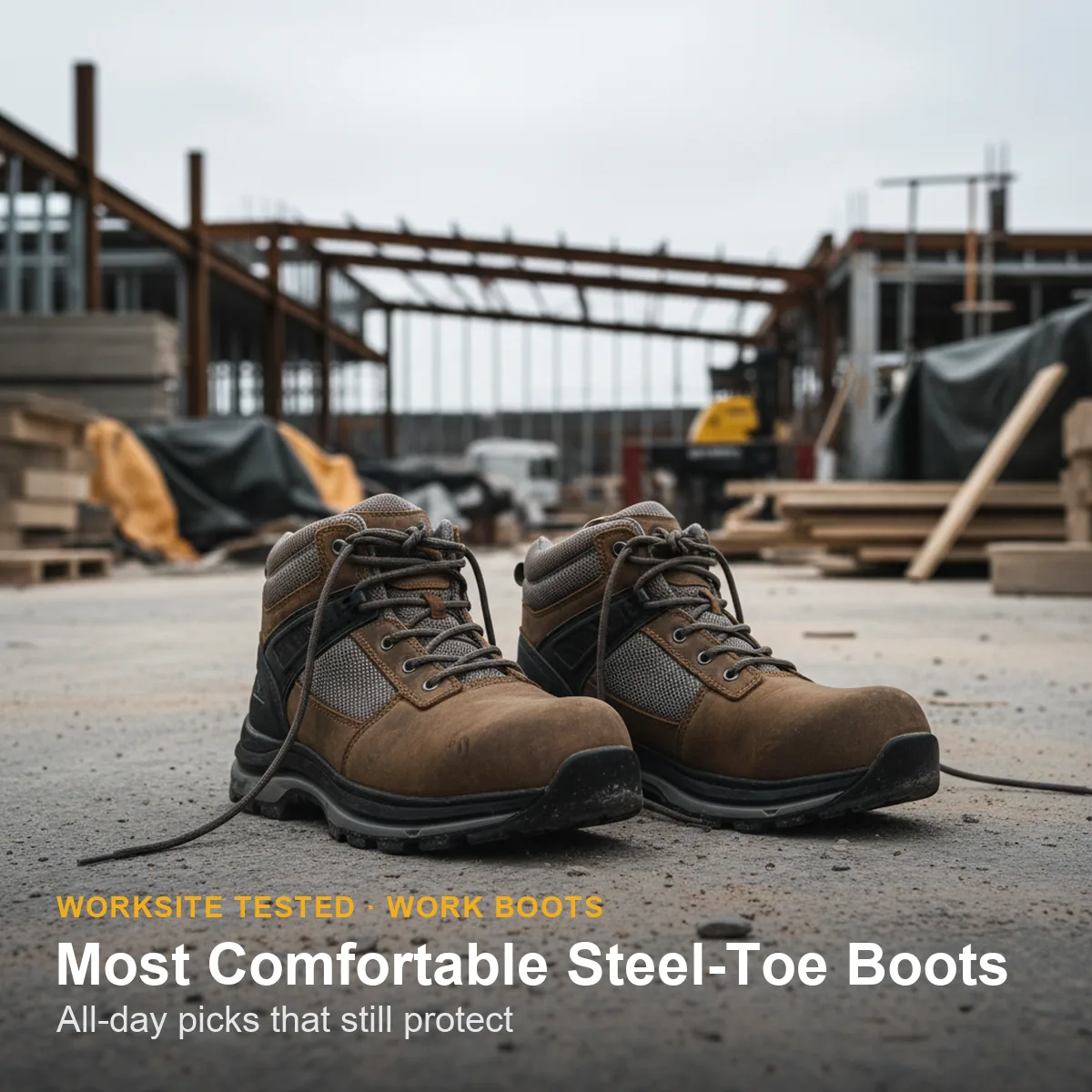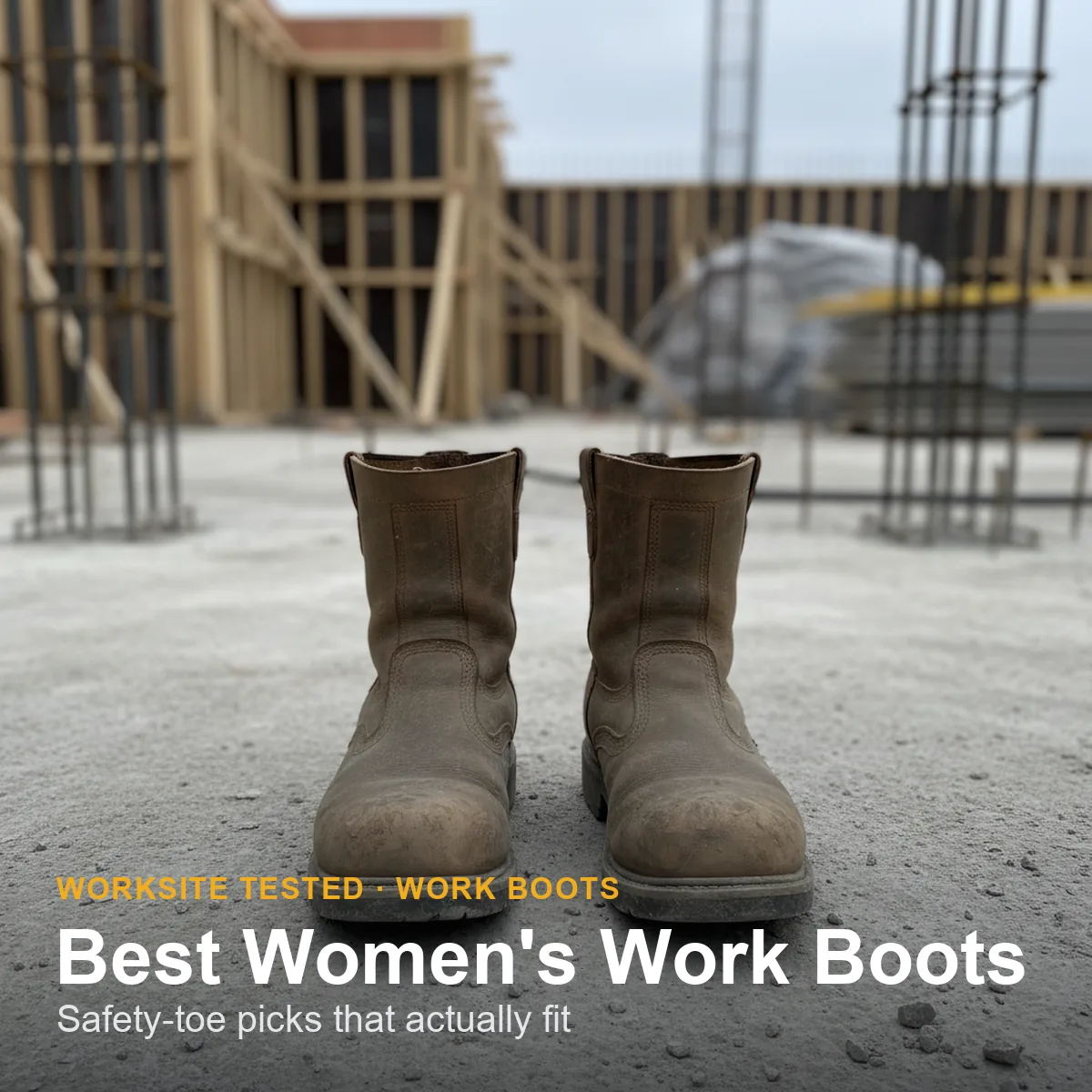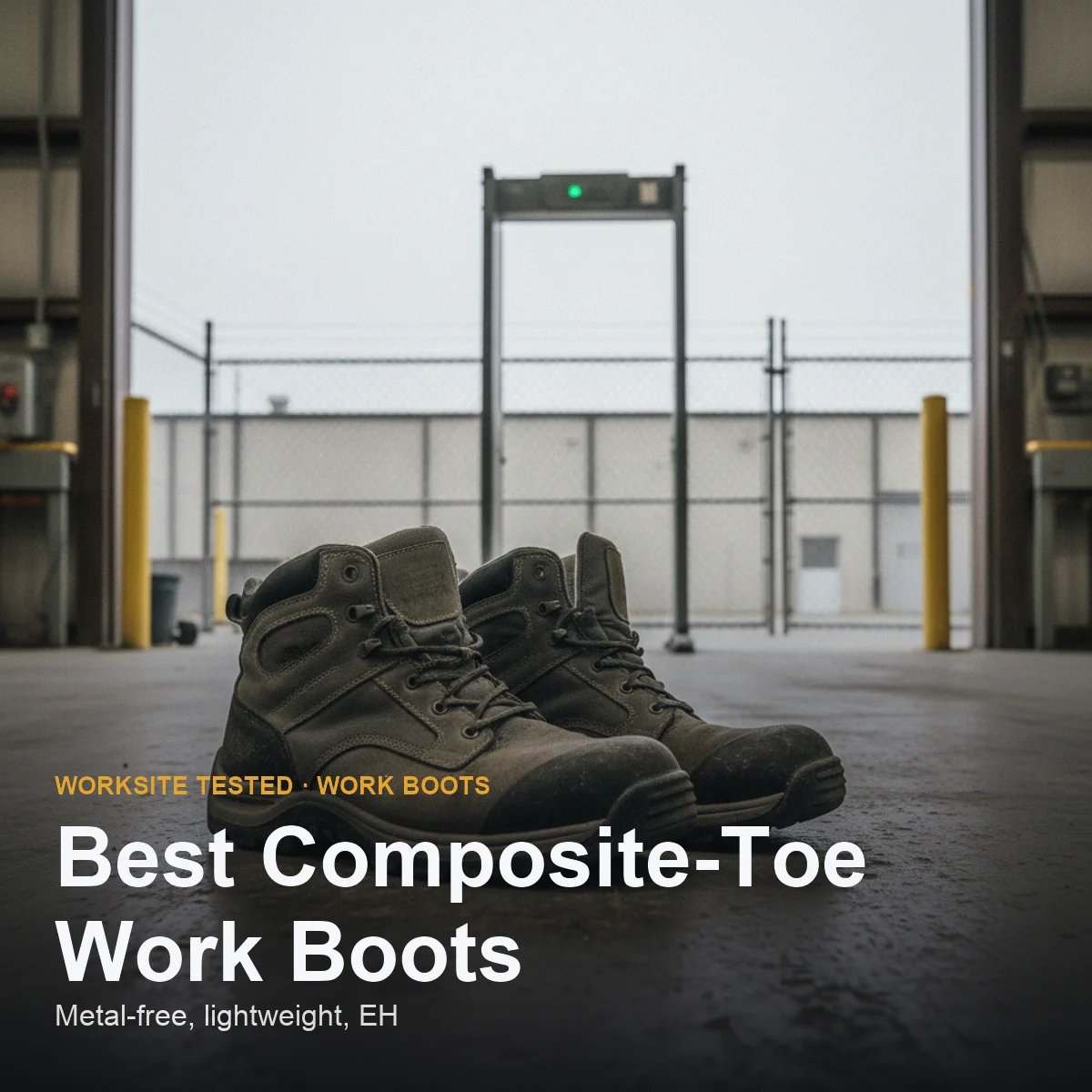

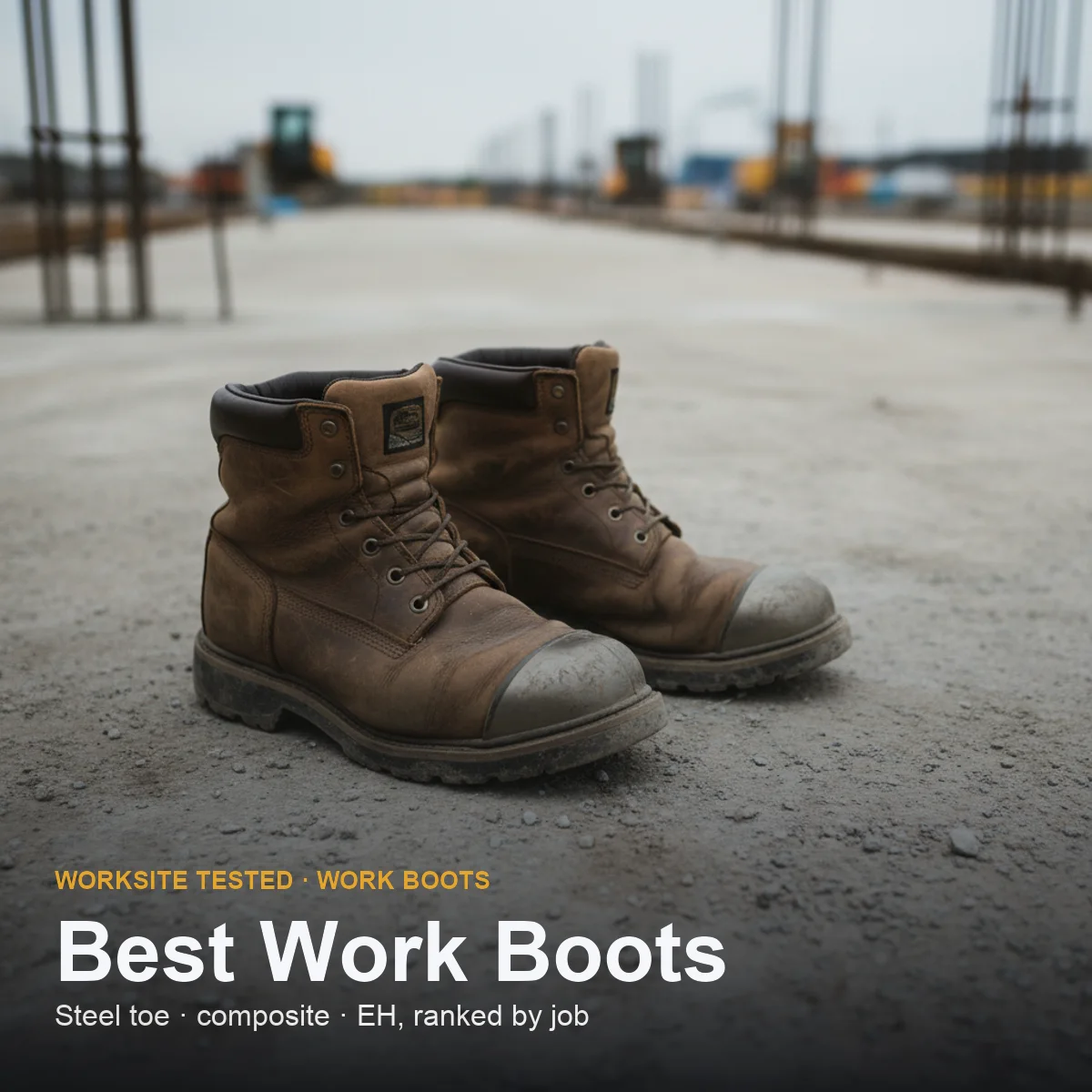
Short answer: the Thorogood 804-3600 is the boot I would put on for a 10-hour shift on concrete if money was no object. The CAT P91660 is what I would grab if I needed Goodyear welt construction at a fair price. And the Wolverine W10633 is what I would tell a helper to buy on their first paycheck. All three are real boots from real listings — everything in this guide is in stock at Working Person's Store as of June 27, 2026, with prices and specs pulled directly from each product page.
One rule I follow in a safety category: every number in here traces back to the actual listing. If the listing doesn't say it, I don't say it. I will tell you when a spec is a manufacturer claim versus an independently tested standard. I will tell you when cheaper is fine. And I don't rank by commission — the $104 boot and the $284 boot both have a fair shot at the top slot depending on your job.
Key Takeaways
- All 7 boots carry ASTM F2413-05 M I/75 C/75. That's a 75 ft-lbf impact and 2,500 lbf compression rating on the toe cap. The "05" is the 2005 edition of the standard — still legally compliant under OSHA 29 CFR 1910.136, which cites F2413-2005 by reference.
- EH does not replace electrical PPE. EH-rated boots insulate the outsole against open circuits under dry conditions. The ASTM F2412 test runs 18,000 V at 60 Hz for one minute. Individual listings may state lower field application values (CAT P91660 states "up to 600 volts in dry conditions") — that is application guidance, not a different test. Wet or contaminated boots may not maintain the EH rating.
- Met guard (Mt 75) is not standard equipment. Only two boots here carry metatarsal protection — the Georgia GB00322 (internal) and the Carolina 599 (external). If your trade has dropped-object or crush risk on the top of the foot, look at those two first.
- Waterproof claims differ. Five of the seven boots carry a "guaranteed waterproof membrane" (Carhartt Storm Defender, Thorogood X-Stream) or manufacturer waterproof system (Wolverine, CAT, Georgia). The Carolina 599 is not waterproof — right tool for covered or dry environments.
- Construction type determines repairability. Goodyear welt = can be resoled. Cement / San Crispino = lighter, but when the sole goes, the boot goes. See the comparison table below.
- Internal links: Composite toe vs steel toe | Waterproof work boots guide | EH boots explained
What ASTM F2413 actually means on a boot label
Every product in this guide carries the marking ASTM F2413-05 M I/75 C/75. Here is what each piece means in plain terms, based on the standard and verified against multiple independent sources:
- F2413-05: The 2005 edition of the ASTM F2413 standard. OSHA 29 CFR 1910.136 (general industry) references the 2005 edition by name, so boots labeled to this version are compliant. A newer edition, F2413-18, eliminated the tiered I/75 / I/50 designation in favor of single-level labeling. F2413-24 added formal slip-resistance markings (SR / SRO). Boots in this guide are labeled to the '05 edition — that's the version on the workingperson.com listing, even where a manufacturer's own description also references a newer edition.
- M: Men's sizing.
- I/75: Impact resistance. The toe cap must withstand a 75 ft-lbf impact without exceeding clearance limits between the cap and the toe.
- C/75: Compression resistance. The toe cap must withstand 2,500 lbf of static compression without failure.
- EH: Electrical Hazard. The outsole and heel insulate the wearer against an open electrical circuit. The ASTM F2412 test method applies 18,000 volts at 60 Hz for one minute with no more than 1.0 milliampere passing through. EH is secondary protection only — it is not a substitute for primary electrical PPE.
- Mt / Mt 75: Metatarsal protection. An external or internal guard protects the metatarsal bones from a 75 ft-lbf impact. Optional designation — most boots don't carry it.
- PR: Puncture resistant. A protective plate between insole and outsole resists nail penetration. None of the 7 boots in this guide carry PR — worth noting if you are on a demo site with scattered fasteners.
- ESD: Electrostatic Dissipative. Allows controlled, slow discharge of static electricity. Only one boot here — the Georgia GB00313 — carries ESD alongside EH.
OSHA does not certify or approve specific boot models. Compliance is demonstrated by the manufacturer's label on the boot. Sources: OSHA 29 CFR 1910.136; ASTM F2413 standard history per sturdyboot.com, wcsafety.com, and tyndaleusa.com (all fetched June 27, 2026).
All 7 boots at a glance
| Boot | Construction | Toe / Met guard | EH | Waterproof | Best for | Price |
|---|---|---|---|---|---|---|
| Wolverine W10633 | Cement (flexible) | Steel I/75 C/75 | Yes | Yes | Budget general construction | $104.95 |
| CAT P91660 | Goodyear welt | Steel I/75 C/75 | Yes | Yes | Best value resole-capable boot | $139.95 |
| Georgia GB00322 | Goodyear welt | Steel I/75 C/75 + Mt 75 (internal) | Yes | Yes | Top-of-foot crush hazard trades | $165.00 |
| Georgia GB00313 | San Crispino | Steel I/75 C/75 | Yes + ESD | Yes | Petrochemical / electronics / ESD sites | $180.00 |
| Carhartt CMW6275 | Goodyear welt | Steel I/75 C/75 | Yes | Yes (guaranteed membrane) | Carpenters / concrete standing | $184.99 |
| Carolina 599 | Goodyear welt | Steel I/75 C/75 + Mt 75 (external) | Yes | No | Foundry / forge / metalwork | $204.99 |
| Thorogood 804-3600 | Goodyear welt | Steel I/75 C/75 | Yes | Yes (guaranteed membrane) | Premium all-day comfort / USA-made | $284.95 |
1. Wolverine W10633 — best boot under $110
Steel toe, EH, waterproof construction, and free shipping at $104.95. That is a hard combination to beat for a helper, apprentice, or anyone who burns through boots fast and needs to watch budget. The cement construction means no resoling — when the sole wears, the boot is done — but it also means the boot is lighter and more flexible out of the box than a welt-built one. The nylon shank gives you torsional stability without the weight of steel. The dual ASTM citation (F2413-05 in the listing header, F2413-11 in the product description) is a minor labeling inconsistency, not a protection issue — both are compliant.
- Grab these if: you need a solid compliant boot at a price that makes sense to replace when the sole goes.
- Skip if: you need met-guard protection, a resole-capable welt, or you are in a waterproof-guarantee environment.
Check price at Working Person's Store →
2. Caterpillar P91660 — best Goodyear welt boot for the money
The Second Shift has been around long enough that most tradespeople have worn a pair. The P91660 is the current full-grain leather, Goodyear welt version with waterproofing and EH. The 90-degree heel grabs ladder rungs correctly — a detail that matters more than most people think until they are 20 feet up. The listing states EH protection up to 600 volts in dry conditions; that is CAT's field application guidance, not the ASTM F2412 test parameter (which runs 18,000 V). The boot passed the test, the 600V number tells you what the listing author thinks your real-world exposure is. At $139.95 with Goodyear welt construction, this is the boot I would hand most general tradespeople.
- Grab these if: you want a resole-capable boot with proven comfort and a name that holds up on any jobsite.
- Skip if: you need met-guard coverage or a wedge sole for all-day concrete.
Check price at Working Person's Store →
3. Georgia GB00322 — best pick for met-guard protection
If you work around dropped material with any realistic chance of landing on the top of your foot — pipe, I-beam, plate steel, heavy tooling — you need met-guard coverage and most boots don't have it. The GB00322 carries an internal met guard rated Mt 75 (the same 75 ft-lbf impact test as the toe cap) using XRD material. Internal is the right design here. External met guards add snag points and visual bulk that catches on form work, scaffolding, and equipment. Georgia's version stays inside the boot profile. You get Goodyear welt construction, the Georgia waterproof system, EH rating, and a double-ribbed tempered steel shank for torsional stability at $165. The strongest protection-to-profile ratio in this group.
- Grab these if: you work in heavy manufacturing, structural steel, or any trade with real dropped-object risk above the toes.
- Skip if: your site does not require met-guard coverage — the extra $25 over the CAT buys protection you don't need on a standard construction site.
Check price at Working Person's Store →
4. Georgia GB00313 Eagle One — only EH + ESD boot in the group
Most people don't need both EH and ESD on the same boot. But if you do, your choices narrow fast. EH insulates you from live circuits. ESD does the controlled opposite — it gives you a defined, slow discharge path so static charges bleed off before you touch sensitive electronics or work near ignitable vapors. Petrochemical refinery, semiconductor fab, explosive detonator environments — these are the sites where your safety officer will ask about both. The GB00313 is the only boot in this roundup certified for both. San Crispino construction keeps it lighter than a welt build (listing states 3.7 lbs in size 10), which matters for a long day. The tradeoff: not resole-capable.
- Grab these if: your site requires ESD certification alongside EH — petrochemical, semiconductor, or detonator-sensitive environments.
- Skip if: you don't need ESD. Pay less and get a welt-built boot instead.
Check price at Working Person's Store →
5. Carhartt CMW6275 — best wedge sole for carpenters and concrete workers
The wedge sole is a job-specific choice. Carpenters, trim installers, finish tradespeople, and anyone standing mostly on flat hard surfaces — concrete slab, wood subfloor, asphalt — often prefer the full-contact wedge over a heeled lug because there is less ankle angle shift throughout the day. The CMW6275 gives you a Goodyear welt (resole-capable), a Carhartt Storm Defender waterproof membrane with a guarantee, EH rating, and steel toe in that wedge configuration. The smooth/minimal tread is the right design for the work it's meant for, but don't wear it on muddy grades, wet metal grating, or loose gravel. At $184.99, the Goodyear welt brings the cost-per-year down if you take care of it.
- Grab these if: you are a carpenter or tradesperson who stands on flat hard surfaces most of the day and wants comfort over lug-sole grip.
- Skip if: you work on slopes, wet metal, or terrain that needs aggressive tread.
Check price at Working Person's Store →
6. Carolina 599 — best boot for foundry and metalwork
The Vibram outsole with Kevlar heat and flame resistance is the distinguishing spec here. When you are walking across a foundry floor, forge area, or welding shop where hot slag, sparks, or metal shavings land on the ground, the sole compound matters beyond just grip. The Carolina 599 adds external met-guard protection (Mt 75) and EH to that Vibram Kevlar base, built on Goodyear welt construction with a full steel shank. At $204.99 it is the most expensive non-premium option in the group. It earns that price for metalwork environments. One honest note: it is not waterproof. If you work outdoors in wet conditions, this is not your boot.
- Grab these if: you work in foundry, forge, structural welding, or any environment with heat and flame exposure at floor level plus met-guard risk.
- Skip if: you need waterproofing or work outdoors in wet conditions.
Check price at Working Person's Store →
7. Thorogood 804-3600 — best boot if you wear it every day for years
Made in Wisconsin. That matters to some people and to some worksites — Buy American contract requirements on government jobs, union hall floors where the label gets checked. Beyond the origin story, the 804-3600 is a legitimately excellent boot. The MaxWear single-density PU wedge outsole conforms slightly underfoot over time — most guys who put 200+ hours on these say the comfort noticeably improves after the first week. The X-Stream membrane carries a waterproof guarantee. Goodyear welt means you resole when the tread is gone, not the boot. EH rated. Full-grain briar pitstop leather. At $284.95 this is the top of the price range in this group. The math works if you resole them — the boot will outlast two pairs of cheaper options.
- Grab these if: you wear the same pair 50+ hours a week and want a USA-made boot you can resole two or three times.
- Skip if: you are budget-constrained or burn through boots fast from abrasive environments where longevity doesn't help.
Check price at Working Person's Store →
Goodyear welt vs cement vs San Crispino: why it matters
Goodyear welt: The upper, a strip of welt leather, and the outsole are all stitched together. The outsole can be separated and replaced. Five of the seven boots here use Goodyear welt: the CAT P91660, Georgia GB00322, Carhartt CMW6275, Carolina 599, and Thorogood 804-3600. More durable and more repairable — heavier and usually stiffer out of the box.
Cement construction: The outsole is bonded to the upper with adhesive. Lighter and more flexible immediately, but not resole-capable. The Wolverine W10633 uses cement construction. When the sole wears out, you buy a new boot.
San Crispino (also called slip-lasted or California construction): The upper wraps under the foot and the outsole bonds over it. Even lighter than cement, good for fatigue on long shifts. The Georgia GB00313 uses this method. Not resole-capable.
If you are buying one pair and expecting to wear them for two or three years, buy Goodyear welt. If you replace boots every 12 months from hard use, cement or San Crispino saves you weight and money up front.
Marketing claims vs actual standards: how to read a boot listing
Boot listings mix certified standards with marketing language and it is easy to confuse the two. Here is how to read them:
- "ASTM F2413-05 M I/75 C/75" on the listing — this is the manufacturer's stated compliance. OSHA does not independently test or certify individual boots. The claim is substantiated by the label on the boot, not a third-party certification body. It means the manufacturer represents the boot passes the standard.
- "EH — protection up to 600 volts in dry conditions" (CAT P91660 listing) — this is the manufacturer's field application guidance, not the ASTM F2412 test voltage. The ASTM test runs 18,000 V; the 600V number is what the listing author states as practical protection guidance. Both figures describe the same boot's EH characteristic — one is the test parameter, one is the stated application.
- "Guaranteed Waterproof — Membrane" (Carhartt CMW6275, Thorogood 804-3600) — this is a manufacturer guarantee, not an ASTM or OSHA designation. It means the brand stands behind the waterproof claim for a defined period. Read the fine print on what the guarantee covers and for how long.
- "Vibram rubber with Kevlar heat and flame resistance" (Carolina 599) — Vibram is a brand name, Kevlar is a DuPont material mark. Neither alone is an ASTM or OSHA code designation. The listing does not cite a specific heat-resistance ASTM designation — I will not assign one that is not on the listing.
Frequently Asked Questions
What is the best work boot overall?
For most trades: the Caterpillar P91660 at $139.95 — Goodyear welt, full-grain leather, waterproof, EH-rated, proven comfort. If you stand on concrete all day as a carpenter or finish tradesperson, the Carhartt CMW6275 wedge sole is the better fit. If you want the best boot money can buy and plan to resole it, the Thorogood 804-3600 at $284.95 is made in Wisconsin and built to last.
When do I actually need EH-rated boots?
When your employer's job hazard analysis identifies contact with live or potentially live electrical circuits as a hazard. OSHA 29 CFR 1910.136 requires protective footwear where foot injury can occur from electrical hazards. EH boots are secondary protection — they insulate your feet from the ground side of a circuit. They do not replace rubber gloves, insulated tools, or lockout/tagout procedures. And they are tested in dry conditions — a wet boot is not a reliable EH boot.
Do I need a metatarsal guard?
If your site hazard assessment identifies risk of dropped objects or rolling objects that could strike the top of the foot (between your toes and ankle), yes. Heavy manufacturing, structural steel, shipyards, and some mining operations commonly require met-guard boots. Most general construction sites do not mandate them, but check your site's PPE requirements. The two met-guard boots in this guide are the Georgia GB00322 (internal, Mt 75) and the Carolina 599 (external Mt 75).
Steel toe or composite toe — which should I pick?
All seven boots in this roundup use steel toes. Composite toe boots are lighter, don't conduct cold or heat, and don't set off metal detectors — useful in airports, courthouses, and some industrial sites with metal-detector entry. Steel toes are heavier but typically thinner in profile (smaller toe box protrusion) and have a longer track record in ASTM testing. See our composite vs steel toe deep-dive for the full trade-off breakdown.
Is a waterproof membrane the same as waterproof leather?
No. Waterproof leather (like the Georgia GB00313's "waterproof full-grain leather upper") uses a treated hide that resists water at the surface. A membrane waterproofing system (Carhartt Storm Defender, Thorogood X-Stream) adds a breathable barrier layer inside the boot between the lining and upper. Membrane systems tend to last longer and work independently of how worn or scuffed the upper leather gets. Both can be effective — the membrane-backed boots in this guide state a guarantee, which is a meaningful signal.
About this guide
Marco Reyes is a bilingual (EN/es-US) field reviewer who covers PPE and workwear for WorkSite Tested from the tradesman's side of the job. Every product in this guide was pulled live from Working Person's Store on June 27, 2026, confirmed in stock, and verified against the listing specs — no numbers were inferred, extrapolated, or borrowed from other models. ASTM F2413 standard facts were cross-checked against OSHA regulatory text (29 CFR 1910.136 and 1926.96) and three independent technical sources: sturdyboot.com, wcsafety.com, and tyndaleusa.com. We earn an affiliate commission on purchases made through links in this guide, at no extra cost to you. Ranking is by protection and trade fit — never by commission rate. See our affiliate disclosure.