

Here is the part nobody tells the new guy: a fall arrest system that is rated, certified, and clipped in correctly can still let you hit the ground. Not because the gear failed. Because there was not enough room underneath you for the system to finish stopping you. The harness held, the lanyard held, the anchor held — and you still bottomed out on the deck below.
That is a fall clearance problem. It is math, and it is the math people skip. I have watched experienced guys clip a 6-foot lanyard to a foot-level anchor on a structure with maybe 12 feet of air under it, and nobody ran the number. So let me run it with you, slow. Every standards figure in here traces to OSHA or ANSI — not to a product listing, not from memory.
Key Takeaways
- Total fall clearance = free fall + deceleration distance + D-ring shift + back D-ring height + safety factor. That is the OSHA Technical Manual formula. Leave out any term and your number is wrong on the low side — the dangerous side. Source: OSHA Technical Manual, Section V Ch. 4.
- OSHA caps free fall at 6 ft and deceleration at 3.5 ft. A personal fall arrest system must be rigged so a worker can neither free fall more than 6 ft (1.8 m) nor exceed 3.5 ft (1.07 m) of deceleration distance. Source: OSHA 29 CFR 1926.502(d)(16).
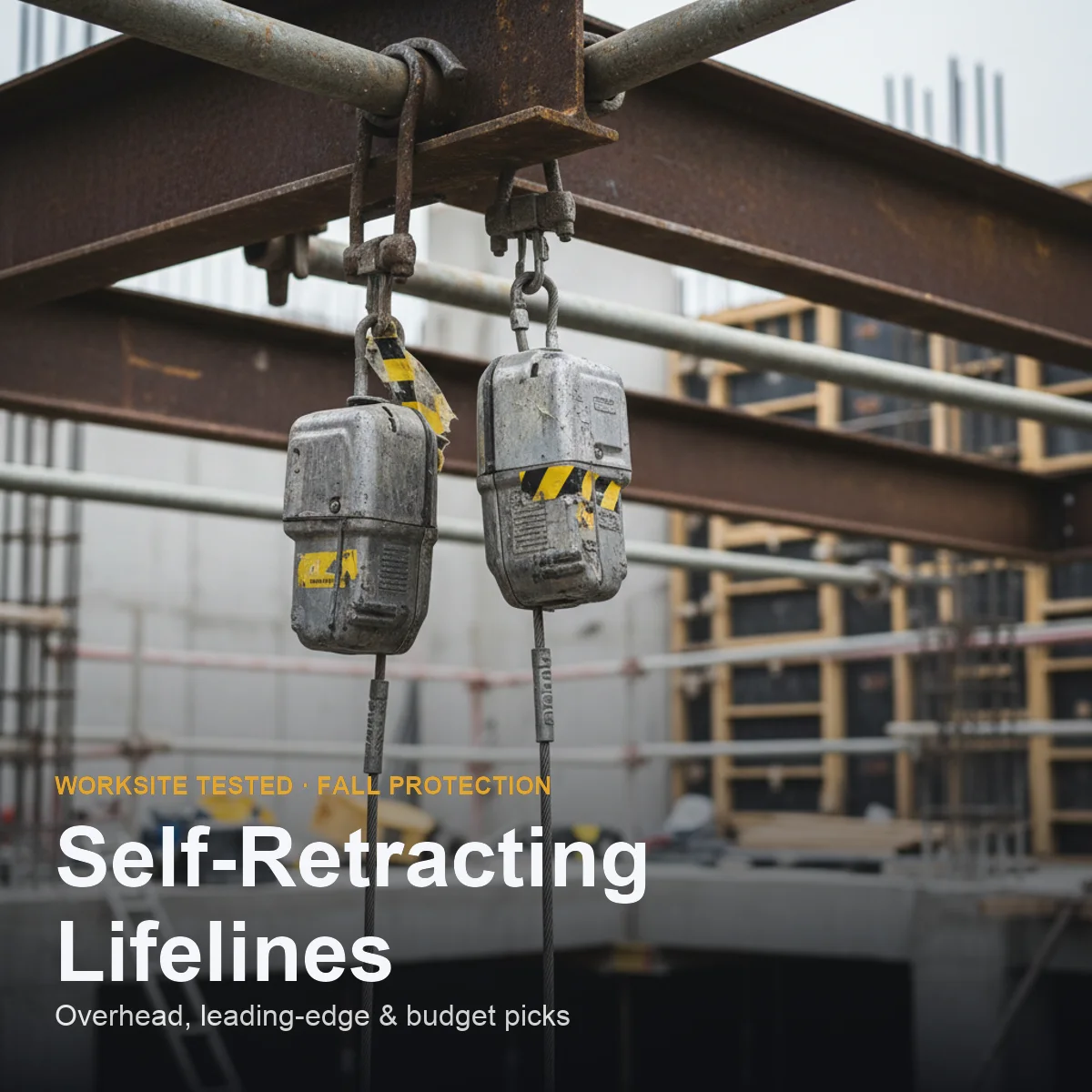
- An SRL needs less clearance than a lanyard — usually. A Class 1 SRL limits free fall to 2 ft and arrests inside 42 in; a 6 ft shock-absorbing lanyard can free fall up to 6 ft. That difference is feet of clearance. But a Class 2 SRL anchored at foot level gives back the free fall you saved. Source: FallTech / ANSI Z359.14-2021 summary.
- The fall height trigger is 6 ft in construction, 4 ft in general industry. OSHA 1926.501 (construction) triggers at 6 ft above a lower level; OSHA 1910.28 (general industry) triggers at 4 ft. Sources: 1926.501, 1910.28.
- Internal links: SRL vs shock-absorbing lanyard | Fall protection basics | Best SRLs ranked
First: why this kills people
Fall protection has two jobs. Stop your fall, and stop it with enough room to spare that you do not touch the level below. The first job is the harness, the lanyard or SRL, and the anchor. Everyone focuses on that. The second job is clearance — the vertical distance below your feet at the moment you start to fall.
When a worker who is fully tied off still hits the ground, clearance is almost always the reason. The anchor was too low. The lanyard was too long. The worker forgot that their own body adds five-plus feet to the drop. The system was busy stopping them and ran out of floor.
OSHA sets the floor under the whole thing. In construction, fall protection is required at 6 feet (1.8 m) or more above a lower level (29 CFR 1926.501(b)(1)). In general industry it is required at 4 feet (1.2 m) — a lower trigger that catches a lot of maintenance and warehouse work people assume is "not high enough to matter" (29 CFR 1910.28(b)(1)). Those triggers tell you when you need a system. They do not tell you whether you have enough room for it to work. That is on you to calculate.
Sources: OSHA 29 CFR 1926.501(b)(1); OSHA 29 CFR 1910.28(b)(1).
The formula, term by term
The OSHA Technical Manual (Section V, Chapter 4) lays out total fall clearance as a sum of five distances. Add them up and you get the minimum air you need below your feet:
Total clearance = Free Fall + Deceleration Distance + D-Ring Shift + Back D-Ring Height + Safety Factor
Here is what each one is, in plain terms:
- Free fall distance. How far you drop before the system even starts to slow you. With a lanyard, this depends on lanyard length and where the anchor sits relative to your D-ring. OSHA caps it: a personal fall arrest system must be rigged so an employee can neither free fall more than 6 feet (1.8 m) (29 CFR 1926.502(d)(16)(iii)). With a Class 1 SRL, free fall is limited to about 2 ft because the brake engages almost immediately.
- Deceleration distance. How far you keep traveling while the system stops you — the lanyard's energy absorber tearing open, or the SRL's brake paying out. OSHA limits deceleration distance to 3.5 feet (1.07 m) (29 CFR 1926.502(d)(16)(iv)). The OSHA Technical Manual uses 3.5 ft as the standard lanyard value in its worked examples.
- D-ring shift. When the system loads, the dorsal D-ring slides up your back and the harness shifts. The OSHA Technical Manual uses 1 ft for this.
- Back D-ring height. The distance from your dorsal D-ring down to the soles of your boots — your own body in the drop. The OSHA Technical Manual uses 5 ft as a standard value. A taller worker has more; measure if you are not average height.
- Safety factor. Margin so you do not calculate down to the exact inch. The OSHA Technical Manual uses 2 ft. Some manufacturers and trainers use 3 ft. More is not waste here.
Sources: OSHA Technical Manual, Section V Ch. 4 (formula and standard component values); OSHA 29 CFR 1926.502(d)(16)(iii) and (iv) (6-ft free fall limit, 3.5-ft deceleration limit).
Worked example 1: the 6-foot lanyard (OSHA's own example)
Let's do the exact example OSHA publishes in its Technical Manual. A worker uses a 6-foot shock-absorbing lanyard. The anchor is 2 feet above the back D-ring. Because the anchor is above the D-ring, the free fall is shorter than the full lanyard length — it works out to 4 feet of free fall.
| Component | Distance |
|---|---|
| Free fall distance | 4.0 ft |
| Deceleration distance | 3.5 ft |
| D-ring shift | 1.0 ft |
| Back D-ring height | 5.0 ft |
| Safety factor | 2.0 ft |
| Total required clearance | 15.5 ft |
4 + 3.5 + 1 + 5 + 2 = 15.5 feet. That is OSHA's stated total for this exact case, and the rows add up to it. Read that number again: a 6-foot lanyard, anchored above your D-ring — the favorable case — still needs 15 and a half feet of air under your boots. If you anchor a 6-foot lanyard down at foot level instead, your free fall jumps and the total climbs higher. That is why short structures and lanyards are a bad mix.
Source: OSHA Technical Manual, Section V Ch. 4, Example 1b (4 ft free fall + 3.5 ft deceleration + 1 ft D-ring shift + 5 ft back D-ring height + 2 ft safety factor = 15.5 ft).
Worked example 2: same lanyard, anchored at D-ring level
Now move the anchor down to the same height as your back D-ring instead of 2 feet above it. The full 6 feet of lanyard is now available to free fall through before the energy absorber engages. The free fall goes from 4 ft up to 6 ft — the OSHA maximum. Here is how that one common trainer reference (fcsafety.com) works the same case, with the worker's body and D-ring shift combined into one 6 ft "worker height" term:
| Component | Distance |
|---|---|
| Free fall distance | 6.0 ft |
| Deceleration distance | 3.5 ft |
| Worker height (D-ring to feet + harness stretch) | 6.0 ft |
| Safety factor | 2.0 ft |
| Total required clearance | 17.5 ft |
6 + 3.5 + 6 + 2 = 17.5 feet. Two feet more than Example 1, and the only thing that changed was lowering the anchor. The anchor position is not a small detail. Anchoring above the D-ring shortens free fall; anchoring at or below it lengthens it. Two identical workers, two identical lanyards, two feet of difference in survival margin — decided entirely by where the snap hook clipped.
Note: this table groups the OSHA "D-ring shift" and "back D-ring height" terms into a single "worker height" value, which is why it has four rows instead of five. The component scheme differs from OSHA's Example 1 but describes the same drop. Source: fcsafety.com fall clearance worked example (6 + 3.5 + 6 + 2 = 17.5 ft).
Worked example 3: a self-retracting lifeline instead
Now swap the lanyard for an SRL on the same kind of overhead setup. A self-retracting lifeline locks up almost instantly — the brake catches within a couple of feet — so the free fall term collapses and the deceleration is shorter, too. Same reference, worked the SRL way:
| Component | Distance |
|---|---|
| Free fall distance (SRL) | 2.0 ft |
| Deceleration distance | 1.5 ft |
| Worker height (D-ring to feet + harness stretch) | 6.0 ft |
| Safety factor | 3.0 ft |
| Total required clearance | 12.5 ft |
2 + 1.5 + 6 + 3 = 12.5 feet. Compare that to the 17.5 ft a 6-foot lanyard needs when anchored at the same level: the SRL saved you 5 feet of required clearance. On a structure where you have 14 or 15 feet of air below — common on a lot of jobs — that 5 feet is the difference between a system that works and one that does not. That is the real argument for an SRL on short drops, and it is built right into the math.
Source: fcsafety.com fall clearance worked example (2 + 1.5 + 6 + 3 = 12.5 ft). SRL free fall and deceleration figures here are the reference example's values; the actual required clearance for any specific SRL is printed on the device label and in its manual — always use that number.
SRL vs. lanyard: the clearance comparison straight up
Put the three examples next to each other and the lesson is obvious:
| Setup | Free fall | Required clearance |
|---|---|---|
| 6 ft lanyard, anchor above D-ring | 4.0 ft | 15.5 ft |
| 6 ft lanyard, anchor at D-ring | 6.0 ft | 17.5 ft |
| SRL, overhead anchor | 2.0 ft | 12.5 ft |
The SRL wins on clearance because it kills your free fall. That is the whole story on short structures. But — and this matters — an SRL only beats a lanyard when it is the right class for your anchor. Here is the part that catches people:
- Class 1 SRL under ANSI Z359.14-2021: anchor at or above the dorsal D-ring only. Maximum allowable free fall 2 ft. This is the low-clearance hero — overhead tie-off, free fall almost nothing.
- Class 2 SRL under ANSI Z359.14-2021: can anchor at, above, or up to 5 ft below the dorsal D-ring, with extra leading-edge testing. But maximum allowable free fall jumps to 6 ft — the same as a lanyard — because you might be tied off at your feet. A Class 2 SRL anchored low gives back the free fall a Class 1 saves.
Both classes share the same arrest ceilings under Z359.14-2021: maximum arrest distance 42 inches, maximum arresting force 1,800 lb, average arresting force 1,350 lb. The difference is entirely about anchor geometry and free fall — which is exactly what drives clearance. So "an SRL needs less clearance" is true for a Class 1 overhead, and not automatically true for a Class 2 you have anchored at foot level. Read the device's own fall clearance chart.
Sources: ANSI/ASSP Z359.14-2021 SRD class summary (FallTech) (Class 1 = anchor at/above D-ring, 2 ft max free fall; Class 2 = up to 5 ft below D-ring, 6 ft max free fall; 42 in arrest distance, 1,800 lb max / 1,350 lb avg arresting force for both); Z359.14-2021 replaced Class A/B with Class 1/Class 2.
Three real connectors and what they tell you about clearance
You cannot do this math without real gear, so here are three live products — verified in stock and priced at named retailers on June 27, 2026. I am not ranking them against each other; they are different tools. I am pointing at what each one does to your clearance number. Specs come off the listings; standards numbers come off OSHA and ANSI.
Honeywell Miller TurboLite 6 ft — Class 1 SRL (the clearance saver)
A 6-foot Class 1 personal fall limiter, anchored overhead. Class 1 caps free fall at 2 ft under ANSI Z359.14-2021 — the exact lever that pulled Example 3 from 17.5 ft down to 12.5 ft. The WebstaurantStore listing states a 400 lb maximum working load and that it "meets all applicable OSHA, CSA, and ANSI requirements"; the FallProtectionPros listing for the same model spells capacity out as 420 lb OSHA / 310 lb ANSI and names ANSI Z359.14-2021 Class 1. Honest catch for a clearance article: neither listing prints a required fall clearance number, so you must read the device label and manual for the actual clearance — the 2 ft free fall figure is not the whole story. At $162.49 it is a fair-priced name-brand limiter for overhead work.
- Use it when: you can anchor overhead at or above your D-ring and you are fighting for clearance on a short structure.
- Do not use it when: you need leading-edge or foot-level tie-off — this is Class 1 only.
Check price at WebstaurantStore →
FallTech FT-R 30 ft Class 2 Leading Edge SRL (the geometry changer)
The other side of the SRL story. A Class 2 leading-edge unit can be anchored up to 5 ft below your dorsal D-ring and still pass leading-edge testing — what you need when you are tied off at foot level on a flat roof or steel deck where the cable can drag a sharp edge. But Class 2 allows up to 6 ft of free fall, so anchoring it low gives back the clearance a Class 1 saves. The listing states max arrest force 1,800 lb, average arrest force 1,350 lb max, and max arrest distance 42 in — all inside the ANSI Z359.14-2021 ceilings. The 30 ft of 7/32" galvanized cable (3,600 lb minimum static strength per listing) gives working range, and both connectors are plated alloy steel at a 5,000 lb minimum static strength — which is exactly OSHA's requirement for D-rings and snaphooks. At $721.89 it is a working tool for decking and steel erection, not a casual overhead pick.
- Use it when: you must tie off low or at a leading edge — flat roofing, decking, steel.
- Do not use it when: a simple overhead Class 1 limiter would cover the job — you would be paying for leading-edge capability and accepting more free fall than you need.
Check price at US Cargo Control →
FallTech FT-Iron 1D Harness (where two of your clearance feet come from)
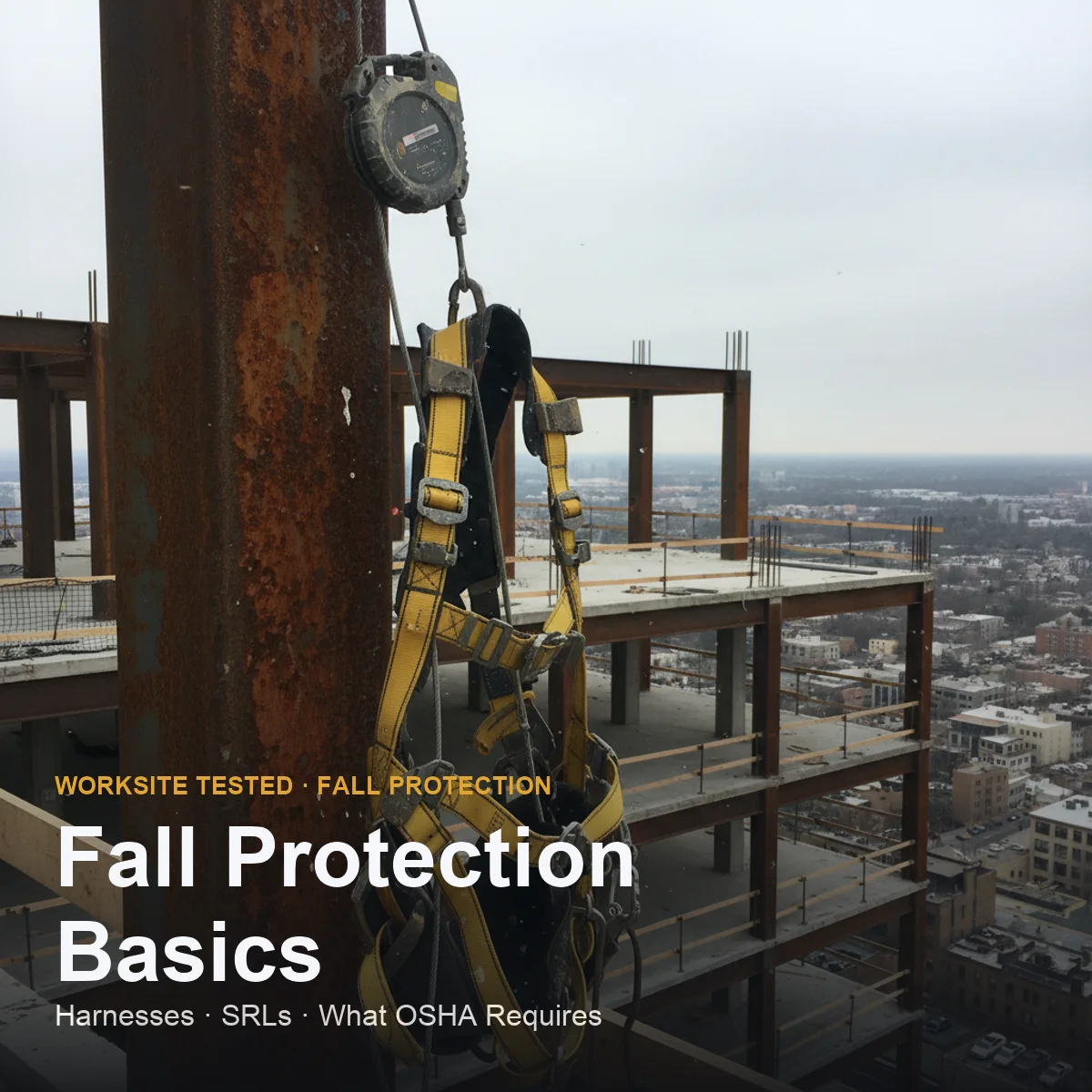
The harness is not just what you wear — it is two terms in the formula. The "back D-ring height" (about 5 ft in OSHA's example) and part of the harness-stretch / D-ring shift come from the harness on your body. This one is a single dorsal D-ring (1D) design, which is the correct and only attachment for vertical fall arrest — never clip a fall arrest connector to a chest or side D-ring. The aluminum D-ring and polyester webbing are both rated to a 5,000 lb minimum static strength per listing, matching what OSHA wants for harness components. It carries ANSI Z359.11-2021 — the harness standard, separate from the Z359.14 SRL standard. One clearance-adjacent feature worth the money: the included suspension trauma relief straps. They do not change your fall distance, but if you do catch a fall and hang, they buy time against suspension trauma while you wait for rescue. At $294.99 it is fairly priced and fully rated.
- Use it when: you need a compliant single-D-ring arrest harness — which is most general fall-arrest work.
- Do not over-buy: if your job needs positioning or rescue attachment points, a 1D harness is not the right body — that is a different harness, not a knock on this one.
Check price at US Cargo Control →
What the marketing language is doing
A listing that says "ANSI Z359.14-2021 Class 1" or "meets OSHA requirements" is telling you the device passed the standard's tests. That is a manufacturer's stated compliance — it is not a third-party certificate, and OSHA does not test or approve individual models. Read it as "the maker represents this passes," and verify against the label on the actual unit. That is not paranoia; that is how the system is designed to work.
Two specific traps on a clearance article:
- "Class 1 / Class 2" is anchor geometry, not a quality grade. A Class 2 unit is not "better" than a Class 1 — it is built for a different anchor position and it allows more free fall. Picking Class 2 because it sounds higher will cost you clearance.
- A listing that prints performance numbers (42 in arrest distance, 1,800 lb arrest force) is not printing your required clearance. Those are device test ceilings. The required fall clearance for your specific setup is the sum you calculate, capped by the chart on the device — never a single number lifted off a sales page.
One more thing: the anchor has to hold
Clearance math assumes the anchor does not fail. OSHA requires anchorage points for personal fall arrest to support at least 5,000 pounds (22.2 kN) per employee attached, or be designed with a safety factor of at least 2 under the supervision of a qualified person (29 CFR 1926.502). The connecting hardware — D-rings and snaphooks — must have a minimum tensile strength of 5,000 pounds and be proof-tested to 3,600 pounds without cracking or permanent deformation. The maximum arresting force allowed on a body harness is 1,800 pounds (8 kN). Those are the numbers your whole calculation rests on. If the anchor is not rated, the cleanest clearance math in the world does not matter.
Sources: OSHA 29 CFR 1926.502 (5,000 lb anchorage; 5,000 lb tensile / 3,600 lb proof test for D-rings and snaphooks; 1,800 lb maximum arresting force).
Frequently Asked Questions
What is the formula for fall clearance?
Total fall clearance = free fall distance + deceleration distance + D-ring shift + back D-ring height + safety factor. This is the OSHA Technical Manual formula (Section V, Chapter 4). In OSHA's own worked example — a 6-foot lanyard anchored 2 feet above the back D-ring — that comes out to 4 + 3.5 + 1 + 5 + 2 = 15.5 feet of required clearance. Anchoring the same lanyard lower raises the free fall and the total.
Does an SRL need less fall clearance than a lanyard?
Usually yes, when it is a Class 1 SRL anchored overhead. A Class 1 SRL limits free fall to about 2 feet under ANSI Z359.14-2021, versus up to 6 feet for a shock-absorbing lanyard, which can save roughly 5 feet of required clearance. But a Class 2 leading-edge SRL anchored at foot level allows up to 6 feet of free fall — the same as a lanyard — so it gives that clearance advantage back. Always use the fall clearance chart printed on the specific device.
How much free fall does OSHA allow?
OSHA 29 CFR 1926.502(d)(16) requires a personal fall arrest system to be rigged so an employee can neither free fall more than 6 feet (1.8 m) nor contact a lower level. The same section limits maximum deceleration distance to 3.5 feet (1.07 m) and caps maximum arresting force on a body harness at 1,800 pounds (8 kN).
Why does my own body count in the calculation?
Because your dorsal D-ring sits on your upper back, not at your feet. When you fall and the system stops you, the lowest part of your body — your boots — keeps going past the D-ring by the distance from the D-ring down to your feet, plus a little harness shift. The OSHA Technical Manual uses 5 feet for the back D-ring height plus 1 foot for D-ring shift. A taller worker adds more, so measure if you are not average height.
What if I do not have enough clearance for a lanyard?
Reduce the free fall. Anchor higher (above your D-ring shortens free fall), switch to a Class 1 SRL that limits free fall to about 2 feet, or use a shorter or self-retracting connector. If you still cannot meet the calculated clearance, the fall arrest approach is wrong for that location — you need fall restraint (a system that physically prevents reaching the edge) or a different method. Never tie off to a system that the math says will let you hit the level below.
About this guide
Marco Reyes is a bilingual (EN/es-US) field reviewer who covers PPE and fall protection for WorkSite Tested from the worker's side of the job. Every product in this guide was pulled live and confirmed in stock on June 27, 2026 — the Honeywell Miller TurboLite at WebstaurantStore, and the FallTech FT-R SRL and FT-Iron harness at US Cargo Control — with prices and specs read directly off each listing. No spec was inferred, extrapolated, or borrowed from another model. Every regulatory and standards number — the 6-foot free fall limit, 3.5-foot deceleration limit, 1,800-lb arresting force, 5,000-lb anchorage, the OSHA Technical Manual clearance formula and its component values, and the ANSI Z359.14-2021 Class 1/Class 2 free fall and arrest figures — is traced to OSHA regulatory text, the OSHA Technical Manual, or published ANSI Z359.14-2021 summaries, and attributed to the standard rather than to any product listing. Every worked clearance table adds up internally to its stated total. We earn an affiliate commission on purchases made through links in this guide, at no extra cost to you, and ranking is never by commission rate. See our affiliate disclosure.