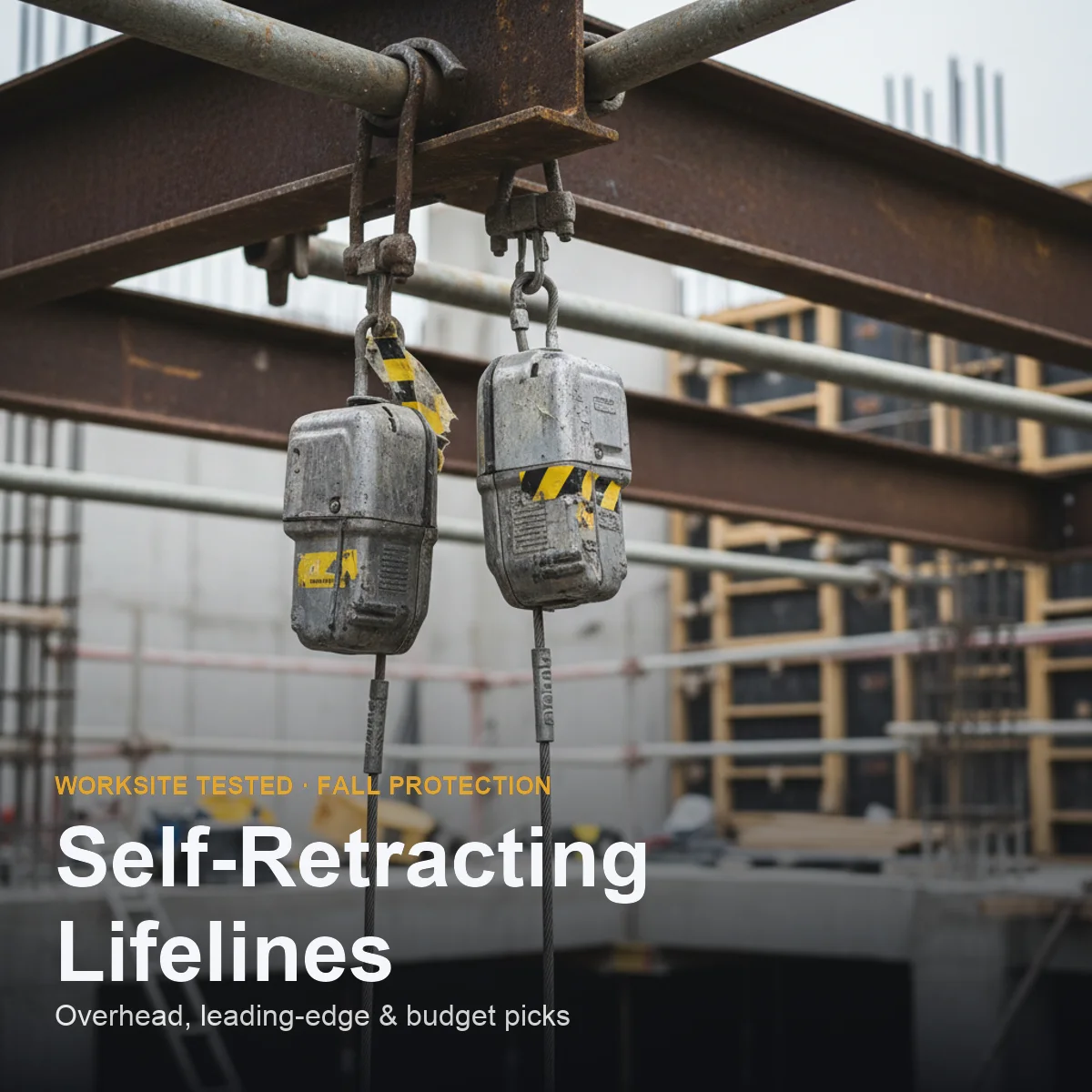
Let me be direct: an SRL is a piece of equipment that either catches you or it doesn't. There is no partial credit at 30 feet. So this guide covers six real units from live listings — nothing specced from memory, nothing cited that wasn't in the research — and I will tell you which one fits your anchor setup, your budget, and your actual work.
The most important split in this category is Class 1 versus Class 2. One works overhead. The other works at foot level and on leading edges. Using the wrong class in the wrong application is a serious mistake. I cover that first before touching any product.
Key Takeaways
- Class 1 vs Class 2 is not a quality rating. It is an anchor geometry designation under ANSI Z359.14-2021. Class 1 = overhead anchor only. Class 2 = foot-level and leading edge anchor capable. Using a Class 1 SRL at foot level is a misapplication.
- OSHA requires fall protection at 6 ft in construction. That is the regulatory floor (29 CFR 1926.501). It is not a suggestion and it is not negotiable on a covered site. Source: OSHA 29 CFR 1926.501.
- ANSI Z359.14-2021 replaced the 2014 standard. Mandatory compliance for new SRDs was August 1, 2023. If your current SRL is labeled "Class A" or "Class B," it is to the old standard — Class A maps to Class 1, Class B maps to Class 2. Source: FallTech standards blog.
- Both Class 1 and Class 2 share the same arrest performance requirements under Z359.14-2021: Maximum Arresting Force (MAF) 1,800 lb (8 kN); Average Arresting Force (AAF) 1,350 lb (6 kN) or less; Maximum Arrest Distance 42 inches. Test mass 310 lb (140 kg). Source: FallTech standards blog.
- Inspect before every shift. ANSI Z359.14-2021 requires a pre-use inspection by the user before every shift, plus a formal documented inspection by a competent person at least annually. Source: FallTech standards blog.
- After a fall, retire the unit. Any SRL that has arrested a fall must be removed from service and inspected by the manufacturer or a qualified person before any reuse. Do not field-reset a unit that caught someone.
Class 1 vs Class 2: the most important thing in this guide
Under ANSI/ASSP Z359.14-2021 — the current standard — self-retracting devices are divided into two classes based on where you anchor them:
- Class 1: Anchor at or above the worker's dorsal D-ring (overhead only). Maximum allowable free fall does not exceed 2 feet. Source: FallTech standards blog.
- Class 2: Anchor can be at, above, or up to 5 feet below the worker's dorsal D-ring. Maximum allowable free fall does not exceed 6 feet (1.8 m). Class 2 SRLs are required to display a fall clearance table or diagram on the product and in the user manual. Source: FallTech standards blog.
Leading-edge work — walking or working near an unprotected edge where the lifeline might contact a sharp structural edge during a fall — requires a Class 2 unit designed and rated for that specific application. A standard overhead Class 1 SRL used at foot level or on a leading edge is not an appropriate application. The Nano-Lok Edge and the V-SHOCK EDGE in this guide are Class 2 leading-edge units. The Smart Lock, TurboLite+, and FallTech 727620 are Class 1 overhead units.
What OSHA actually requires
OSHA 29 CFR 1926.501(b)(1) requires fall protection for construction workers on walking/working surfaces with unprotected sides or edges 6 feet or more above a lower level. Employers must use guardrail systems, safety nets, or personal fall arrest systems. Source: OSHA 29 CFR 1926.501.
For self-retracting lifelines specifically, OSHA 29 CFR 1926.502(d)(12) states: SRLs that automatically limit free fall to 2 feet or less must sustain a minimum tensile load of 3,000 pounds (13.3 kN) in the fully extended position. Source: OSHA 29 CFR 1926.502. If the SRL does not limit free fall to 2 feet or less, the tensile load requirement rises to 5,000 pounds (22.2 kN). Source: OSHA 29 CFR 1926.502.
OSHA also sets a maximum arresting force: personal fall arrest systems must limit the maximum arresting force on the employee to 1,800 pounds (8 kN). Source: OSHA 29 CFR 1910.140(d)(1)(i). Maximum deceleration distance: 3.5 feet (1.1 m). Source: OSHA 29 CFR 1910.140(d)(1)(ii). And the employee cannot free fall more than 6 feet or contact a lower level. Source: OSHA 29 CFR 1910.140(d)(2)(ii).
One important note on fall clearance calculations: the total clearance required below a worker depends on the anchor height, the SRL class, the deceleration distance, worker height, and a safety factor. Any calculation example you see in educational materials is illustrative — the authoritative source for your specific setup is the fall clearance table or diagram that Class 2 SRLs are required to display on the unit. For Class 1 overhead units, the retailer listings I checked do not publish a fall clearance figure, so you go to the manufacturer's instruction manual for that unit. Always check the unit's own fall clearance documentation, not a generic formula from an article.
All 6 SRLs at a glance
| Unit | Class | Lifeline | Capacity | Best for | Price (June 2026) |
|---|---|---|---|---|---|
| 3M Smart Lock 3503872 | Class 1 (overhead) | 20 ft galvanized cable | 310 lb ANSI | Premium overhead, high-use crews | $1,099.10 |
| 3M Nano-Lok Edge 3500293 | Class 2 (leading edge) | 8 ft galvanized cable | 420 lb (per listing) | Personal leading-edge, back-mount | $499.23 (sale) |
| MSA V-SHOCK EDGE VSLEG-061 | Class 2 (leading edge) | 20 ft galvanized cable | 310 lb ANSI | Leading-edge shared unit, 20 ft range | $529.75 |
| MSA V-EDGE 63410-00A | Class 2 (leading edge) | 30 ft galvanized cable | 310 lb ANSI | Fixed-zone leading edge, crew use | $1,291.06 (sale) |
| Honeywell TurboLite+ MTL-OHW1-01/6FT | Class 1 (overhead) | 6 ft Vectran/polyester | 310 lb ANSI / 420 lb OSHA | Budget overhead, tight spaces | $131.00–$178.18 |
| FallTech Contractor 727620 | Class 1 (overhead) | 20 ft galvanized cable | 130–310 lb | Mid-range overhead, 20 ft range | $435.15 |
All prices from listed retailers, June 2026. Prices fluctuate — follow source links for current pricing.
1. 3M DBI-SALA Smart Lock 3503872 — best premium overhead SRL
Twenty feet of 3/16" galvanized cable in a glass-filled nylon housing with a magnetic retraction control system that stops the cable from whipping when you unclip. On a 10-hour shift where you are moving in and out of a fall-arrest zone repeatedly, that retraction control matters. The swiveling snap hook has an impact indicator — if the unit sees a load event, the indicator changes appearance and you pull it from service. The Connected Safety RFID chip logs inspection records without a paper trail. Listing states ANSI Z359.14-2021 Class 1 and compliance with 29 CFR OSHA 1926.502 and OSHA 1910.140.
The listing at pksafety.com also cites 420 lb OSHA user capacity. The standard ANSI test mass under Z359.14-2021 is 310 lb. Both figures describe the same unit under different regulatory frameworks — check the product label for the relevant figure for your site's requirements.
One real limitation: made to order, ships in 5–7 days, non-returnable per the pksafety.com listing. Source: pksafety.com. At $1,099.10 you are buying a managed-asset SRL, not a throw-in-the-truck unit.
- Get this if: you run a crew that uses SRLs daily and manages fall-arrest equipment as an asset with inspection records.
- Skip if: you need leading-edge capability (this is Class 1 overhead only) or quick availability.
2. 3M DBI-SALA Nano-Lok Edge 3500293 — best personal leading-edge SRL
This is the unit for workers who are regularly within 6 feet of an unprotected leading edge and need a personal SRL that mounts directly to the harness back D-ring. Eight feet of galvanized cable, a speed-sensing brake fast enough to catch a leading-edge fall (where you go horizontal before the line pulls taut), and RFID inspection tracking. The ergonomic housing is designed specifically for back mounting — it sits against your spine rather than hanging free.
User capacity listed at jendcosafety.com is 420 lb. The ANSI Z359.14-2021 test mass is 310 lb. These two numbers coexist because OSHA and ANSI use different capacity frameworks. Verify the specific figure required by your site safety plan against the product label, not just the listing. Listing states ANSI Class 2 and 29 CFR OSHA 1926.502 compliance. Source: jendcosafety.com.
At 4.25 lb it is not the lightest unit you will wear, but it is the right weight for what it does. In stock per the jendcosafety.com listing as of June 2026. Price $499.23 on sale.
- Get this if: you work regularly near leading edges and need a personal unit that stays with you rather than a fixed-anchor shared SRL.
- Skip if: all your anchor points are overhead and you never approach a leading edge — pay less for a Class 1 unit instead.
Check price at Jendco Safety →
3. MSA V-SHOCK EDGE VSLEG-061-NE-A — best value leading-edge SRL
Green housing. That color coding is not decoration — it is a field signal that tells workers and supervisors at a glance this is a leading-edge unit, not a standard overhead SRL. In a crew environment where multiple units are hanging from anchor points, that visual differentiation prevents the wrong unit getting used in the wrong application.
Twenty feet of galvanized cable, retraction dampening, ANSI Z359.14-2021 compliance and EN 360 certification per the listing. Device weight was not published on the industrialproshop.com listing I checked — if pack weight matters for your anchor setup, call the distributor for a confirmed spec. This is the 20 ft version; MSA catalogs the V-SHOCK EDGE line in 30 ft and 50 ft too, but I only verified the 20 ft on this listing. User capacity 310 lb ANSI. Ships in an estimated 1–3 days. Source: industrialproshop.com.
Price: $529.75 at industrialproshop.com, $605.43 at thesafetyequipmentstore.com (June 2026). At the low end of that range it is competitive with the Nano-Lok on price while offering 20 ft of cable range versus the Nano-Lok's 8 ft. The right choice depends on your anchor geometry — foot-level personal mount favors the Nano-Lok, shared fixed-anchor favors the V-SHOCK EDGE.
- Get this if: you need a shared leading-edge unit at a fixed anchor with 20 ft of working range and want the visual coding built in.
- Skip if: you need a personal back-mount unit for direct harness connection.
Check price at Industrial Pro Shop →
4. MSA V-EDGE 63410-00A — best heavy-duty leading-edge unit for fixed work zones
This is the serious crew unit. Thirty feet of galvanized cable in a 12 lb polycarbonate housing with a patent-pending roll cage designed to survive foot-level contact during a fall. The clear housing is the feature that serious safety managers notice — a competent person can do a visual internal inspection without opening the case. Internal components are user-replaceable, so the unit can be serviced rather than scrapped after heavy use. RFID. Operating temperature -40 to 130°F. Listing states ANSI/ASSP Z359.14-2021 Class 2 and OSHA compliance.
At 12 lb this is not a personal portable unit. It goes on a fixed anchor at the work zone and the crew uses it. That is the application. At $1,291.06 on sale (down from $1,772.83 regular at jendcosafety.com — Source: jendcosafety.com), the serviceability and clear housing justify the price for a site where the SRL takes real abuse over a long project.
- Get this if: you have a fixed leading-edge work zone — rooftop mechanical, bridge deck, steel erection — and the SRL will be used by multiple workers over weeks or months.
- Skip if: you need portability or a personal-mount unit.
Check price at Jendco Safety →
5. Honeywell Miller TurboLite+ MTL-OHW1-01/6FT — best budget overhead SRL
Here is where I call out the honest pick that safety salespeople often skip because the margin is thin: $131 on Amazon, $178 at Mastermans, certified to ANSI Z359.14-2021 Class 1 and CSA Z259.2.2-2017 Class SRL, in stock from multiple US retailers. Source: mastermans.com.
Vectran core with polyester jacket is the lifeline construction. Vectran is a high-strength liquid crystal polymer fiber — lighter and more flexible than galvanized cable at the same length, handles better in cold, and the abrasion-resistant jacket protects against normal jobsite contact. Six feet of working length. Weight 3.70 lb. The mastermans.com listing states a 420 lb OSHA capacity; Honeywell's own published working capacity for the TurboLite+ is 310 lb ANSI/CSA and 420 lb OSHA, and 310 lb is also the ANSI Z359.14-2021 test mass. Verify the figure for your site against the product label. Integral swivel prevents lifeline twisting on a long shift.
If your overhead SRL budget is under $200 and your work zone is within 6 feet of the anchor, this is the right answer. The marketing around the more expensive units is real — the Smart Lock's magnetic retraction control and RFID are genuinely useful features at high utilization. But if you are a solo worker who goes up occasionally and needs a compliant overhead SRL, the TurboLite+ does what it says at a price that makes sense.
- Get this if: you need a code-compliant overhead Class 1 SRL under $200 and your anchor is overhead.
- Skip if: you need leading-edge capability, more than 6 ft of working range, or RFID inspection tracking.
6. FallTech Contractor 727620 — best mid-range overhead SRL
Twenty feet of 3/16" galvanized cable, Class 1, rated to ANSI Z359.14-2021 per the official falltech.com product page. Source: falltech.com. The feature that earns its place in this group over the TurboLite+ is the load-indicating swivel snap hook — the hook changes appearance when the unit has arrested a fall. No RFID reader required. No logbook entry to remember. The hook tells you mechanically that the unit needs to come out of service. That is a practical field advantage.
Cable static strength: 3,600 lb minimum per falltech.com — meets the ANSI Z359.14-2021 static load requirement of 3,600 lb. Anchorage connector is a double-locking twist-lock carabiner with 5,000 lb minimum static strength and 3,600 lb gate strength, per falltech.com. Ships in 1–2 days. Price: $435.15 at safewerks.com, $502.97 regular at fallprotectionpros.com (June 2026). Source: safewerks.com.
One distributor (safewerks.com) lists this as Class B under the old ANSI Z359.14-2014 standard. The official falltech.com product page states Class 1 under Z359.14-2021, which is the authoritative source. When distributor labels conflict with the manufacturer page, go with the manufacturer page.
- Get this if: you want a 20 ft overhead SRL in the $400–500 range with a mechanical fall indicator and quick availability.
- Skip if: you need leading-edge capability or the inspection documentation features of the Smart Lock.
Check current price at FallTech →
What to check on the SRL before you clip in
ANSI Z359.14-2021 requires a pre-use inspection before every shift, by the user. Source: FallTech standards blog. Here is what that means in practice:
- Housing: No cracks, dents, or deformation. Clasps and locking mechanisms operate smoothly.
- Lifeline: Pull out the cable or webbing and inspect for cuts, kinks, corrosion, fraying, or burn marks. Run your hand along it. A galvanized cable with broken strands comes out of service.
- Swivel and hooks: Snap hook gate opens and closes and locks positively. No corrosion on the swivel. Carabiner gate functions if one is included.
- Retraction: Pull the cable out a few feet and let it retract. It should retract smoothly and fully. A unit that doesn't retract cleanly may not brake correctly in a fall.
- Impact indicator: If your unit has one (FallTech 727620, 3M Smart Lock), verify it has not been activated. If it has, pull the unit from service.
- Label: Confirm the label is legible and shows ANSI Z359.14-2021 and the correct class for your application. If the label is gone, the unit should not be in service — you cannot confirm what standard it was built to.
After any arrested fall, the unit is out of service until inspected by the manufacturer or a qualified person. That is not a suggestion. The internal components absorb energy during arrest and may appear fine externally while no longer meeting performance requirements.
Manufacturer claims vs actual standards: what to trust
A few things I see in SRL listings that are worth calling out directly:
- "420 lb capacity" — OSHA 29 CFR 1926.502 uses a 310 lb test mass in earlier guidance; ANSI Z359.14-2021 uses 310 lb test mass. When a listing says 420 lb OSHA capacity, that is the listing's application guidance under a specific OSHA interpretive framework, not the Z359.14-2021 test figure. The ANSI test mass is 310 lb. Verify against your specific regulatory requirement and site safety plan.
- "ANSI Z359.14-2021 compliant" on a listing — this is the manufacturer's stated compliance. OSHA does not certify individual SRL units. Compliance is demonstrated by the label on the unit and the manufacturer's documentation. "Listing states" and "independently certified to" are different claims — this guide uses the first phrase throughout because that is what we can verify from a product page.
- Arrest force numbers attributed to a specific product — unless a product-specific test data sheet is available, arrest force numbers you see in descriptions of individual Class 2 products (like MSA V-SHOCK EDGE) reflect the ANSI Z359.14-2021 standard maximums (MAF 1,800 lb / AAF 1,350 lb / Max Arrest Distance 42 inches), not published product-specific test results. This guide attributes those numbers to the standard, not to individual products.
- Distributor labels that show old Class A/Class B designations — the FallTech 727620 is listed as Class B on safewerks.com and Class 1 on falltech.com's own page. This is a labeling transition artifact: the 2021 revision retired the old Class A/B labels (an arrest-distance scheme) and replaced them with Class 1/Class 2 labels (an anchor-location scheme) — two different classification systems, so a device reading "Class B" on an older listing and "Class 1" on the manufacturer's current page is old-vs-new labeling, not a contradiction. The manufacturer page is authoritative.
Frequently Asked Questions
Can I use a Class 1 SRL on a leading edge?
No. Class 1 SRLs under ANSI Z359.14-2021 are designed for overhead anchor use only. On a leading edge where the cable may contact a sharp structural edge or the worker may fall horizontally, a Class 1 unit is not the appropriate application. You need a Class 2 SRL specifically designed and rated for leading-edge use — like the Nano-Lok Edge or the V-SHOCK EDGE listed in this guide.
How often do I have to inspect an SRL?
ANSI Z359.14-2021 requires two levels of inspection: a pre-use inspection by the user before every shift, and a formal documented inspection by a competent person at least annually. Source: FallTech standards blog. After any arrested fall, the unit must be inspected by the manufacturer or a qualified person before reuse — regardless of when the last scheduled inspection was.
How much fall clearance do I need below my feet?
The correct answer comes from the fall clearance table or diagram that Class 2 SRLs are required to display on the product and in the user manual — not from a formula in an article. For Class 1 overhead units, use the manufacturer's instruction manual for the specific unit; retailer listings generally do not publish a clearance figure. Clearance depends on the specific unit, anchor height, class, and user height. Always use the unit's own documentation. Never estimate fall clearance based on generic educational examples.
My SRL caught a fall. Can I keep using it?
No. Any SRL that has arrested a fall must be removed from service immediately and inspected by the manufacturer or a qualified person before any reuse. Internal components that absorb energy during arrest may no longer meet performance requirements even if the unit looks intact externally. Units with load indicators (like the FallTech 727620) make this obvious. Units without indicators require you to know the service history — which is why inspection records matter.
What height does OSHA require fall protection in construction?
Six feet above a lower level for construction under 29 CFR 1926.501. General industry (29 CFR 1910.28) requires fall protection at 4 feet. Shipyards require it at 5 feet. Source: OSHA 29 CFR 1926.501. These are the regulatory minimums — your site, contract, or employer safety plan may set a lower trigger height.
About this guide
Marco Reyes is a bilingual (EN/es-US) field reviewer covering PPE and safety equipment for WorkSite Tested from the worker's side of the job. Every product in this guide was pulled from a live retail or manufacturer listing in June 2026 and verified against the listing specs. Standards facts (OSHA regulatory text, ANSI Z359.14-2021 requirements) are sourced from OSHA.gov and industry technical sources including FallTech's standards blog and UltraSafe USA — all cited inline. No numbers were inferred, extrapolated, or borrowed from memory. Where a spec was not confirmed from a fetched listing (MSA V-SHOCK EDGE device weight, for example), it is omitted rather than assumed. We earn an affiliate commission on purchases through links in this guide at no extra cost to you. Ranking is by application fit and field value — never by commission rate. See our affiliate disclosure.