
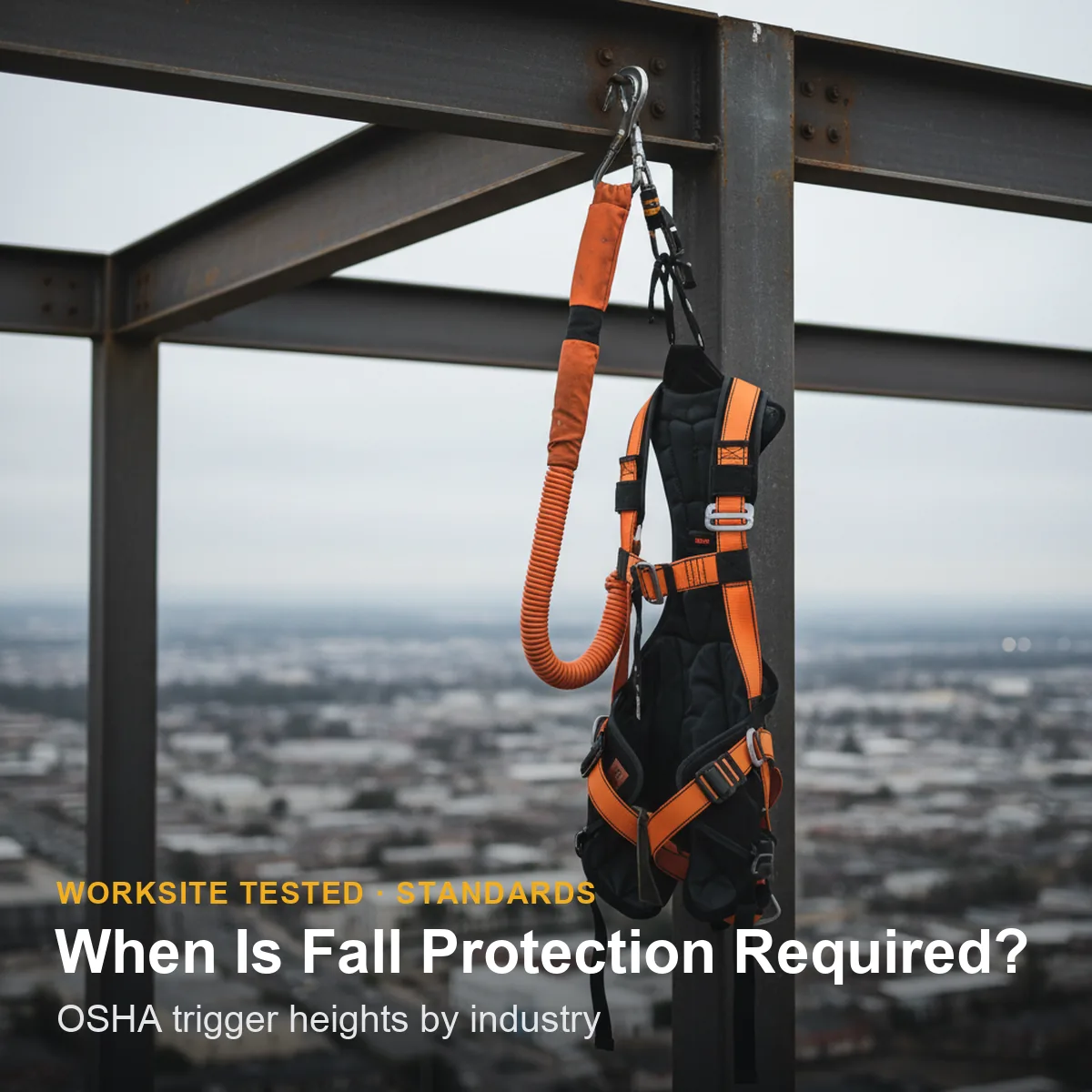
Short answer: it depends on your industry. OSHA sets four core trigger heights — 4 feet in general industry, 5 feet in shipyards, 6 feet in construction, and 8 feet in longshoring. On top of those, specialty rules kick in for scaffolds (10 feet), steel erection (15 feet), and fixed ladders (24 feet of climb). This guide walks through every one of those numbers and ties each to the exact OSHA regulation, so you can find the rule that applies to your work instead of guessing.
One rule I follow in a safety category: every number here traces back to OSHA's own text. Fall protection is a YMYL topic — the wrong trigger height on a jobsite gets someone hurt or killed. If the standard doesn't say it, I don't say it, and I cite the CFR section for each figure so you can check it yourself.
Key Takeaways
- Four core trigger heights, four industries. Per OSHA: fall protection is required at 4 feet in general industry, 5 feet in shipyards, 6 feet in construction, and 8 feet in longshoring operations (osha.gov/fall-protection).
- Construction and general industry are governed by different rulebooks. Construction falls under 29 CFR Part 1926 (Subpart M, 1926.501) with a 6-foot trigger; general industry falls under 29 CFR Part 1910 (Subpart D, 1910.28) with a 4-foot trigger. Same fall, different number, because the standards were written for different work.
- Protection can be required below the trigger height. In general industry, a worker over dangerous equipment must be protected even at less than 4 feet above it (29 CFR 1910.28(b)(6)(i)).
- Specialty triggers override the core numbers. Scaffolds at 10 feet (1926.451(g)(1)), steel erection at 15 feet (1926.760(a)(1)), and fixed ladders at a 24-foot climb (1926.1053(a)(19)) each have their own trigger.
- OSHA's hierarchy of controls comes first. Eliminate the hazard, then engineer it out (guardrails), and use personal protective equipment — a harness and lanyard — as the last resort, not the first (osha.gov/safety-management/hazard-prevention).
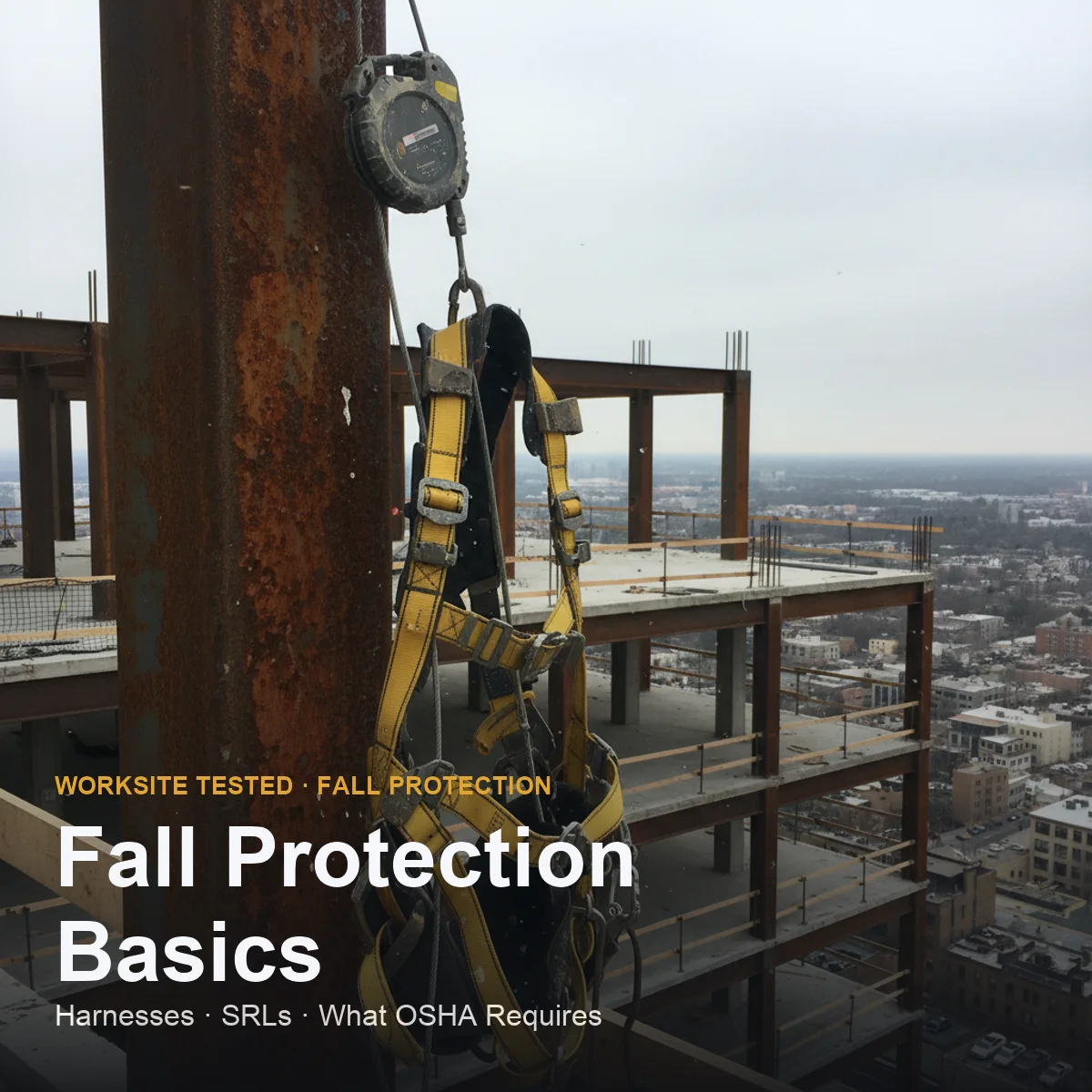
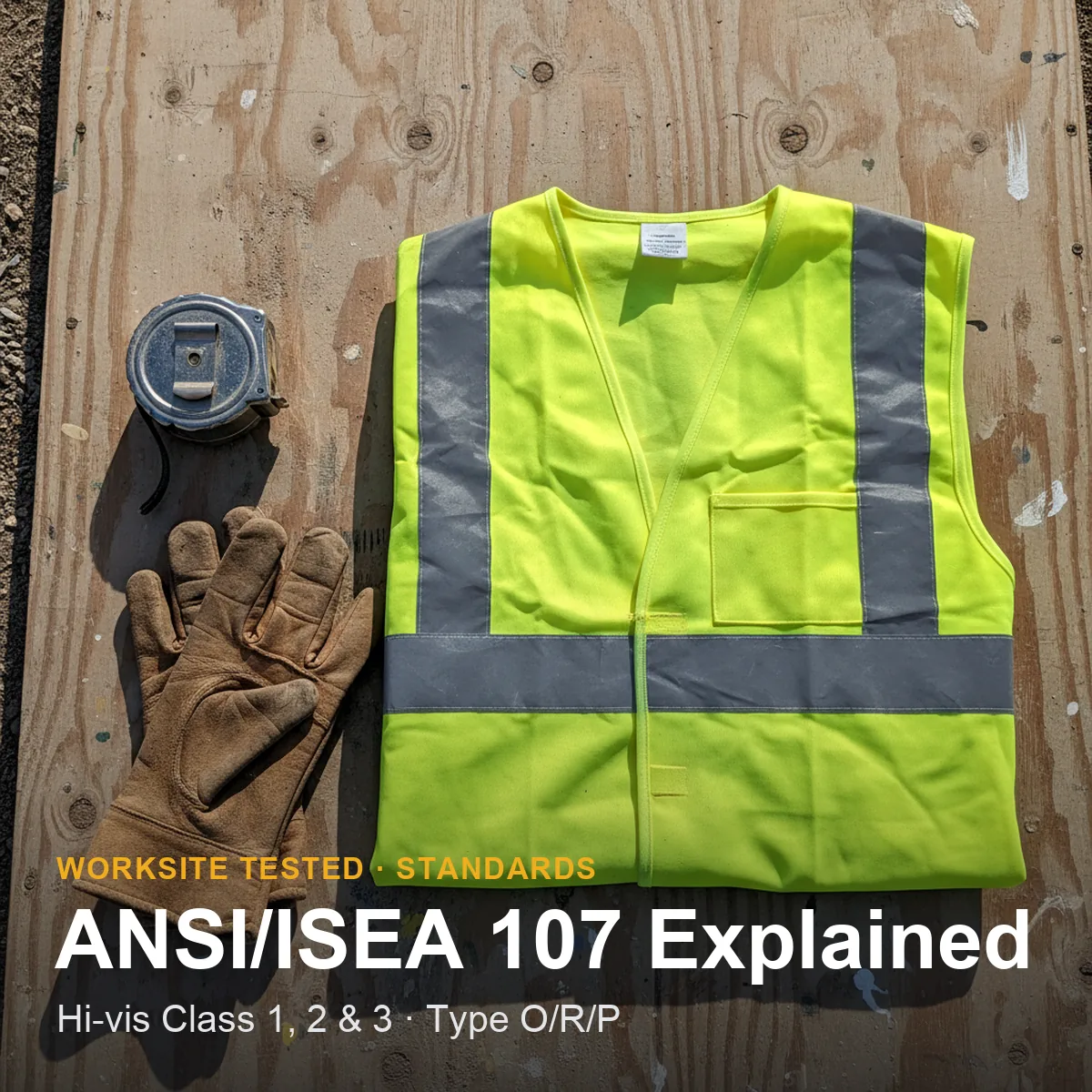
- Internal links: Fall protection basics | Best full-body harnesses | ANSI/ISEA 107 hi-vis classes
What OSHA requires, in one paragraph
OSHA's Fall Protection overview puts it plainly: employers "must set up the work place to prevent employees from falling off of overhead platforms, elevated work stations or into holes in the floor and walls." The concrete measures it lists include: "Guard every floor hole into which a worker can accidentally walk," "Provide a guard rail and toe-board around every elevated open sided platform, floor or runway," and "Select and provide required personal protective equipment at no cost to workers." The height at which those obligations kick in is what varies by industry.
The single sentence that anchors everything below comes straight from OSHA: fall protection must be provided "at elevations of four feet in general industry workplaces, five feet in shipyards, six feet in the construction industry and eight feet in longshoring operations." Source: OSHA Fall Protection.
OSHA fall-protection trigger heights at a glance
Seven triggers cover almost every situation you'll run into. The four core industry numbers, plus three specialty rules for scaffolds, steel erection, and fixed ladders. Find your work in the "Applies to" column and read across.
| Trigger | Height | Standard (CFR) | Applies to |
|---|---|---|---|
| General industry | 4 ft (1.2 m) | 29 CFR 1910.28(b)(1)(i) | Walking-working surfaces with an unprotected side or edge; also holes, dockboards, runways, and hoist areas 4 ft or more above a lower level. |
| Shipyards | 5 ft | 29 CFR 1915 (eTool) | Workers exposed to fall hazards at elevations of more than 5 feet, or over water. |
| Construction | 6 ft (1.8 m) | 29 CFR 1926.501(b)(1) | Unprotected sides and edges, leading edges, hoist areas, holes, ramps, roofing, wall openings, residential work, and 6 ft deep excavations. |
| Longshoring | 8 ft (2.44 m) | 29 CFR 1918.2 | Working within 3 feet of the unprotected edge of a work surface 8 feet or more above the adjoining surface. |
| Scaffolds | 10 ft (3.1 m) | 29 CFR 1926.451(g)(1) | Any employee on a scaffold more than 10 feet above a lower level. |
| Steel erection | 15 ft (4.6 m) | 29 CFR 1926.760(a)(1) | Steel-erection work on a surface with an unprotected side or edge more than 15 feet above a lower level. |
| Fixed ladders (construction) | 24 ft (7.3 m) | 29 CFR 1926.1053(a)(19) | Where the total climb equals or exceeds 24 feet: ladder safety device, self-retracting lifeline with rest platforms, or cage/well with multiple sections. |
Sources: OSHA Fall Protection; 29 CFR 1910.28; 29 CFR 1926.501; 29 CFR 1918.2; 29 CFR 1926.451; 29 CFR 1926.760; 29 CFR 1926.1053.
Construction: 6 feet (29 CFR 1926.501)
If you work construction, the number you memorize is 6 feet. The core rule reads: "Each employee on a walking/working surface (horizontal and vertical surface) with an unprotected side or edge which is 6 feet (1.8 m) or more above a lower level shall be protected from falling by the use of guardrail systems, safety net systems, or personal fall arrest systems" (1926.501(b)(1)).
That same 6-foot (1.8 m) trigger runs through nearly all of Subpart M. It applies to leading edges (1926.501(b)(2)(i)), hoist areas (1926.501(b)(3) — guardrail or PFAS), holes more than 6 ft (1926.501(b)(4)(i) — PFAS, covers, or guardrails), ramps and runways (1926.501(b)(6) — guardrails), roofing and low-slope roofs (1926.501(b)(10)), wall openings (1926.501(b)(14)), residential construction (1926.501(b)(13)), and walking/working surfaces generally (1926.501(b)(15)). Excavations get their own line: employees at the edge of an excavation 6 feet or more in depth must be protected by guardrail systems, fences, barricades, or covers (1926.501(b)(7)(ii)).
The practical takeaway: on a construction site, if you are 6 feet or more above any lower level — or standing at the edge of a 6-foot-deep excavation — you need a system. Source: 29 CFR 1926.501.
General industry: 4 feet (29 CFR 1910.28)
General industry — think manufacturing, warehousing, maintenance, utilities — uses a lower trigger: 4 feet. Employers must protect each employee on a walking-working surface with an unprotected side or edge that is 4 feet (1.2 m) or more above a lower level, using guardrail systems, safety net systems, or personal fall protection systems (1910.28(b)(1)(i)).
The 4-foot rule also covers holes 4 ft or more (1910.28(b)(3)(i) — covers, guardrails, travel restraint, or PFAS), dockboards 4 ft or more (1910.28(b)(4)(i) — guardrail or handrails), runways and similar walkways 4 ft or more (1910.28(b)(5)(i) — guardrail), and hoist areas 4 ft or more (1910.28(b)(2)(i) — guardrail, PFAS, or travel restraint).
OSHA's walking-working-surfaces rule also built in flexibility: "The final rule allows employers to protect workers from falls by choosing from a range of accepted fall protection systems, including personal fall protection systems." For work on unprotected sides and edges 4 feet or more above a lower level — a residential roof is OSHA's own example — a guardrail, safety net, or personal fall protection system is required. Sources: 29 CFR 1910.28; OSHA Walking-Working Surfaces FAQ.
The exception: any height over dangerous equipment
Here's the rule people miss. In general industry, height alone doesn't decide it. Even below the 4-foot trigger, protection is required when you're working over dangerous equipment: "Each employee less than 4 feet (1.2 m) above dangerous equipment is protected from falling into or onto the dangerous equipment by a guardrail system or a travel restraint system" (1910.28(b)(6)(i)). At 4 feet or more above dangerous equipment, the options expand to guardrails, safety nets, travel restraint, or personal fall arrest systems (1910.28(b)(6)(ii)). If there's a vat, an auger, a conveyor, or anything that can injure you below, the fall distance stops being the deciding factor. Source: 29 CFR 1910.28.
Shipyards: 5 feet (29 CFR 1915)
Shipyard employment sits between general industry and construction at 5 feet. OSHA's Shipyard Employment eTool states it directly: "When workers are exposed to fall hazards while working at elevations of more than five feet, or over water, fall protection is required." Note the "or over water" clause — the water hazard triggers protection independent of height. The applicable standards include 29 CFR 1915.71, 1915.73, 1915.77, 1915.159 (personal fall arrest systems), and 1915.160 (positioning device systems). OSHA's Shipbreaking eTool repeats the same 5-foot-or-over-water rule. Sources: OSHA Shipyard Employment eTool; OSHA Shipbreaking eTool.
Longshoring: 8 feet (29 CFR 1918.2)
Longshoring — marine cargo handling — carries the highest core trigger at 8 feet. OSHA's definitions section spells out what counts: a "fall hazard" is defined, among other situations, as "whenever employees are working within three feet (.91 m) of the unprotected edge of a work surface that is 8 feet or more (2.44 m) above the adjoining surface" (1918.2). Two conditions have to line up — you're within 3 feet of the edge, and that edge is 8 feet or more above the surface below. Source: 29 CFR 1918.2.
Specialty triggers: scaffolds, steel erection, and ladders
Beyond the four core industry numbers, three activities carry their own trigger heights that override the general construction 6-foot rule.
Scaffolds: 10 feet (29 CFR 1926.451(g)(1))
"Each employee on a scaffold more than 10 feet (3.1 m) above a lower level shall be protected from falling to that lower level." The required system depends on scaffold type: personal fall arrest systems for boatswains' chairs, needle beam, and ladder jack scaffolds; both PFAS and guardrails for single- or two-point adjustable suspension scaffolds; guardrails for others. Source: 29 CFR 1926.451.
Steel erection: 15 feet (29 CFR 1926.760)
Steel erection gets a higher trigger because of the nature of connecting work. Each employee engaged in a steel-erection activity on a walking/working surface with an unprotected side or edge more than 15 feet (4.6 m) above a lower level must be protected by guardrail systems, safety net systems, personal fall arrest systems, positioning device systems, or fall restraint systems (1926.760(a)(1)).
Connectors have their own graduated rule. At heights over 15 feet and up to 30 feet above a lower level, a connector must be provided with a personal fall arrest system, positioning device system, or fall restraint system and wear the equipment necessary to be tied off — or be provided with other means of protection (1926.760(b)). Connectors and controlled decking zone workers must be protected from falls of more than two stories or 30 feet (9.1 m), whichever is less. Source: 29 CFR 1926.760.
Fixed ladders: 24 feet of climb (29 CFR 1926.1053)
Fixed ladders in construction trigger at a 24-foot climb. Where the total length of a climb equals or exceeds 24 feet (7.3 m), fixed ladders must be equipped with a ladder safety device; or self-retracting lifelines and rest platforms at intervals not to exceed 150 feet (45.7 m); or a cage or well plus multiple ladder sections (1926.1053(a)(19)). Cages, wells, ladder safety devices, or self-retracting lifelines are also required where the climb is less than 24 feet but the top of the ladder is more than 24 feet above lower levels (1926.1053(a)(18)). Source: 29 CFR 1926.1053.
Before you reach for a harness: the hierarchy of controls
Trigger heights tell you when you need protection. The hierarchy of controls tells you which kind to reach for first — and a harness is the last resort, not the first. OSHA ranks controls from most to least effective:
- Elimination — physically remove the hazard (do the work at ground level, prefabricate on the deck).
- Substitution — replace the hazard with something less dangerous.
- Engineering controls — isolate people from the hazard, e.g. guardrails.
- Administrative controls — change the way people work (plans, sequencing, training).
- PPE — protect the worker with personal protective equipment, e.g. a harness, lanyard, and lifeline.
OSHA's guidance is to select controls "according to a hierarchy that emphasizes engineering solutions (including elimination or substitution) first... and finally personal protective equipment." In practice that means: a guardrail beats a harness every time, because a guardrail protects everyone passively without depending on a worker to clip in correctly. Reach for the personal fall arrest system when guardrails, nets, or restraint aren't feasible. Source: OSHA Hazard Prevention and Control.
What the systems have to do once you pick one
Choosing a system is only half of it — OSHA also sets performance minimums for the hardware. A few of the numbers worth knowing:
- Guardrails (construction): the top edge of the top rail must be 42 inches (1.1 m), plus or minus 3 inches (8 cm), above the walking/working level (1926.502(b)(1)).
- Personal fall arrest systems (construction): a PFAS must be rigged so an employee can neither free fall more than 6 feet (1.8 m) (1926.502(d)(16)(iii)) nor contact a lower level, and it must bring the worker to a complete stop while limiting maximum deceleration distance to 3.5 feet (1.07 m) (1926.502(d)(16)(iv)).
- Safety nets (construction): nets must be installed as close as practicable under the work surface, but never more than 30 feet (9.1 m) below it (1926.502(c)(1)); each mesh opening must not exceed 36 square inches (230 cm²) nor be longer than 6 inches (15 cm) on any side (1926.502(c)(7)).
- PFAS free fall (general industry): a personal fall arrest system must be rigged so the employee cannot free fall more than 6 feet (1.8 m) or contact a lower level (1910.140(d)(2)(ii)).
Two related systems get confused with fall arrest. A travel restraint system is "a combination of an anchorage, anchorage connector, lanyard (or other means of connection), and body support that an employer uses to eliminate the possibility of an employee going over the edge of a walking-working surface" — it stops you before you can fall. A positioning system supports a worker on an elevated vertical surface with both hands free (1910.140(b)). Neither is a substitute for fall arrest where a fall is possible. Sources: 29 CFR 1926.502; 29 CFR 1910.140.
For the deeper dive on how a personal fall arrest system is built and inspected, see fall protection basics, and for picking the harness itself, our guide to the best full-body harnesses.
Frequently Asked Questions
At what height does OSHA require fall protection?
It depends on the industry. OSHA sets the trigger at 4 feet in general industry (29 CFR 1910.28), 5 feet in shipyards, 6 feet in construction (29 CFR 1926.501), and 8 feet in longshoring (29 CFR 1918.2). Specialty triggers also apply: scaffolds at 10 feet (1926.451(g)(1)) and steel erection at 15 feet (1926.760(a)(1)).
Why is the construction fall-protection height (6 ft) different from general industry (4 ft)?
They are governed by different OSHA standards written for different work. General industry falls under 29 CFR Part 1910 (Subpart D, 1910.28) with a 4-foot trigger, while construction falls under 29 CFR Part 1926 (Subpart M, 1926.501) with a 6-foot trigger. OSHA's overview page confirms both numbers.
Is fall protection ever required below the normal trigger height?
Yes. In general industry, any employee working over dangerous equipment must be protected even at less than 4 feet above it, using a guardrail or travel restraint system (29 CFR 1910.28(b)(6)(i)). At 4 feet or more above dangerous equipment, guardrails, safety nets, travel restraint, or personal fall arrest systems are required (1910.28(b)(6)(ii)).
When is a harness (personal fall arrest system) required instead of guardrails?
OSHA's hierarchy of controls favors eliminating the hazard, then engineering controls like guardrails, before relying on PPE. A personal fall arrest system is used where guardrails or other passive protection are infeasible. A construction PFAS must limit free fall to no more than 6 feet and bring the worker to a complete stop within 3.5 feet of deceleration distance (29 CFR 1926.502(d)(16)).
At what height do fixed ladders need fall protection?
In construction, when the total length of a climb equals or exceeds 24 feet, a fixed ladder must have a ladder safety device, a self-retracting lifeline with rest platforms, or a cage/well with multiple ladder sections (29 CFR 1926.1053(a)(19)). Protection is also required when the climb is under 24 feet but the ladder top is more than 24 feet above lower levels (1926.1053(a)(18)).
What counts as a fall hazard in longshoring?
OSHA defines a fall hazard in longshoring as, among other situations, working within three feet of the unprotected edge of a work surface that is 8 feet or more above the adjoining surface (29 CFR 1918.2).
How high do guardrails have to be under OSHA?
For construction, the top edge of a guardrail's top rail must be 42 inches (plus or minus 3 inches) above the walking/working level (29 CFR 1926.502(b)(1)).
What is the hierarchy of controls for fall hazards?
OSHA ranks controls from most to least effective: elimination (remove the hazard), substitution, engineering controls (e.g. guardrails), administrative controls (plans and training), and PPE (harnesses and lanyards) as the last resort (osha.gov/safety-management/hazard-prevention).
About this guide
Marco Reyes is a bilingual (EN/es-US) field reviewer who covers PPE and workwear for WorkSite Tested from the tradesman's side of the job. This is an editorial standards explainer, not a product roundup — every trigger height and performance number in it comes straight from OSHA's own regulatory text, fetched July 1, 2026, and is attributed to the specific CFR section or OSHA page it appears in: the Fall Protection overview (osha.gov/fall-protection), 29 CFR 1910.28 and 1910.140 (general industry), 1926.501, 1926.502, 1926.451, 1926.760, and 1926.1053 (construction), 1918.2 (longshoring), the Shipyard Employment and Shipbreaking eTools (shipyards), the Walking-Working Surfaces FAQ, and the Hazard Prevention hierarchy of controls. No number was inferred, rounded, or borrowed from a secondary source. Standard requirements are attributed to the standard, never to a product listing, and where OSHA leaves a system choice to the employer we say so. Our gear guides earn an affiliate commission on purchases made through their links, at no extra cost to you, and we never rank by commission over safety. See our affiliate disclosure.