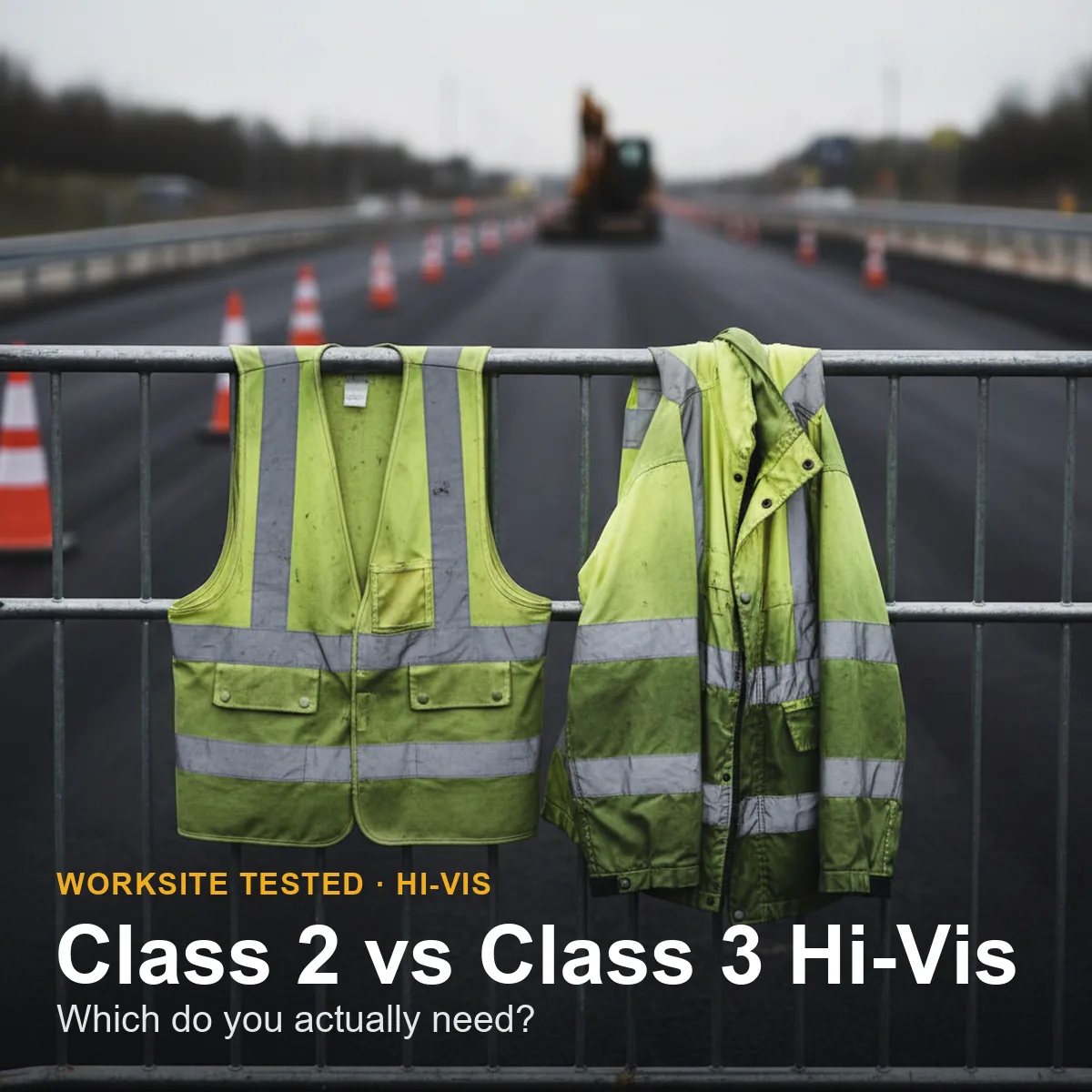

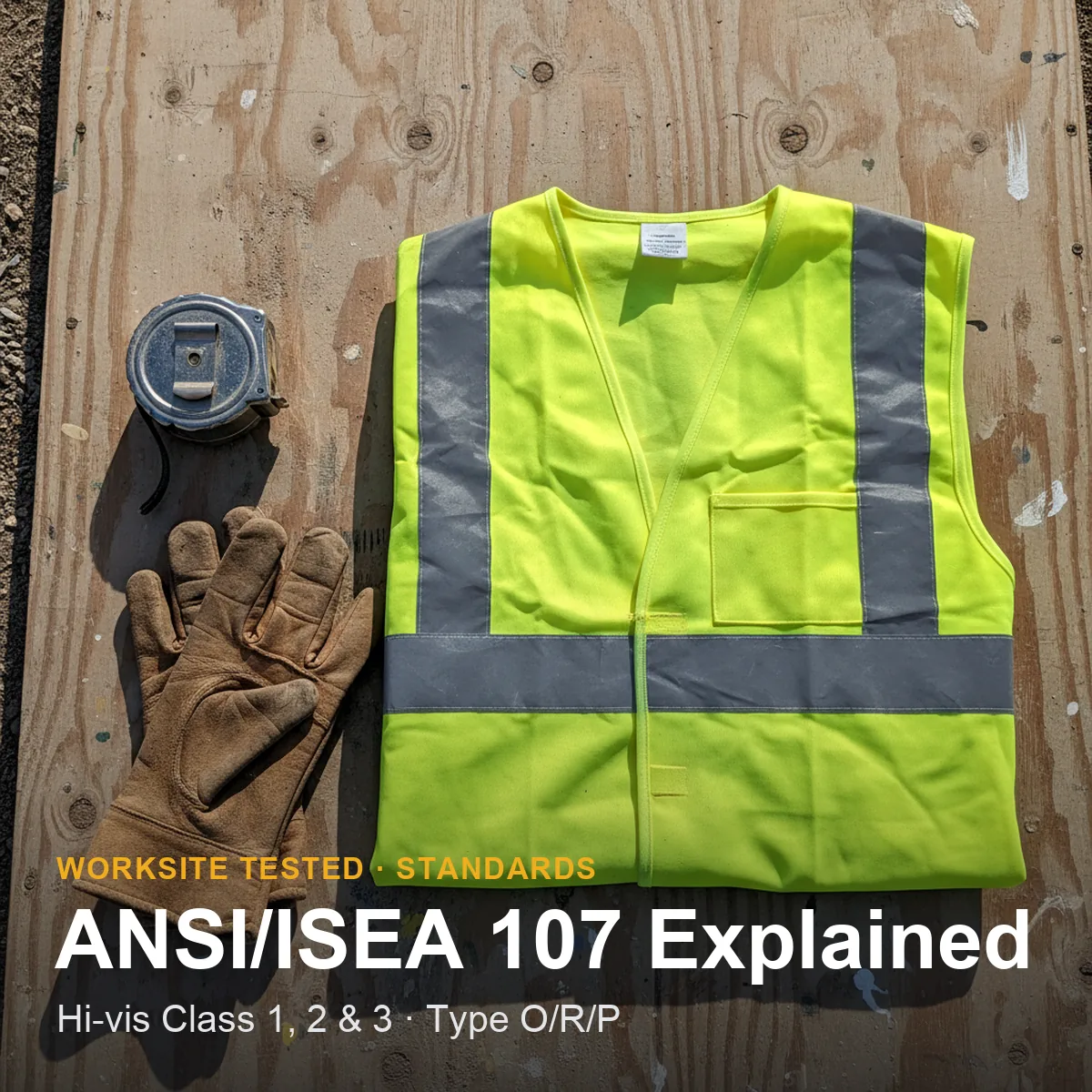
Short answer: Class tells you how much hi-vis material a garment carries, and Type tells you what environment it is built for. If you work inside the right-of-way of a public highway, federal rule 23 CFR Part 634 sets Class 2 as the legal floor and Class 3 for higher-speed or low-light work; off-road work that never sees public traffic can drop to Class 1 (Type O). This page is the standard, in plain trade language — no product ranking, just the numbers and rules so you can read a vest tag and know what you are actually wearing.
One rule I follow in a safety category: every number here traces back to a published source — ANSI/ISEA 107 summaries, the federal regulation text, and OSHA's own interpretation letter, all linked inline. Where I quote a product tag I say "the listing states." Where I cite the standard or the law, that is the independent rule. When you are done here, the two pages this explainer feeds — our best hi-vis safety vests and best hi-vis jackets guides — show real garments at each class.
Key Takeaways
- Class = amount of hi-vis material. Higher class means more fluorescent background fabric and more retroreflective tape, which buys you longer detection and identification distance and greater conspicuity (Ergodyne).
- Type = the work environment. Type O (Off-Road) is Class 1 only, for workers not exposed to public-roadway traffic. Type R (Roadway) and Type P (Public Safety) cover roadway and responder work and come in Class 2 or 3 (Ergodyne).
- Class 1 (Type O): minimum 217 in² fluorescent background + 155 in² retroreflective, with bands at least 1 inch wide; for controlled, sub-25-mph settings (Traffic Safety Store).
- Class 2: minimum 201 in² retroreflective material (775 in² background for Type R per the Traffic Safety Store). This is the federal minimum on highways (LegalClarity).
- Class 3 (Type R): minimum 1,240 in² background + 310 in² retroreflective — the most material in the standard, for high-speed, low-light, highest-risk work (Traffic Safety Store).
- The federal floor is Class 2. 23 CFR Part 634 requires HVSA meeting Performance Class 2 or 3 for workers exposed to traffic or construction equipment in a Federal-aid highway right-of-way (23 CFR 634).
- Internal links: Best hi-vis safety vests | Best hi-vis jackets | All standards explainers
What ANSI/ISEA 107 actually is
ANSI/ISEA 107 is the U.S. national consensus standard for high-visibility safety apparel — HVSA, what most of us just call hi-vis. It does two jobs. It sorts garments into a Performance Class (1, 2, or 3) based on how much high-visibility background fabric and retroreflective material they carry, and it sorts them into a Type (O, R, or P) based on the work environment and traffic exposure they are built for (Traffic Safety Store).
The Class number is the part that matters most when you are checking whether a garment is legal for your job. It is the minimum visibility performance of the garment — how much fluorescent background and retroreflective tape it has and how it performs in daylight and low light. The higher the class, the longer the distance at which a driver or equipment operator can detect you, identify you as a person, and react (Ergodyne). That detection-distance difference is the whole point — it is not about looking "more official," it is about giving the driver more seconds.
Type O, R, and P: matching the garment to the job
Before you worry about class, figure out your Type — it narrows the field fast.
- Type O (Off-Road): a single Performance Class — Class 1 — for off-road use, often indoors or in more controlled environments where workers are not exposed to public-roadway traffic (Ergodyne). Think warehouse yards, parking facilities, equipment yards behind a fence.
- Type R (Roadway): offered in Class 2 and Class 3, designed for use on roadways and in temporary traffic control zones. Per Reflective Apparel's summary, Type R "roadway" garments are "suitable to meet the MUTCD regulatory requirements" (Reflective Apparel). This is the everyday road-construction and flagging category.
- Type P (Public Safety): offered in Class 2 and Class 3, this adds a compliance option for emergency and incident responders and law enforcement. Class 3 Type P requires more background and retroreflective material than Class 2 Type P (Ergodyne). Type P trims the background fabric so it can be worn over a duty belt and gear.
So Type O is Class 1 only. Type R and Type P each come in Class 2 or Class 3. There is no "Type O Class 3" or "Type R Class 1" — the combinations are fixed by the standard.
Class 1, 2, and 3: the square-inch minimums
Here is where the standard gets specific. The class is defined by minimum areas of two materials: fluorescent background (the lime or orange fabric that does the work in daylight) and retroreflective material (the silver tape that throws headlights back at the driver at night). The figures below are minimums from the published summaries — a compliant garment meets or exceeds them.
- Class 1 (Type O): minimum 217 in² fluorescent background and minimum 155 in² retroreflective material, with retroreflective bands at least 1 inch wide. Intended for controlled environments with vehicle/equipment speeds under about 25 mph (Traffic Safety Store).
- Class 2: minimum 201 in² retroreflective material. For background fabric the numbers split by Type: the Traffic Safety Store lists a Type R Class 2 garment at a minimum 775 in² of fluorescent background, and LegalClarity's table lists Type R Class 2 as 775 in² background / 201 in² retroreflective and Type P Class 2 as 450 in² background / 201 in² retroreflective (LegalClarity).
- Class 3 (Type R): minimum 1,240 in² fluorescent background and minimum 310 in² retroreflective material — the highest material requirement in the standard. Type P Class 3 requires 775 in² background / 310 in² retroreflective per LegalClarity's table (Traffic Safety Store; LegalClarity).
One thing the area numbers tell you that the class number alone hides: Type P garments at the same class carry less background fabric than Type R (450 vs 775 in² at Class 2; 775 vs 1,240 in² at Class 3 per LegalClarity). That is deliberate — Type P is cut to leave room for a responder's belt and gear, not to shortchange you on visibility.
Class E and the "compliant ensemble" rule
You will see hi-vis pants and shorts marked Class E. Class E is a supplemental item, not a standalone class. LegalClarity's material table lists Class E items at a minimum 465 in² background and 109 in² retroreflective material — but a Class E item is worn with a Class 2 or Class 3 garment and does not by itself provide a compliant ensemble (LegalClarity). In practice: a hi-vis pant alone does not make you compliant. Pair Class E pants with a Class 2 or 3 top and you get the combined visibility the standard is after.
Hi-vis classes by the numbers
| Class / Type | Min. background | Min. retroreflective | Built for | Example garment (listing-stated) |
|---|---|---|---|---|
| Class 1 (Type O) | 217 in² | 155 in² | Off-road, no public traffic, under ~25 mph | — |
| Class 2 (Type R) | 775 in² | 201 in² | Roadways / temporary traffic control zones | MCR Safety VCL2ML, SURVL; Ergodyne 8260 FRHL |
| Class 2 (Type P) | 450 in² | 201 in² | Emergency / incident responders, law enforcement | — |
| Class 3 (Type R) | 1,240 in² | 310 in² | High-speed, low-light, highest-risk roadway work | Radians RW30 3Z1Y jacket |
| Class 3 (Type P) | 775 in² | 310 in² | Responders needing Class 3 visibility over gear | — |
| Class E (supplemental) | 465 in² | 109 in² | Hi-vis pants/shorts — worn WITH a Class 2 or 3 top | — |
The "example garment" column lists items whose listings state the class shown — that is a manufacturer claim on the product page, not an independent re-test by me. The four garments are detailed below as illustrations of what each class looks like on a real tag; this is a standards page, so I am not ranking them.
What each class looks like on a real garment
To make the classes concrete, here are four in-stock garments at Working Person's Store as of June 28, 2026, each carrying a different class/format on its listing. Specs and prices are pulled straight from the product pages — where a listing does not state the Type, I say so instead of guessing it.
Class 2 mesh vest — MCR Safety VCL2ML ($9.99)
The listing states ANSI/ISEA 107 Type R Class 2 compliant. It is a fluorescent lime polyester mesh with black trim, 2-inch silver reflective stripes, three pockets, and a hook-and-loop front. This is the bare-bones Class 2 that meets the federal highway floor — no FR, no breakaway, just compliant conspicuity at a price you can keep a box of in the truck.
Check price at Working Person's Store
Class 2 solid vest with pockets — MCR Safety SURVL ($17.99)
The listing states ANSI/ISEA 107-2015 Class 2, Type R compliant. It steps up from mesh to a fluorescent lime solid polyester, adds 3-inch orange/silver stripes, six pockets, a zipper front, and a mic-tab holder. Same Class 2 visibility floor as the mesh, but the solid fabric and pocket count suit a foreman or anyone carrying a radio and a notebook all shift.
Check price at Working Person's Store
Class 2 flame-resistant vest — Ergodyne 8260 FRHL ($89.99)
The listing states Class 2 (the Type is not stated on the page, so I am not assigning one). What makes this one different is the hazard stack: it is a 5.4 oz modacrylic mesh that is flame-resistant and ASTM F1506 rated with a listing-stated ATPV of 5.1 cal/cm². It carries three 2-inch reflective stripes, a side pocket plus a dual pen pocket, and hook-and-loop closures. If you need hi-vis and arc/flame protection — utility, oilfield, some electrical work — a standard polyester vest can melt; this is the kind of garment that exists to solve that. Confirm the F1506/ATPV figure against your own arc-flash requirements; that number is from the listing.
Check price at Working Person's Store
Class 3 hooded rain jacket — Radians RW30 3Z1Y ($84.99)
The listing states ANSI Class 3 (Type not stated on the page). A jacket is the natural home for Class 3 because the sleeves add the background and retroreflective area the standard demands at that level. This one is a 300-denier polyurethane-coated hi-vis oxford, water resistant, with a detachable hood, four pockets (including an upper-chest radio pocket), snap-and-zipper closure, a D-ring pass-through, a vented cape back, adjustable cuffs, and mic tabs. For high-speed roadway work in low light or rain — the exact conditions Class 3 is written for — a jacket like this gets you over the line where a vest alone would not.
Check price at Working Person's Store
What the law actually requires: 23 CFR 634, OSHA, and MUTCD
The class you can legally wear is not just a buying preference on a highway job — it is written into federal regulation.
23 CFR Part 634 (Worker Visibility) defines high-visibility safety apparel as "personal protective safety clothing that is intended to provide conspicuity during both daytime and nighttime usage, and that meets the Performance Class 2 or 3 requirements of the ANSI/ISEA 107-2004 publication." That single sentence is why Class 2 is the federal minimum in the highway right-of-way (govinfo, 23 CFR 634).
The rule on who has to wear it is just as plain. 23 CFR 634.3 requires that "All workers within the right-of-way of a Federal-aid highway who are exposed either to traffic (vehicles using the highway for purposes of travel) or to construction equipment within the work area shall wear high-visibility safety apparel" (govinfo, 23 CFR 634.3). Note that it is not only traffic — exposure to construction equipment inside the work area triggers it too.
As for OSHA: there is no single OSHA hi-vis apparel standard, but OSHA's interpretation letter states that high-visibility apparel "is required under the General Duty Clause to protect employees exposed to the danger of being struck by public and construction traffic while working in highway/road construction work zones," citing Section 5(a)(1) of the OSH Act (29 U.S.C. 654(a)(1)) and referencing the FHWA Worker Visibility Rule (23 CFR Part 634) and the MUTCD (OSHA standard interpretation, 2009-08-05). So even where the FHWA rule does not directly reach, OSHA can cite an employer under the General Duty Clause for the same hazard.
Frequently Asked Questions
What is the difference between ANSI 107 Class 1, Class 2, and Class 3?
Class is the amount of hi-vis material a garment carries. Class 1 (Type O only) requires a minimum 217 in² background / 155 in² retroreflective and is for off-road, low-speed (under ~25 mph) settings. Class 2 requires a minimum 201 in² retroreflective (775 in² background for Type R per Traffic Safety Store) for roadway and complex-background work. Class 3 (Type R) requires the most — a minimum 1,240 in² background / 310 in² retroreflective — for high-speed, low-light, and highest-risk conditions (Traffic Safety Store; LegalClarity).
What do Type O, Type R, and Type P mean in ANSI/ISEA 107?
Type O (Off-Road) is for workers not exposed to public-roadway traffic and is offered only as Class 1. Type R (Roadway) is for workers on or alongside public roadways and temporary traffic control zones and comes in Class 2 or 3. Type P (Public Safety) is for emergency/incident responders and law enforcement and comes in Class 2 or 3 (Ergodyne; LegalClarity).
What ANSI 107 class is required to work in a highway work zone?
Federal rule 23 CFR Part 634 requires high-visibility safety apparel meeting ANSI/ISEA 107 Performance Class 2 or 3 for all workers within the right-of-way of a Federal-aid highway who are exposed to traffic or construction equipment — making Class 2 the federal minimum (23 CFR 634, govinfo).
Does OSHA require high-visibility clothing?
OSHA does not have a single hi-vis apparel standard but has stated that high-visibility apparel is required under the General Duty Clause, Section 5(a)(1) of the OSH Act, to protect employees from being struck by traffic in highway/road construction work zones, and it references the FHWA Worker Visibility Rule (23 CFR 634) and the MUTCD (OSHA standard interpretation, 2009-08-05).
How much reflective material does a Class 2 vest need?
A Class 2 garment must carry a minimum of 201 square inches of retroreflective material, plus background fabric (775 in² for Type R per the Traffic Safety Store) (Traffic Safety Store; LegalClarity).
What is the minimum hi-vis class for a Type O off-road vest?
Type O is offered only at Class 1, which requires a minimum 217 in² of fluorescent background material and 155 in² of retroreflective material; it is meant for off-road use where workers are not exposed to public-roadway traffic (Ergodyne; Traffic Safety Store).
Why Trust This Guide
This guide is written and reviewed by Marco Reyes, an independent work-safety-gear reviewer. Every recommendation is built on the published standards (ASTM F2413 for footwear, ANSI Z359 for fall protection, ANSI/ISEA 107 for hi-vis, the OSHA rules), manufacturer spec sheets and product labels, hands-on handling, and what tradespeople actually report — and we tell you when a number is a manufacturer claim versus an independent standard, and when a garment is rated for one hazard but not another. The four example garments here were pulled live from Working Person's Store on June 28, 2026, and confirmed in stock, with class and specs read off each listing. We earn an affiliate commission if you buy through some of our links, at no extra cost to you, and we never rank by commission over safety — see our affiliate disclosure.