
Short answer: for a documented near-traffic vest at an economy price, the Ergodyne GloWear 8217BA is the one I reach for — its listing spells out the full spec you actually want ("ANSI/ISEA 107-2020, Type R, Class 2") and states five breakaway closures, at $15.65. If you want that same 5-point tear-away from a retailer WorkSite Tested links directly, the Radians SV4 GM at $14.00 is the value play. And if your hazard assessment requires flame resistance, the OccuNomix LUX-SSBRPFR ($115.00, inherently FR modacrylic, ASTM F1506, ATPV 5.5 cal/cm2, 5-point) is the vest to spec. Everything in this guide was pulled live from the listed retailer on July 1, 2026, with prices and specs read straight off each product page.
One rule I follow in a safety category: every number here traces back to the actual listing. If the page doesn't say it, I don't say it — so when a vest's listing states "Class 2" but never states a Type (R or O), I tell you that instead of assuming Type R. I'll flag where a page uses the word "breakaway" without giving a point count, and I'll tell you when the cheapest vest is genuinely enough. I don't rank by commission — several of these vests are sold at specialist retailers I earn nothing on, and one of them is my top pick.
Key Takeaways
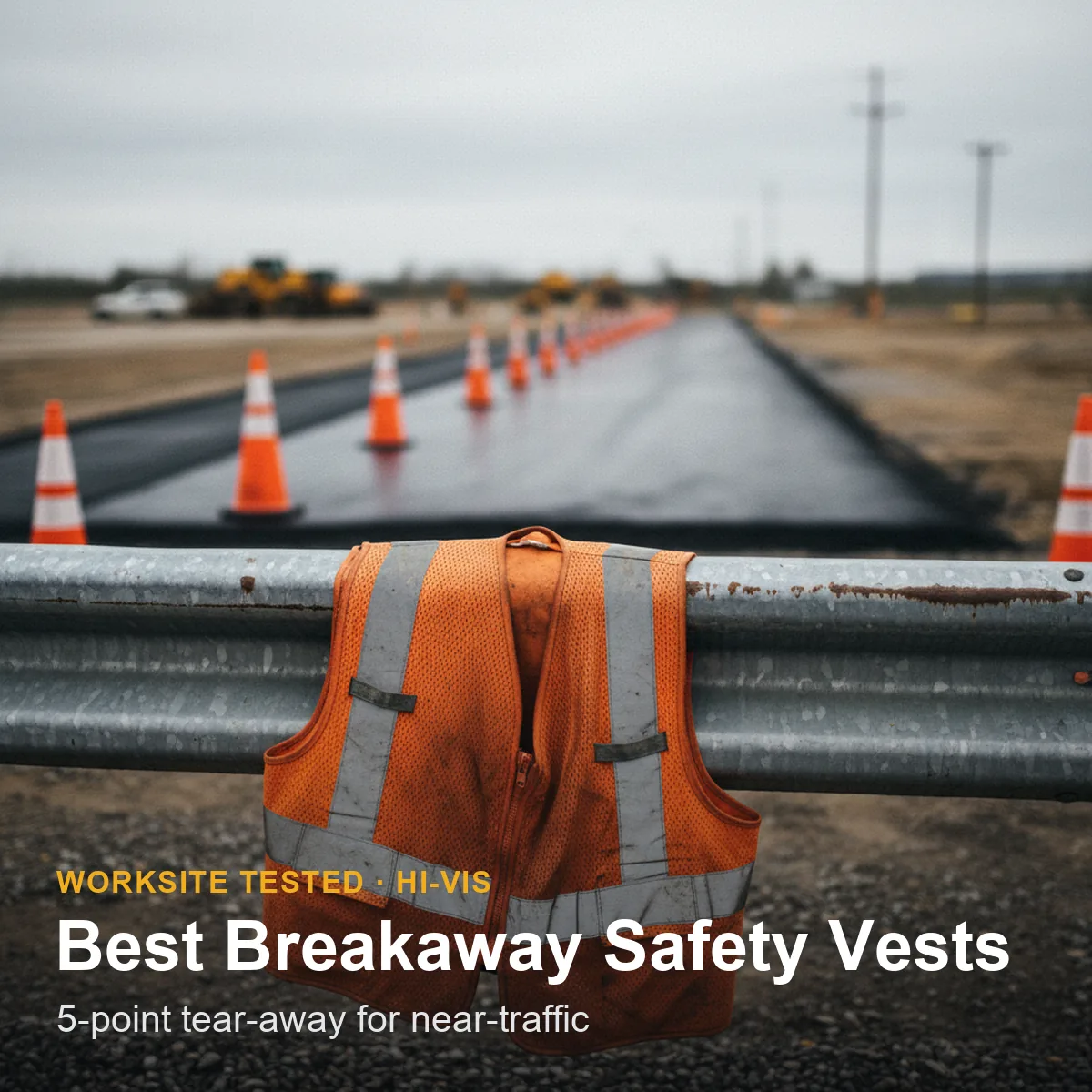
- A breakaway vest is a snag-release vest. It uses hook-and-loop closures — commonly a 5-point design at the shoulders, sides, and front — engineered to detach if the vest is caught by a passing vehicle or moving machinery, letting the wearer break free. Ergodyne describes it as "Five hook & loop closures designed to break away if caught on equipment or machinery." I ground the snag-release rationale only in the fetched product listings — I don't overstate injury prevention beyond what the pages say.
- "Class 2" alone is not "Type R." Per NIOSH/CDC on ANSI/ISEA 107-2020, Type R = roadway and temporary traffic control garments and Class is a performance level. Only three of these vests state a Type (the two Ergodyne GloWear models and the Kishigo/Pyramex listings) — the Radians, CAT, Tingley, and OccuNomix listings state Class 2 without a Type. Near roadway traffic you generally want a stated Type R.
- Point count varies — capture the exact number. Most listings here describe a 5-point breakaway (both shoulders, both sides, front): Radians SV4, CAT 1322029, OccuNomix LUX-SSBRPFR, and Ergodyne's 8217BA (five closures). But the Ergodyne 8216BA lists four breakaway closures (shoulders and sides only). More release points generally mean the vest can separate more readily if caught.
- Federal roadway rule. 23 CFR 634.3 requires all workers within the right-of-way of a Federal-aid highway who are exposed to traffic or construction equipment to wear high-visibility apparel meeting ANSI/ISEA 107 Performance Class 2 or 3 (634.2). A breakaway vest that is certified Class 2 or 3 satisfies the visibility requirement; the tear-away feature is an added snag-release benefit, not a separate legal mandate.
- FR is a separate need. Only the Tingley V81522 and OccuNomix LUX-SSBRPFR add flame resistance (both Class 2, both ASTM F1506), and both cost far more ($88.99 and $115.00) than a poly-mesh breakaway vest. Buy FR only if your hazard assessment calls for it.
- Internal links: Best hi-vis safety vests | Class 2 vs Class 3 hi-vis | ANSI/ISEA 107 classes explained
What a breakaway (tear-away) vest actually is
A breakaway vest replaces sewn-shut seams with hook-and-loop closures at key points so the garment can come apart under load. Ergodyne's product page describes the mechanism directly: "Five hook & loop closures designed to break away if caught on equipment or machinery." The safety idea, per the manufacturer and retailer listings, is that if the vest is snagged by a passing vehicle, a piece of moving machinery, or a rotating part, the closures release and the wearer breaks free instead of being pulled in or dragged.
That is the entire value proposition — and it's worth being precise about. I ground the snag-release rationale only in the fetched product listings; I don't claim a specific injury-reduction statistic, because the listings don't state one. What the pages do support is this: a breakaway vest is designed to separate under a snag load, and a standard sewn vest is not.
"ANSI/ISEA 107 Type R, Class 2" — what the label means near traffic
The single most useful thing you can read off a hi-vis listing is the Type and Class. Here's what they mean, sourced to the standards references, not to memory:
- Type R (roadway): Per NIOSH/CDC on ANSI/ISEA 107-2020, the standard identifies garment types by expected use setting — off-road (Type O), roadway and temporary traffic control (Type R), or public safety (Type P). Per Ergodyne's standards explainer, Type R garments are designed for use on roadways and offer Performance Class 2 and Class 3, chosen for construction and transportation applications because of the high presence of moving vehicles and equipment; Type R carries more fluorescent background material and additional retroreflective square inches than Type O.
- Class 2: Per Reflective Apparel Inc, Class 2 apparel requires at least 775 square inches of fluorescent background material and a minimum of 201 square inches of retroreflective material, and suits environments with traffic speeds typically between 25 and 50 mph.
- Class 3: By the same source, Class 3 requires a minimum of 1,240 square inches of background material and at least 310 square inches of retroreflective material, and is for high-risk areas with fast-moving traffic exceeding 50 mph. Note: none of the breakaway vests in this roundup are Class 3 — every one states Class 2.
Why this matters for these vests: only the two Ergodyne GloWear models state the full "ANSI/ISEA 107-2020, Type R, Class 2," and the Kishigo and Pyramex listings state "Type R Class 2" / "ANSI Type R Class 2." The Radians, CAT, Tingley, and OccuNomix listings state Class 2 but do not state a Type. If your DOT contract or site spec specifically requires a stated Type R, that distinction can decide the purchase — so I flag it on every pick.
All 8 breakaway vests at a glance
| Vest | Standard stated on listing | Breakaway points | Flame-resistant | Retailer | Price |
|---|---|---|---|---|---|
| Radians SV4 GM | Class 2 (Type not stated) | 5-point (shoulders, sides, front) | No | Working Person's Store | $14.00 |
| CAT 1322029 407 | ANSI Class 2 / EN471 Class 2 (Type not stated) | 5-point (shoulders, front, sides) | No | Working Person's Store | $39.99 |
| Tingley V81522 | ANSI/ISEA 107 Class 2 (Type not stated) | Front, shoulders, sides (count not stated) | Yes (ASTM F1506, NFPA 70E HRC 1) | Working Person's Store | $88.99 |
| OccuNomix LUX-SSBRPFR | Class 2 (Type not stated) | 5-point (shoulders, sides, front) | Yes (ASTM F1506, ATPV 5.5 cal/cm2) | Working Person's Store | $115.00 |
| Ergodyne GloWear 8217BA | ANSI/ISEA 107-2020, Type R, Class 2 | 5 hook & loop closures (locations not itemized) | No | Ergodyne (brand site) | $15.65 |
| Ergodyne GloWear 8216BA | ANSI/ISEA 107-2020, Type R, Class 2 | 4 closures (shoulders and sides) | No | Ergodyne (brand site) | $20.85 |
| Kishigo 1174 | Type R Class 2 | Shoulders, sides & front (count not stated) | No | Full Source | $23.19 |
| Pyramex RVHL25 | ANSI Type R Class 2 | Shoulders, sides & front (count not stated) | No | Safety Vests and More | $10.97 (mixed stock) |
1. Ergodyne GloWear 8217BA — best-documented breakaway vest
This is the vest whose listing does the least guessing. It states ANSI/ISEA 107-2020, Type R, Class 2 — the exact spec you want near roadway traffic — and it states five hook-and-loop closures designed to break away if caught on equipment or machinery. Ergodyne's own description of the mechanism is the cleanest in the category and the one I quote throughout this guide: "Five hook & loop closures designed to break away if caught on equipment or machinery." You also get 3.3 oz polyester mesh, 2-inch reflective solid tape, and 3 pockets, at $15.65. The only thing to know is that it's sold on Ergodyne's own brand site, not Working Person's Store — so the link below is a plain reference link, and I earn nothing on it.
- Grab these if: you want the roadway spec (Type R, Class 2, 2020 revision) stated plainly on the listing, five breakaway points, and pockets — at an economy price.
- Skip if: you need flame resistance, or you specifically want to buy from Working Person's Store.
See it at Ergodyne (brand site) →
2. Radians SV4 GM — best value 5-point from Working Person's Store
If you'd rather buy through a retailer WorkSite Tested links directly, the Radians SV4 GM is the value play at $14.00. It's a genuine 5-point breakaway — hook-and-loop release in the shoulders, sides, and front closure — in 100% polyester solid knit and mesh with 2-inch silver reflective tape. The one honest caveat is the same one I give on several vests here: the listing calls it a "Class 2 breakaway safety vest" but does not state a Type. For most crews that's fine, but if your spec sheet requires a stated Type R roadway designation, confirm before you buy. For the price, a real 5-point tear-away is hard to beat.
- Grab these if: you want a true 5-point breakaway at the lowest price from Working Person's Store.
- Skip if: your contract requires a stated Type R on the label, or you need FR.
Check price at Working Person's Store →
3. OccuNomix LUX-SSBRPFR — best FR breakaway vest
When your hazard assessment calls for flame resistance, this is the vest to spec. It's inherently flame-resistant modacrylic — meaning the FR is in the fiber, not a wash-out treatment — meeting ASTM F1506 with a stated ATPV of 5.5 cal/cm2, and it carries a full 5-point breakaway with break-away panels at the shoulders, sides, and front plus a Velcro (hook-and-loop) front closure. Its listing states a Class 2 safety rating (Type not stated). At $115.00 it's the priciest vest in this roundup, and it should only be on your list if you actually need FR — a general roadway crew is paying for protection it doesn't need. But for utility, electrical, or arc-flash-adjacent work, a 5-point tear-away with a stated ATPV is exactly the combination you want.
- Grab these if: your hazard assessment requires flame resistance and you want a 5-point breakaway with a stated ATPV (5.5 cal/cm2).
- Skip if: you don't need FR — you're paying a large premium for protection a standard crew doesn't require.
Check price at Working Person's Store →
4. Tingley V81522 — best FR vest built on fabric
The other flame-resistant option, and a different construction philosophy: the V81522 is a 55% modacrylic / 45% cotton blend that meets ASTM F1506 and NFPA 70E Hazard Risk Category 1, with breakaway hook-and-loop closures at the front, shoulders, and sides. One honest note — the listing describes the closure locations but does not give an explicit point count, so I won't label it "5-point" the way I do the OccuNomix. Its listing states ANSI/ISEA 107 Class 2 (Type not stated). At $88.99 it's less than the OccuNomix but still well above a poly-mesh vest. The modacrylic/cotton blend tends to feel more like a garment and less like a plastic shell, which crews who wear FR all shift tend to prefer.
- Grab these if: you want an FR breakaway vest in a modacrylic/cotton fabric (ASTM F1506, NFPA 70E HRC 1) at a lower price than the OccuNomix.
- Skip if: you need a stated breakaway point count on the label, or you want a stated ATPV number (this listing doesn't give one).
Check price at Working Person's Store →
5. Ergodyne GloWear 8216BA — best breakaway vest with an ID badge holder
Same documentation as the 8217BA — ANSI/ISEA 107-2020, Type R, Class 2, 3.3 oz mesh, 2-inch reflective tape — but with one difference the listing is explicit about: four breakaway closures, located on the shoulders and sides, with no front breakaway called out. That's a real distinction. A vest that also releases at the front can separate more readily if it's caught from the front; a four-point shoulders-and-sides design is still a genuine tear-away but has fewer release points. What you get in exchange is an ID badge holder, which is why plants and access-controlled sites choose this one. At $20.85 from Ergodyne's brand site (plain reference link — I earn nothing on it), it's a smart pick if you badge in daily, as long as you know you're at four points, not five.
- Grab these if: you badge in daily and want the documented Type R, Class 2 spec with an ID holder.
- Skip if: you specifically want a front breakaway / a full 5-point release — this one is four-point (shoulders and sides).
See it at Ergodyne (brand site) →
6. Kishigo 1174 Ultra-Cool — best hot-weather breakaway vest
If you're on a summer road crew, breathability is a real spec, and the Kishigo 1174's Ultra-Cool 100% polyester mesh is built for it. The listing states Type R Class 2 with hook-and-loop breakaway at the shoulders, sides, and front closure — the 5-point layout, though the page doesn't put the number on it. You also get 2-inch-wide VizLite reflective material with a 4.5-inch contrasting color band and three inside pockets. It's stocked at Full Source, a specialist retailer — Working Person's Store doesn't carry Kishigo breakaway vests — so the link below is a plain reference link, not an affiliate link. At $23.19 it's a solid warm-weather roadway choice with a stated Type R.
- Grab these if: you work hot and want an open-weave mesh vest with a stated Type R Class 2 and breakaway shoulders/sides/front.
- Skip if: you want to buy from Working Person's Store (it's not stocked there) or you need FR.
7. CAT 1322029 407 — the brand-name build
The CAT (Caterpillar) name carries weight on a lot of jobsites, and this is a straightforward 5-point breakaway: hook-and-loop closers with crossover plackets on the front shoulders, the front placket, and at the side, in 100% polyester tricot with reflective stripes front and back. The listing states ANSI Class 2 and EN471 Class 2 — no Type designation given. The tricot construction is a heavier, more solid feel than an open-mesh economy vest, which some crews prefer for durability. At $39.99 you're paying for the brand and the build more than for any spec the cheaper vests here don't already have — so buy it if you value the name and the sturdier fabric, not because it's more compliant.
- Grab these if: you want the CAT name and a heavier polyester tricot 5-point breakaway.
- Skip if: you're budget-focused (the Radians is a 5-point for far less) or you need a stated Type R.
Check price at Working Person's Store →
8. Pyramex RVHL25 — cheapest stated-Type-R vest (watch the stock)
At $10.97 this is the lowest-priced vest in the roundup, and it doesn't skimp on the spec that matters: the listing states ANSI TYPE R CLASS 2, with breakaway hook-and-loop at the shoulders, sides, and front closure. It's a hi-vis lightweight polyester mesh with 2-inch silver reflective material, a chest pocket with hook-and-loop closure, an inside pocket, and a reinforced D-ring slot for a badge or radio, in Lime and Orange. The one caveat I'll flag hard: the listing shows mixed stock — some size/color combinations in stock, others out of stock — so confirm your size and color are available before you count on it. It's sold at Safety Vests and More, a specialist retailer (not Working Person's Store), so the link below is a plain reference link.
- Grab these if: you want the lowest price on a stated ANSI Type R Class 2 breakaway vest and your size/color is in stock.
- Skip if: your size/color shows out of stock, or you want to buy from Working Person's Store.
See it at Safety Vests and More →
The law near traffic: 23 CFR 634 and OSHA
Two separate authorities drive when you're required to wear hi-vis near traffic, and a breakaway vest satisfies them the same way any Class 2/3 vest does — the tear-away is a bonus, not a legal requirement of its own.
Federal highway rule (23 CFR Part 634). Per the GPO-authenticated CFR text, 23 CFR 634.3 states verbatim: "All workers within the right-of-way of a Federal-aid highway who are exposed either to traffic (vehicles using the highway for purposes of travel) or to construction equipment within the work area shall wear high-visibility safety apparel." And 23 CFR 634.2 defines that apparel as clothing that provides conspicuity during both daytime and nighttime usage and "meets the Performance Class 2 or 3 requirements of the ANSI/ISEA 107-2004 publication." The purpose (634.1) is "to decrease the likelihood of worker fatalities or injuries caused by motor vehicles and construction vehicles and equipment while working within the right-of-way on Federal-aid highways"; states and other agencies were required to comply no later than November 24, 2008 (634.4 compliance date).
OSHA. Per the OSHA Letter of Interpretation dated 2009-08-05, high-visibility apparel is required under the General Duty Clause (Section 5(a)(1) of the OSH Act) to protect employees from being struck by public and construction traffic in highway/road work zones. For flaggers, 29 CFR 1926.201 requires warning garments conforming to the MUTCD; for excavation work, 29 CFR 1926.651(d) requires employees exposed to public vehicular traffic to be provided with, and wear, warning vests or other suitable garments marked with or made of reflectorized or high-visibility material.
Bottom line: a breakaway vest that is certified Class 2 or 3 meets the visibility requirement. The breakaway feature adds a snag-release safety benefit on top — it does not, on its own, satisfy or replace any legal requirement, and there is no separate "breakaway" mandate in these rules.
Frequently Asked Questions
What is a breakaway (tear-away) safety vest and why use one near traffic?
A breakaway vest uses hook-and-loop closures — commonly a 5-point design at the shoulders, sides, and front closure — engineered to detach if the vest is snagged or caught by a passing vehicle or moving machinery, letting the wearer break free instead of being dragged or pulled in. Ergodyne describes it as "Five hook & loop closures designed to break away if caught on equipment or machinery." Ground the snag-release rationale only in what the product listings say — a breakaway vest is designed to separate under a snag load, but the listings don't state a specific injury-reduction number, and neither will I.
What does "ANSI/ISEA 107 Type R, Class 2" mean on a breakaway vest?
Per NIOSH/CDC and ANSI/ISEA 107-2020, Type R = roadway and temporary traffic control garments (for workers exposed to roadway traffic and moving vehicles or equipment), and Class 2 is a performance class requiring at least 775 square inches of fluorescent background and 201 square inches of retroreflective material (Reflective Apparel Inc). Class 2 suits traffic environments roughly 25–50 mph; Class 3 is for higher-speed, high-risk work. Note that several listings in this guide state only "Class 2" without a Type designation — near roadway traffic you generally want a stated Type R.
Are breakaway safety vests OSHA-compliant / legally required?
Federal 23 CFR 634.3 requires all workers within the right-of-way of a Federal-aid highway who are exposed to traffic or construction equipment to wear high-visibility apparel meeting ANSI/ISEA 107 Performance Class 2 or 3 (634.2). OSHA separately requires hi-vis apparel under the General Duty Clause, 29 CFR 1926.201 (flaggers/MUTCD), and 29 CFR 1926.651(d) (excavation near public traffic). A breakaway vest that is certified Class 2 or 3 satisfies the visibility requirement; the breakaway feature is an added snag-release safety benefit, not a separate legal mandate.
How many breakaway points do these vests have — and does it matter?
Most listings describe a 5-point breakaway (both shoulders, both sides, front) — for example the Radians SV4, CAT 1322029, OccuNomix LUX-SSBRPFR, and Ergodyne's 8217BA (five hook-and-loop closures). Some differ: the Ergodyne 8216BA lists four breakaway closures (shoulders and sides only). More release points generally mean the vest can separate more readily if caught. Capture the exact count and locations from each listing — several pages state "breakaway shoulders, sides & front" without printing an explicit number.
Is there a flame-resistant breakaway vest for utility, oil/gas, or electrical work?
Yes. The Tingley V81522 (55% modacrylic / 45% cotton, ASTM F1506, NFPA 70E HRC 1) and the OccuNomix LUX-SSBRPFR (inherently flame-resistant modacrylic, ASTM F1506, ATPV 5.5 cal/cm2) are both Class 2 breakaway vests that add flame resistance. They cost more ($88.99 and $115.00 respectively) than standard polyester-mesh breakaway vests. Only rely on the FR ratings that appear on each listing — buy FR only if your hazard assessment calls for it.
What's the cheapest reliable Class 2 breakaway vest?
Among these listings, the Pyramex RVHL25 ($10.97, ANSI Type R Class 2, breakaway shoulders/sides/front) and the Radians SV4 GM ($14.00, Class 2, 5-point) are the lowest-cost. Note the Pyramex listing shows mixed stock across sizes and colors, so confirm your size and color are available. These are basic polyester-mesh economy vests — FR and multi-pocket models cost significantly more.
Why Trust This Guide
Marco Reyes is a bilingual (EN/es-US) field reviewer who covers PPE and workwear for WorkSite Tested from the tradesman's side of the job. Every product in this guide was pulled live from its retailer on July 1, 2026 — Working Person's Store for the Radians, CAT, Tingley, and OccuNomix vests; the Ergodyne brand site for the two GloWear models; Full Source for the Kishigo; and Safety Vests and More for the Pyramex — and verified against the listing specs, with no numbers inferred, extrapolated, or borrowed from other models. Where a listing states "Class 2" but not a Type, or describes a breakaway without a point count, I say so instead of assuming. ANSI/ISEA 107 and roadway-rule facts were cross-checked against the GPO-authenticated 23 CFR 634 text, an OSHA Letter of Interpretation (2009-08-05), NIOSH/CDC PPE-Info, and manufacturer/retailer standards explainers (Ergodyne, Reflective Apparel Inc). We earn an affiliate commission on purchases made through the Working Person's Store links, at no extra cost to you; links to Ergodyne, Full Source, and Safety Vests and More are plain reference links we earn nothing on. Ranking is by protection and near-traffic fit — never by commission. See our affiliate disclosure.