
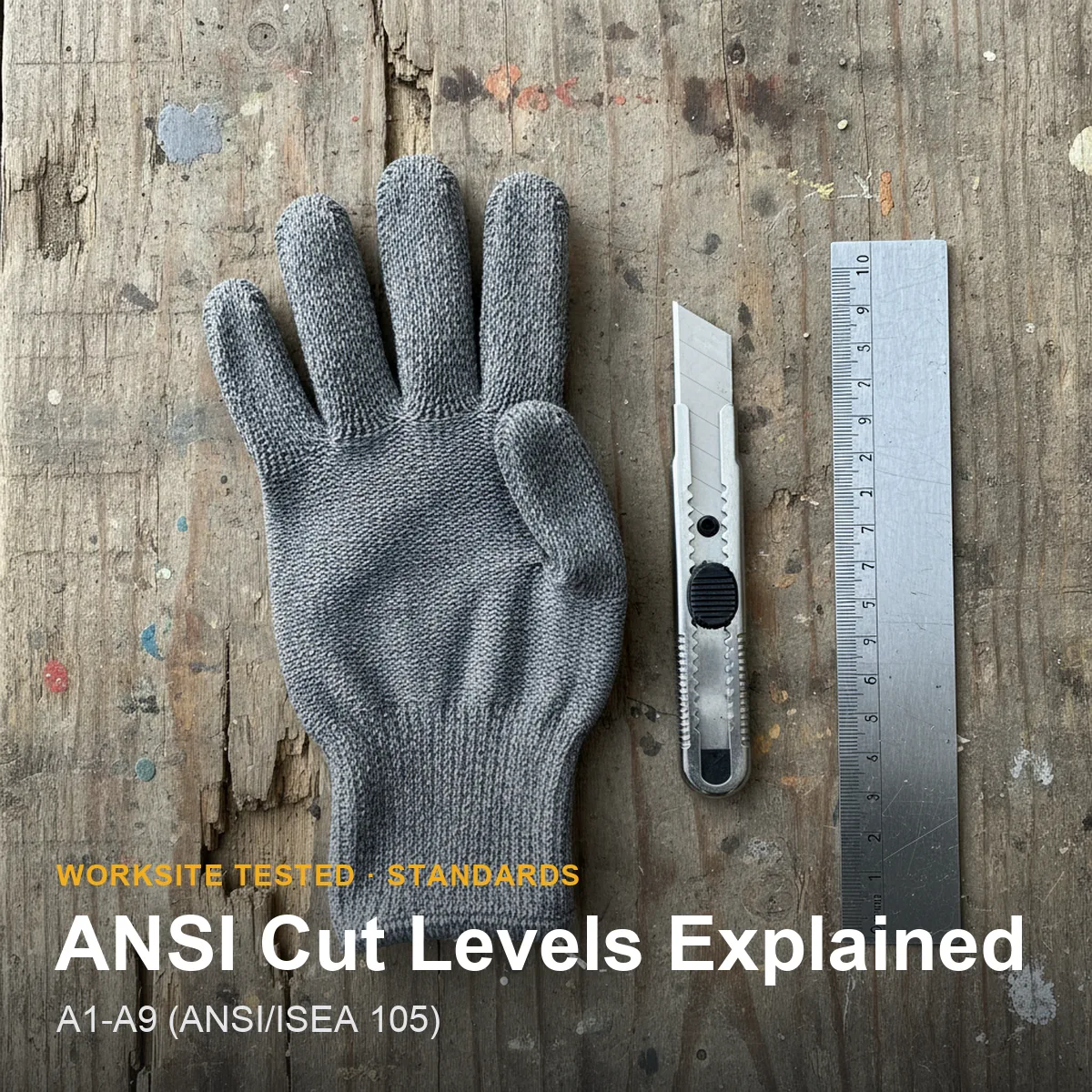
Short answer: ANSI/ISEA 105 rates cut resistance on a nine-level scale, A1 through A9, and the level is set by one number — the grams of force it takes to cut through the material in the TDM-100 test. A1 is the lightest (200–499 grams); A9 is the top of the scale (6000+ grams). What does an ANSI cut level mean? It's the gram-force a straight blade needs to slice through the glove or sleeve material in a standardized lab test — higher number, more cut protection. If you only remember one thing: match the gram band to your actual hazard, and don't confuse the ANSI "A" scale with the EN 388 "A–F" scale — they use different numbers.
This is a standards explainer, not a product roundup. There's nothing to buy on this page. What you'll get is how the scale is built, what each level actually means in grams, the jobs each level is used for, and how to read an ANSI level against an EN 388 letter so a glove's two markings don't trip you up. Every number here traces back to a cited source — I don't assign a level or a gram figure the sources don't state.
Key Takeaways
- Nine levels, set by grams. ANSI/ISEA 105 grades cut resistance A1 through A9 using the TDM-100 test. The scale spans roughly 200 to 6000 grams (about 2 to 60 Newtons). Source: HexArmor.
- The bands are fixed. A1 200–499 g, A2 500–999 g, A3 1000–1499 g, A4 1500–2199 g, A5 2200–2999 g, A6 3000–3999 g, A7 4000–4999 g, A8 5000–5999 g, A9 6000+ g. Confirmed across Mechanix, Pro Tool Reviews, and WC Safety.
- A3 and below vs A4 and up is the real dividing line. A3 and below suit lower-risk handling (hardware assembly, warehouse, general handling); A4 and above are for higher laceration risk — glass sheets, metal press work, heavy assembly. Source: Ansell.
- The test is the TDM-100. A straight blade is drawn in ~20 mm paths under increasing gram loads; a fresh blade each cut; the grams at cut-through, averaged, set the level. Source: HexArmor.
- ANSI ≠ EN 388. EN 388:2016 reports cut on an A–F letter scale in Newtons. Because the bands differ, treat any ANSI↔EN mapping as a comparison, not a certification — and note that ANSI A7–A9 all collapse into EN "F." Source: BAC Tactical.
- Related standards reading: ASTM F2413 boot markings explained | ANSI/ISEA 107 hi-vis classes | hand protection guides
What are the ANSI cut levels A1 to A9?
ANSI/ISEA 105 is the US standard for classifying the cut resistance of hand-protection products — gloves and sleeves. It grades cut resistance on nine levels, A1 (lowest) through A9 (highest). The level is decided by a single measured value: how many grams of force it takes to cut through the material. The full scale runs roughly 200 to 6000 grams, which works out to about 2 to 60 Newtons of force. Source: HexArmor.
Here's the thing most spec sheets don't spell out: the "A" prefix is what tells you this is the ANSI scale. If you see a letter with no "A" — a bare "C" or "F" — that's almost certainly the EN 388 European scale, which is a different measurement entirely. More on that mix-up below. For now, when a glove is marked A4, that means it landed in the 1500–2199 gram band on the ANSI cut test.
How is the ANSI cut level measured? The TDM-100 test
The level comes from the TDM-100 (tomodynamometer) test. In plain terms: a straight razor blade is drawn across the material in a path of about 20 mm under a known weight (in grams). The direction is the same for every cut. A new straight blade is used for each pass, and the grams-load is increased until the blade cuts through. The gram figure at the point of cut-through is recorded, the tests are averaged, and that averaged gram value — anywhere from 200 to 6000 grams — sets the final level. Sources: HexArmor, HexArmor.
Two details worth knowing. First, a fresh blade every cut matters, because high-cut materials (steel yarns, fiberglass) dull a blade fast — reusing a blade would understate the material's real cut resistance. Second, the "grams" you see quoted are grams of force, not the weight of the glove — a common point of confusion. A9 needing "6000+ grams" means it takes over six kilograms of blade load to slice through, not that the glove weighs six kilos.
The nine levels, in grams
Here's the full ANSI/ISEA 105 scale. Every gram band below is stated by the cited sources — I'm not rounding, interpolating, or inventing any of them.
| Level | Grams (cut-through force) | Protection band |
|---|---|---|
| A1 | 200–499 g | Light cut hazards |
| A2 | 500–999 g | Light to medium cut protection |
| A3 | 1000–1499 g | Light to medium cut protection |
| A4 | 1500–2199 g | Medium cut hazards |
| A5 | 2200–2999 g | Medium to heavy cut protection |
| A6 | 3000–3999 g | High cut hazards |
| A7 | 4000–4999 g | High cut hazards |
| A8 | 5000–5999 g | High cut protection |
| A9 | 6000+ g | Highest cut protection |
Per-level gram bands: Mechanix. Independent confirmation of the full A1–A9 bands: Pro Tool Reviews. Second independent confirmation of the minimum thresholds by level: WC Safety.
Which cut level does my job actually need?
The single most useful line to draw is between A3 and below and A4 and above. A3 and below give good cut protection for lower-risk work — hardware assembly, warehouse work, general handling. A4 and above are for jobs where the cut/laceration risk is much higher, like handling glass sheets, metal press work, or heavy assembly. Source: Ansell.
Drilling into specific levels and the jobs they're used for:
- A2 (500–999 g) — pulp/paper handling and automotive assembly, where sharp part edges are the main hazard.
- A4 (1500–2199 g) — the baseline for metal fabrication and handling, and also used in food prep/processing, packaging, appliance manufacturing, light glass handling, drywall, electrical, and HVAC work.
- A5 (2200–2999 g) — increased protection for tradesmen handling sharp metals and blades daily.
- A9 (6000+ g) — the maximum cut level, the top of the scale, for the highest-hazard cut work.
Source for the level-by-job context: Pro Tool Reviews.
One honest caveat a lot of buying guides skip: cut level is only cut resistance. It says nothing about puncture, abrasion, heat, or grip. A high A-level glove that's slick in oil, or that a needle goes straight through, can still get you hurt. Pick the cut level for the laceration hazard, then check the glove's other properties separately for the rest of the job.
How do ANSI cut levels compare to EN 388?
This is where people get burned, because gloves sold in the US often carry both markings. EN 388:2016 (the European standard) reports cut resistance from the ISO 13997 / TDM test on a letter scale A–F, measured in Newtons — not the ANSI grams scale. The EN 388 letter bands are: A = 2–4.9 N (204–508 g), B = 5–9.9 N (509–1019 g), C = 10–14.9 N (1020–1529 g), D = 15–21.9 N (1530–2242 g), E = 22–29.9 N (2243–3058 g), F = 30+ N (3059+ g). Source: Mechanix. Independent confirmation of the same Newton letter bands: BAC Tactical.
| ANSI cut level | Approx. EN 388 letter |
|---|---|
| A1–A2 | A / B |
| A3–A4 | C / D |
| A5–A6 | E / F |
| A7–A9 | F (EN scale stops at F) |
Read that last row carefully. Because the EN scale tops out at F, everything from ANSI A6 up through A9 can carry the same EN "F." So a single EN F rating can hide anything from ANSI A6 to A9 — always check the ANSI level too if you need to tell those apart. Treat the whole table as a comparison, not a certification, because the two standards use different Newton bands. Source: BAC Tactical.
A concrete example of a real dual-marked material: CutPRO's Cut-Tex PRO fabric is rated ANSI/ISEA 2016 Level A5 and EN 388:2016 cut resistance (TDM-100 test) Level E — a clean illustration of how an ANSI A5 material lines up with EN 388 E. Source: CutPRO.
The EN 388 Coupe test vs the TDM test
EN 388 actually reports cut two ways, and this trips people up on a European glove label. The older Coupe (Coup) test scores cut from 0 to 5 by counting how many rotations a circular blade needs to cut through the material. The problem: high-cut-resistance materials (steel, fiberglass) dull that circular blade, which makes the Coupe result unreliable. For those materials the ISO 13997 / TDM test (the letter A–F, in Newtons) is mandatory — either in addition to, or instead of, the Coupe test. If you see an "X" in the Coupe position on a glove label, that means the Coupe test was not applicable. Source: Ergodyne.
Practical translation: on a high-cut glove, trust the TDM letter (A–F), not the old 0–5 Coupe number — and if the Coupe slot reads "X," that's expected, not a defect.
Frequently Asked Questions
What are the ANSI cut levels A1 to A9?
ANSI/ISEA 105 grades cut resistance on nine levels, A1 (lightest) to A9 (highest), based on the grams of force needed to cut through the material in the TDM-100 test. A1 covers 200–499 grams and A9 covers 6000+ grams; the intermediate bands are A2 500–999 g, A3 1000–1499 g, A4 1500–2199 g, A5 2200–2999 g, A6 3000–3999 g, A7 4000–4999 g, and A8 5000–5999 g. Sources: Mechanix and Pro Tool Reviews.
How is the ANSI cut level measured?
It's measured with the TDM-100 (tomodynamometer) test: a straight blade is drawn in roughly 20 mm paths across the material under increasing gram loads, with a fresh blade each pass, until it cuts through. The grams recorded at cut-through — averaged across the tests, over a 200 to 6000 gram range — set the level. Source: HexArmor.
What does an A2 cut level mean, and what jobs use it?
A2 means 500–999 grams of cut-through force — light-to-medium cut protection. In practice it suits lower-risk tasks such as pulp and paper handling and automotive assembly, where sharp part edges are the main hazard. Source: Mechanix for the gram band, Pro Tool Reviews for the job context.
Is an A4 or A5 glove enough for metal handling?
A4 (1500–2199 g) is the common baseline for metal fabrication and handling, and also covers food processing, packaging, and light glass work; A5 (2200–2999 g) adds protection for tradesmen handling sharp metals and blades daily. Match the exact task to the gram band rather than defaulting to a level. Sources: Mechanix and Pro Tool Reviews.
What is an A9 cut level for?
A9 means 6000+ grams of cut-through force — the top of the ANSI scale and the maximum cut protection, reserved for the highest-hazard cut work. Sources: Mechanix for the gram band, Pro Tool Reviews for it being the top of the scale.
How do ANSI cut levels compare to EN 388?
EN 388:2016 rates cut resistance on a letter scale A–F using the ISO 13997 / TDM test, measured in Newtons. Roughly: ANSI A1–A2 maps to EN A/B, A3–A4 to C/D, A5–A6 to E/F, and A7–A9 all collapse into EN F because the EN scale stops there. Because the Newton bands differ, treat the mapping as a comparison, not a certification, and check the ANSI level under any EN F rating. Sources: BAC Tactical and Mechanix.
What is the difference between the EN 388 Coupe test and the TDM test?
The older Coupe test scores 0–5 by counting the rotations a circular blade needs to cut through, but it dulls on high-cut materials like steel and fiberglass and becomes inaccurate; for those materials the ISO 13997 TDM test (letter A–F, in Newtons) is required. An "X" in the Coupe position means the Coupe test did not apply. Source: Ergodyne.
Why Trust This Guide
This guide is written and reviewed by Marco Reyes, an independent work-safety-gear reviewer. Every recommendation is built on the published standards (ASTM F2413 for footwear, ANSI Z359 for fall protection, ANSI/ISEA 107 for hi-vis, ANSI/ISEA 105 for cut resistance, and the OSHA rules), manufacturer spec sheets and product labels, hands-on handling, and what tradespeople actually report — and we tell you when a number is a manufacturer claim versus an independent standard, and when a glove is rated for one hazard but not another. Product specs referenced here were pulled live from Working Person's Store and the cited standards sources on July 6, 2026. We earn an affiliate commission if you buy through some of our links, at no extra cost to you, and we never rank by commission over safety — see our affiliate disclosure.