
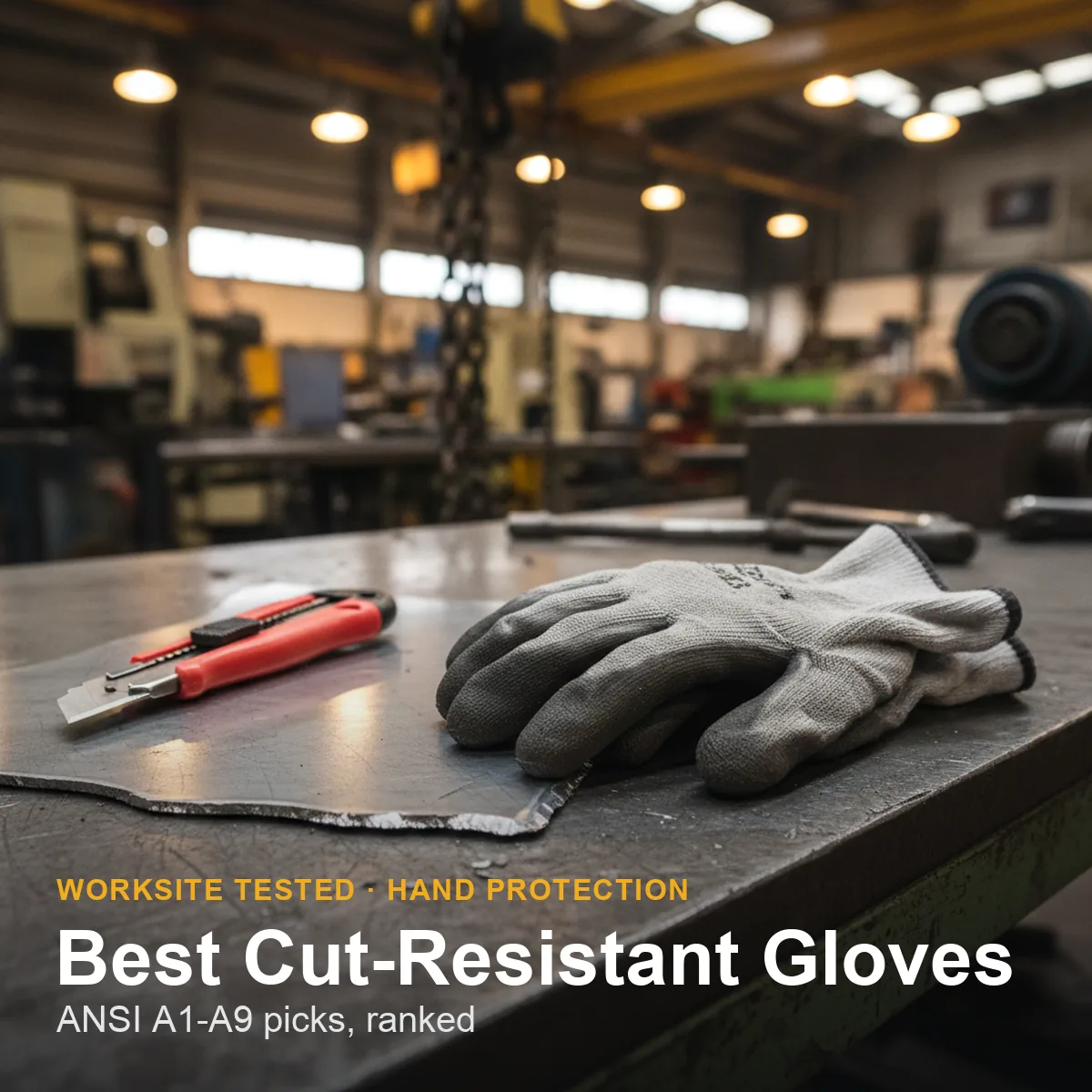
Short answer: for most fabrication and sheet-metal crews the Black Stallion AccuFlex GR5040 HR is the value pick of this group — the listing states ANSI A6 cut plus back-of-hand impact protection for $15.99. If you need a documented A7, the Ergodyne ProFlex 7073 is the specialist choice; for the absolute top of the scale, the Superior TenActiv S21TXUFN lists ANSI A9. And if you are doing light handling on a budget, the Radians RWG550 at $7.50 is plenty of glove. Eight gloves total — the six Working Person's Store picks were pulled live on July 6, 2026 with prices and specs from each listing; the two A7/A9 specialist gloves come from the manufacturers' own spec pages.
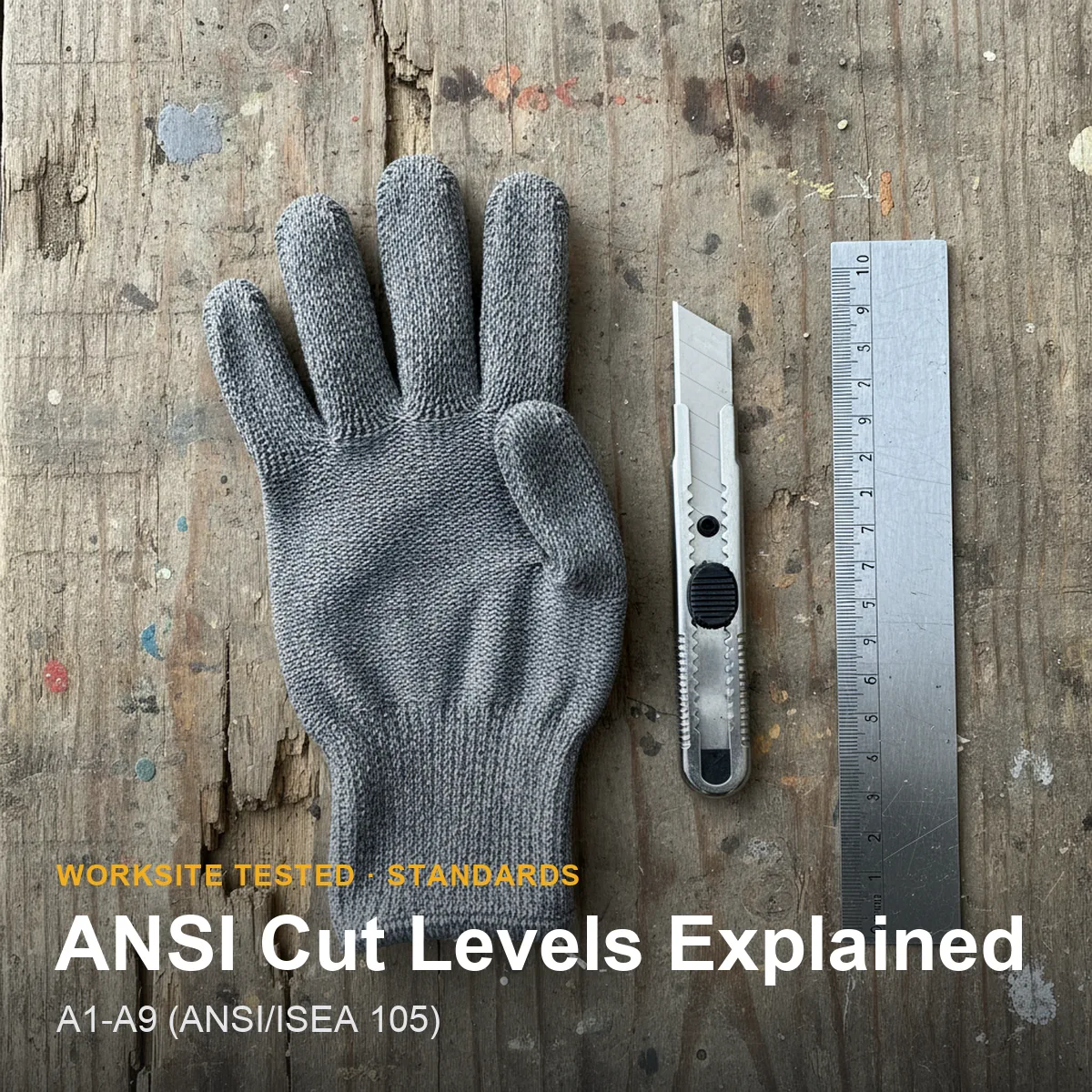
One rule I hold in a safety category: every cut level in here traces back to the page it is stated on. If a listing gives an ANSI number, I use it. If a listing only gives an EN 388 code and no ANSI letter, I say so — I do not convert one into the other or invent a level. And I tell you when a manufacturer's own page disagrees with the retailer (it happens once in this group, on the Ergodyne 812CR6). What does "ANSI A-level" mean on a glove? Under ANSI/ISEA 105-2016, cut resistance is graded A1 through A9 by the grams of force needed to cut through the material on a TDM-100 test machine — A1 is the lowest, A9 the highest.
Key Takeaways
- The ANSI cut scale runs A1 to A9 by grams of force. Per ANSI/ISEA 105-2016, A1 needs at least 200g of force to cut through, then A2 500g, A3 1,000g, A4 1,500g, A5 2,200g, A6 3,000g, A7 4,000g, A8 5,000g, and A9 6,000g and up — measured on a TDM-100 tomodynamometer. Higher number = more force to cut through. (Sources: WC Safety, ATG Glove Solutions.)
- Match the level to the task, not to the highest number. Among these picks the Radians RWG533 lists ANSI cut level 2 (light handling), the Ergodyne 812CR6 lists A3, the Radians RWG603 lists level 5, the Black Stallion GR5040 lists A6, the Ergodyne 7073 lists A7, and the Superior S21TXUFN lists A9. Higher cut levels cost dexterity and money you may not need.
- ANSI and EN 388 are different scales — don't cross-convert. ANSI/ISEA 105 reports one A1–A9 grade in grams of force; EN 388 reports a coupe-test digit plus, for tougher materials, an ISO 13997 result in newtons shown as a letter A–F (that's the trailing letter in a code like 4X42F). A glove can carry both marks. (Source: Ergodyne standards explainer.)
- The shell fiber drives cut protection; the coating drives grip. HPPE, steel/fiberglass blends, tungsten, and engineered yarns like TenActiv carry the cut rating; sandy-nitrile and foam-nitrile coatings grip in oil, while PU/PUD dips give thin dry-grip dexterity. Always read the stated ANSI level rather than guessing from the coating.
- Two listings state an EN 388 code but no ANSI letter. The Radians RWG531 (EN 388:2003 4344) and the Radians RWG550 (EN 388 4342) — if your selection sheet requires a documented ANSI level, those two won't have one.
- For the full standard, see our ANSI cut levels A1–A9 explained guide. Internal links: hand protection guides | standards library.
What ANSI cut levels A1 to A9 actually mean
Every glove in this guide is graded on one of two standards — the American ANSI/ISEA 105 scale, the European EN 388 scale, or both. Here is what those markings mean, verified against the standards facts in the research for this guide:
- ANSI/ISEA 105-2016 (A1–A9): Cut resistance is measured on a TDM-100 tomodynamometer, which draws a standardized blade across the material under increasing gram loads until it cuts through. The grams of force needed sets the level: A1 at least 200g, A2 500g, A3 1,000g, A4 1,500g, A5 2,200g, A6 3,000g, A7 4,000g, A8 5,000g, A9 6,000g and up. Nine levels, low to high. (Sources: WC Safety; ATG Glove Solutions; Ergodyne.)
- EN 388 (the European mechanical-protection standard): It scores cut differently. The Coupe Test handles lower cut-resistant materials, but if the coupe result lands at level 3–5 the ISO 13997 test is required, and that result is measured in newtons and reported on an A–F scale. That is why EN 388 gloves show both a numeric coupe digit and a trailing letter — e.g., EN 388: 4X42F. (Source: Ergodyne standards explainer.)
- Why the two don't convert: ANSI reports one A1–A9 grade in grams of force; EN 388 reports a coupe digit plus an ISO 13997 letter in newtons. They measure with different blades and report in different units, so there is no clean lookup between "A6" and an EN 388 code. A glove that carries both marks was tested to both — read each on its own terms.
For the full breakdown of every level and how to pick one for your job, see our ANSI cut levels A1–A9 explained standards guide.
All 8 cut-resistant gloves at a glance
| Glove | Shell / gauge | Coating | Stated cut rating | Impact (TPR) | Best for | Price |
|---|---|---|---|---|---|---|
| Black Stallion GR5040 HR | 13g HPPE (steel + fiberglass) | Sandy nitrile | ANSI A6; EN 388 4544 | Yes | Best value A6 — fabrication / sheet metal | $15.99 |
| Radians RWG603 | 13g HPPE | Sandy foam nitrile | ANSI level 5; EN 388 code not stated | Yes | Cut + impact on a budget | $22.00 |
| Ergodyne 812CR6 | Poly mesh (gauge not stated) | Not stated | ANSI/ASTM A3 (retailer); EN 388 3543 C | No | Utility / mechanic-style glove | $41.99 |
| Radians RWG531 | 13g HPPE (hi-vis) | Water-based PUD | EN 388:2003 4344; no ANSI level stated | No | Hi-vis dry-grip handling (EN-based spec) | $12.00 |
| Radians RWG550 | 13g HPPE | Polyurethane dip | Cut level 3; EN 388 4342 | No | Cheapest — precision dry handwork | $7.50 |
| Radians RWG533 | 18g HPPE | Sandy foam nitrile | ANSI level 2; EN 388 cut level 3 | No | Light-duty general handling | $10.75 |
| Ergodyne 7073 | 21g tungsten fiber | Sandy nitrile | ANSI A7; EN 388 4X42F | No | High-cut blade work (A7 tier) | $25.85 |
| Superior S21TXUFN | 21g TenActiv yarn | Foam nitrile | ANSI A9; EN 388 3X41F | No | Top of scale — extreme laceration | not stated |
1. Black Stallion AccuFlex GR5040 HR — best value A6 cut glove
Real-shift first: this is the glove I would hand a fabrication or sheet-metal crew when I have to control cost. The listing states ANSI A6 cut resistance and EN388 Cut Level 5 (4544), built on a 13-gauge HPPE knit blend using steel and fiberglass fibers, with sandy nitrile dipped palms for oily grip and an impact-resistant TPR backing for the back of the hand. A6 is genuine metal-, glass-, and sheet-stock territory, and getting it together with impact protection at $15.99 is the standout deal in this group — that's why it takes the top slot on value-per-protection, not commission.
- Pros: Stated ANSI A6 with impact (TPR) backing; steel-and-fiberglass HPPE blend; hi-vis; $15.99 is exceptional for A6-plus-impact.
- Cons: Steel/fiberglass blends can feel a touch stiffer than pure engineered yarn; hi-vis shell shows grime; heavier build than a thin 21-gauge glove.
Check price at Working Person's Store →
2. Radians RWG603 — best cut-plus-impact glove on a budget
If your crew's hands get both cut AND struck — demolition, heavy fabrication, oil-and-gas — you want cut resistance plus back-of-hand armor in one glove, and this one delivers it cheap. The listing states an ANSI cut level 5 on a 13-gauge cut-resistant HPPE shell, with a high-visibility red sandy foam nitrile coating for grip in oil and TPR knuckle/back protection against impact. At $22.00 that two-hazard coverage usually costs more. One honest limit: the listing states the gloves are tested to meet EN 388 but does not print the four-digit code, so I can give you the ANSI level 5 but not the EN 388 numbers.
- Pros: Stated ANSI cut level 5 plus TPR impact protection; sandy foam nitrile grips in oil; strong price for a dual-hazard glove.
- Cons: EN 388 four-digit code not stated on the listing; a hair below the A6 Black Stallion on cut level for near the same money.
Check price at Working Person's Store →
3. Ergodyne ProFlex 812CR6 — utility-glove build with a rating you must double-check
This is a utility/mechanic-style glove more than a bare cut knit: breathable poly mesh construction with an Armortex-backed palm, a reinforced thumb, and a hook-and-loop closure, in black with red accents (sizes SM–2XL). Here is the catch you need before you buy: the WPS listing states ANSI/ASTM Cut A3 and EN 388: 3543 C, but Ergodyne's own product line lists an 812CR6 at A6. Two different cut numbers for the same model designation. I record the A3 exactly as the retailer states it and flag the discrepancy rather than paper over it — if you specifically need A6, confirm the exact rating with the seller before ordering. The coating and knit gauge are not stated on the WPS listing, so I won't guess them.
- Pros: Utility-glove build (Armortex palm, reinforced thumb, hook-and-loop closure); breathable; broad size run.
- Cons: Retailer states A3 while the manufacturer line lists A6 — confirm before buying; priciest WPS glove here at $41.99; coating/gauge not stated.
Check price at Working Person's Store →
4. Radians RWG531 Silver Series — hi-vis dry-grip glove for EN-based specs
Hi-vis yellow with a clear water-based PUD (polyurethane dispersion) coated palm on a 13-gauge HPPE high-visibility shell — this is for handling around moving equipment where the hands need to be seen and stay dexterous. The listing states the gloves meet EN 388:2003 standards for abrasion, cuts, tears, and punctures (4344), but it does not state an ANSI A-scale cut level, so I will not assign one. Be clear-eyed about that: if your glove selection sheet requires a documented ANSI number, this listing gives you the EN 388 code only. If your spec is EN-based, or you just want a visible dry-grip glove, $12.00 is a fair price.
- Pros: Hi-vis shell for visibility; water-based PUD palm gives thin dry-grip dexterity; stated EN 388:2003 4344; fair price.
- Cons: No ANSI A-scale cut level stated on the listing; PUD dip is a dry-hands coating, not for oil.
Check price at Working Person's Store →
5. Radians RWG550 Ghost Series — cheapest glove for precision dry handwork
At $7.50 this is the cheapest glove in the roundup, and for the right job it is a smart buy. The listing states cut level 3 protection and EN 388 4342 on a 13-gauge HPPE shell with a thin polyurethane palm dip — a dry-grip coating that keeps the glove thin and dexterous for detailed handwork like fine assembly, inspection, and parts sorting. The listing describes it as "cut level 3" without printing an explicit ANSI A-scale letter, so I report it as stated. The white shell shows dirt fast, which some shops use as a change-out signal. Buy a case for bench work and you won't overspend.
- Pros: Cheapest here at $7.50; thin PU dip gives strong dexterity for precision work; stated EN 388 4342.
- Cons: ANSI A-scale letter not explicitly stated (listed as "cut level 3"); PU dip is dry-grip only; white shell soils quickly.
Check price at Working Person's Store →
6. Radians RWG533 Axis — light-duty everyday handling glove
This is the light-duty entry, and it does not pretend to be more. The listing states the gloves meet ANSI cut level 2 and EN388 cut level 3 standards, on an 18-gauge HPPE shell with a black sandy foam nitrile coating. The 18-gauge shell is thin and dexterous, and the sandy foam nitrile grips a little oil — good for general handling, light assembly, and material handling where the risk is abrasion and nuisance nicks, not lacerations. At $10.75 it is a fair everyday glove. Do not put these on someone handling sheet metal or glass; that is an A4-and-up job, and this glove is stated at level 2.
- Pros: Thin, dexterous 18-gauge shell; sandy foam nitrile grips in light oil; honest light-duty pricing at $10.75.
- Cons: Stated ANSI cut level 2 only — not for sheet metal, glass, or blade work; no full EN 388 four-digit code stated.
Check price at Working Person's Store →
7. Ergodyne ProFlex 7073 — best documented A7 for high-cut blade work
When you climb into A7, you are buying real laceration protection for blade-heavy work — utility-knife use, glass handling, metal stamping. The manufacturer page states ANSI/ISEA 105-2016 level A7 cut protection and EN 388: 4X42F on a 21-gauge seamless tungsten fiber knit with sandy nitrile coated palms. That fine 21-gauge tungsten construction is what lets a glove this cut-resistant still stay thin and dexterous — heavier A7 gloves lose that. This one fills the A7 tier that isn't carried on the Working Person's Store cut-glove category page, so the link below goes straight to Ergodyne's own product page and we do not earn a commission on it. At a listed $25.85 it is a fair price for documented A7 protection.
- Pros: Stated ANSI A7 with EN 388 4X42F; 21-gauge tungsten knit keeps high cut protection thin and dexterous; sandy nitrile grip.
- Cons: Sourced from the manufacturer page, not a retailer we earn on; no back-of-hand impact protection.
View the Ergodyne ProFlex 7073 spec page →
8. Superior Glove TenActiv S21TXUFN — top of the ANSI scale (A9)
This is the ceiling of the ANSI cut scale in this group. The manufacturer page states ANSI A9 360-degree cut and EN388: 2016+A1: 2018 3X41F on a 21-gauge TenActiv engineered-yarn shell with foam nitrile coating. A9 means 6,000g or more of force to cut through — the top of the nine-level scale — and the 360-degree claim means the cut protection wraps the whole glove, not just the palm. This is a specialist glove for the highest-laceration tasks: knife-intensive processing, sharp stamped-metal edges, glass. Two honest notes: it is not on the Working Person's Store cut-glove category page, so the link below goes to Superior's own page and we do not earn a commission on it; and the manufacturer page does not state a price, so I cannot quote one. Buy on documented need for A9, not on impulse.
- Pros: Stated ANSI A9, the top level (6,000g+); 360-degree cut coverage; 21-gauge TenActiv yarn stays dexterous for its class.
- Cons: No price stated on the manufacturer page; sourced from the manufacturer, not a retailer we earn on; overkill (and pricier) for anything below extreme laceration risk.
View the Superior TenActiv S21TXUFN spec page →
Do nitrile, PU, or foam coatings change cut protection?
Short version: no — the cut rating comes mainly from the knit shell fiber, while the coating drives grip and abrasion. Across these gloves the shells doing the cut work are HPPE, steel/fiberglass blends (Black Stallion GR5040), tungsten (Ergodyne 7073), and engineered yarns like TenActiv (Superior S21TXUFN). The coating is a separate decision:
- Foam-nitrile and sandy-nitrile (Black Stallion GR5040, Radians RWG603, Radians RWG533) grip in oily conditions — the right call for fabrication, automotive, and oil-and-gas hands.
- Polyurethane / PUD dips (Radians RWG550, Radians RWG531) give thin, dry-grip dexterity — better for precision handwork and clean, dry environments than for oil.
Always read the stated ANSI level rather than assuming cut protection from the coating. And remember gauge is about knit density: a higher gauge number means a finer, thinner, more dexterous shell — which is how the 21-gauge Ergodyne 7073 and Superior S21TXUFN hit A7 and A9 while staying thin, versus the general-duty 13-gauge Radians and Black Stallion models.
Frequently Asked Questions
What do the ANSI cut levels A1 to A9 actually mean?
ANSI/ISEA 105-2016 rates cut resistance by the grams of force needed to cut through the material on a TDM-100 machine: A1 starts at 200g, A2 at 500g, A3 at 1,000g, A4 at 1,500g, A5 at 2,200g, A6 at 3,000g, A7 at 4,000g, A8 at 5,000g, and A9 at 6,000g and up. Higher number means more force to cut through. (Sources: WC Safety, ATG Glove Solutions.)
What ANSI cut level do I need for my job?
Match the level to task risk rather than always buying the highest. Lower A1–A3 gloves suit light assembly and general handling; A4–A6 cover metal, glass, and sheet-metal work; A7–A9 are for heavy blade and laceration exposure. Confirm the exact stated level and coating on the product page before buying — among our sourced picks, the Radians RWG533 lists ANSI cut level 2, the Ergodyne 812CR6 lists A3, the Radians RWG603 lists level 5, the Black Stallion GR5040 lists A6, the Ergodyne 7073 lists A7, and the Superior S21TXUFN lists A9.
What is the difference between ANSI cut levels and EN 388?
ANSI/ISEA 105 reports a single A1–A9 grade in grams of force (TDM machine). EN 388 is the European standard and reports cut differently: a coupe-test digit (1–5) and, for tougher materials, an ISO 13997 result in newtons shown as a letter A–F — which is why EN 388 codes look like "4X42F". A glove can carry both marks. (Source: Ergodyne standards explainer.)
Do nitrile, PU, or foam coatings change cut protection?
The cut rating comes mainly from the knit shell fiber (HPPE, steel/fiberglass blends, tungsten, or engineered yarns like TenActiv), while the coating drives grip and abrasion. Foam-nitrile and sandy-nitrile coatings (as on the Black Stallion GR5040 and Radians RWG603/RWG533) grip in oily conditions; polyurethane/PUD dips (Radians RWG550/RWG531) give thin, dry-grip dexterity. Always read the stated ANSI level rather than assuming from the coating.
Does a higher gauge number mean a thinner glove?
Yes — gauge describes knit density, and higher gauge means a finer, thinner, more dexterous shell. Among our sourced gloves, the 13-gauge Radians and Black Stallion models are general-duty, while the 18-gauge Radians RWG533 and the 21-gauge Ergodyne 7073 and Superior S21TXUFN TenActiv are thinner and more precise despite their high cut ratings. Gauge is only recorded where the listing states it.
Why Trust This Guide
This guide is written and reviewed by Marco Reyes, an independent work-safety-gear reviewer. Every recommendation is built on the published standards (ANSI/ISEA 105 for cut resistance, EN 388 for the European mechanical-protection marks, ASTM and OSHA rules for the rest of the PPE the site covers), manufacturer spec sheets and product labels, hands-on handling, and what tradespeople actually report — and we tell you when a number is a manufacturer claim versus an independent standard, and when a retailer's stated cut level disagrees with the manufacturer's (as it does on the Ergodyne 812CR6 here). The six Working Person's Store gloves were pulled live on July 6, 2026 and confirmed in stock; the two A7/A9 specialist gloves come from the manufacturers' own spec pages. We earn an affiliate commission if you buy through some of our links, at no extra cost to you, and we never rank by commission over safety — see our affiliate disclosure.