
Short answer: if you climb ladders, poles, or steps all day and you want the true 90-degree defined heel to bite the rung, the Georgia G7313 at $180 is where I start most guys — Goodyear welt, EH, waterproof. Step up to the Chippewa 73101 if you work around heat and want that Vibram high-heat sole, or the USA-made Thorogood 804-3555 if you want a resolable flagship. For cold work, the Carolina CA5823 (600g Thinsulate) is your winter boot. All six are real boots from real listings — everything here is in stock at Working Person's Store as of July 6, 2026, with prices and specs pulled straight off each product page.
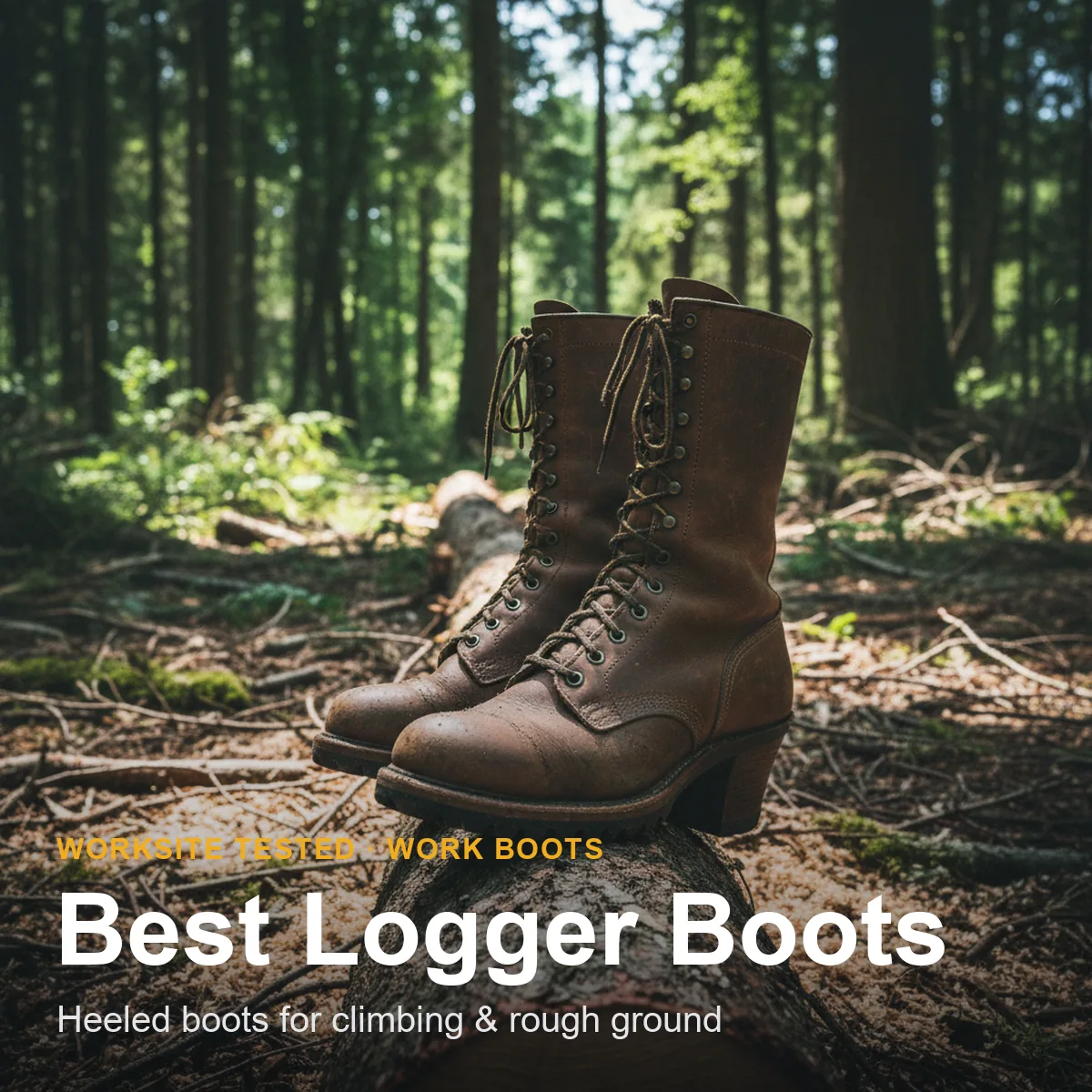
What makes a boot a "logger"? A logger (or 90-degree-heel) boot has a clear, straight 90-degree angled edge where the heel meets the outsole. That defined heel catches ladder rungs, steps, pole gaffs, and rough ground, and gives a steadier step than a flat wedge sole when you climb all day. One rule in a safety category: every number in here traces back to the actual listing. If the listing does not say it, I do not say it. And I flag one honest catch up front — one of these six wears the logger silhouette but does not have the true 90-degree heel. Details below.
Key Takeaways
- Five of six have a true 90-degree defined heel. The Georgia G7313, Chippewa 73101, Carolina CA5823, and both Thorogoods (804-3555 / 804-3554) carry the defined logger heel. The Georgia GB00123 uses a "Counter Lock" heel-stabilizing feature instead — a logger-look boot without the true 90-degree edge. If catching rungs is the whole point, that distinction matters.
- All six carry ASTM F2413-05 M I/75 C/75 on the listing. That is a 75 ft-lbf impact and a 2,500 lbf compression rating on the toe cap (the lower I/50 tier is 50 ft-lbf, C/50 is 1,750 lbf — none of these are that). Five are steel toe; the Georgia GB00123 is composite toe with the identical I/75 C/75 marking.
- EH is not universal here — check the pick. The Georgia G7313, Chippewa 73101, Carolina CA5823, and Georgia GB00123 list EH. The two Thorogoods (804-3555, 804-3554) do NOT list EH on their pages. EH insulates against open circuits up to 18,000 volts at 60 Hz in dry conditions, but it is secondary/backup protection and is diminished when wet or contaminated.
- Insulation splits the group. Only two are insulated: the Carolina CA5823 (Thinsulate 600g, deep-winter) and the Thorogood 804-3554 (Thinsulate 400g, cold-but-moving). The other four are listed without insulation — three-season boots.
- Construction determines repairability. Goodyear welt (Georgia G7313, both Thorogoods, Georgia GB00123) can be resoled. Carolina's Opanka stitches the upper to the outsole. When a non-welt sole goes, the boot goes.
- Internal links: Best work boots overall | ASTM F2413 explained | Composite toe vs steel toe
What makes a logger boot a logger boot: the 90-degree heel
A defined-heel logger boot has a clear 90-degree angled edge between the heel and the sole — which is exactly why people call them "90-degree heel boots." That straight edge is not a style choice. It helps the boot catch on ladder rungs, steps, and rough ground, and it gives a steadier step than a flat-bottomed wedge boot for anyone who climbs all day. It also gives steady footing on messy jobsites like oil rigs or muddy fields, and lifts the foot above debris.
So a logger boot is the right tool if your day involves ladders, poles with gaffs, scaffold rungs, steps, or uneven ground where you want the heel to grip. If you stand flat on concrete or subfloor all day, a wedge sole is usually the better fatigue choice — that is a different guide. The one thing to watch: not every boot sold in the "logger" category actually has the true 90-degree defined heel. One of the six here (the Georgia GB00123) uses a heel-stabilizing "Counter Lock" feature instead of the defined logger heel — I call that out in its section. Source: ironagefootwear.com defined-heel reference.
What ASTM F2413 M I/75 C/75 means on the label
Every boot in this guide carries the marking ASTM F2413-05 M I/75 C/75 on its listing. ASTM F2413 covers the minimum design, performance, testing, labeling, and classification requirements for footwear built to protect against workplace hazards. The marking uses a specific line format: the first line is the standard name and year (e.g. "ASTM F2413-18"), the next line is gender plus the core protection (e.g. "M I/C" for Male plus Impact/Compression), and additional lines list further hazards (e.g. "Mt EH" for Metatarsal and Electrical Hazard). Here is what each piece on these boots means:
- M: the wearer is Male.
- I/75: impact. The toe cap withstands a 75 ft-lbf impact. (The lower tier, I/50, withstands 50 ft-lbf — none of these boots are that.)
- C/75: compression. The toe cap withstands a 2,500 lbf compression / slow crushing load. (The lower tier, C/50, withstands 1,750 lbf.)
- EH: Electrical Hazard. Where listed, the sole and heel are built to insulate the wearer against open circuits up to 18,000 volts at 60 Hz under dry conditions. EH is secondary protection — a backup if primary safeguards fail, not a license to contact live conductors — and its protection is severely diminished in wet conditions or where the boot is contaminated with conductive material such as metal shavings.
Composite and steel toes carry the same I/75 C/75 rating when so marked — the Georgia GB00123 is a composite-toe logger marked ASTM F2413-05 M I/75 C/75, the same impact/compression as the steel-toe picks. Composite is non-metallic (lighter, non-conductive); steel is thinner in profile. Sources: tyndaleusa.com ASTM F2413 and wcsafety.com (both fetched July 6, 2026).
All 6 logger boots at a glance
| Boot | Heel | Toe / ASTM line | EH | Waterproof | Insulation | Price |
|---|---|---|---|---|---|---|
| Georgia G7313 | 90-degree defined | Steel I/75 C/75 | Yes | Yes | None | $180.00 |
| Carolina CA5823 | 90-degree defined | Steel I/75 C/75 | Yes | Yes (membrane) | Thinsulate 600g | $214.99 |
| Georgia GB00123 | Counter Lock (not 90°) | Composite I/75 C/75 | Yes | Yes | None | $240.00 |
| Chippewa 73101 | 90-degree defined | Steel I/75 C/75 | Yes | Yes | None | $309.95 |
| Thorogood 804-3555 | 90-degree defined | Steel I/75 C/75 | Not listed | Yes (membrane) | None | $389.95 |
| Thorogood 804-3554 | 90-degree defined | Steel I/75 C/75 | Not listed | Yes | Thinsulate 400g | $399.95 |
1. Georgia G7313 — best logger boot for the money
This is the one I hand most people first. You get everything the category is supposed to deliver at the lowest price of the six: a true 90-degree defined heel that grabs ladder rungs and steps, Goodyear welt / stitch-down construction so you can resole it instead of throwing it away, EH rating, and waterproof construction. The reddish-brown full-grain leather ages well, the outsole is slip / oil / chemical / heat resistant, and the footbed is removable. The steel toe carries the exact ASTM F2413-05 M I/75 C/75 marking on the listing — 75 ft-lbf impact, 2,500 lbf compression. No insulation, so treat it as a three-season boot.
- Pros: lowest price of the group at $180; true 90-degree defined heel; Goodyear welt (resolable); EH rated; waterproof.
- Cons: no insulation (three-season); imported, not USA-made; not the premium Vibram outsole the Chippewa and Thorogoods carry.
Check price at Working Person's Store →
2. Carolina CA5823 — best insulated logger for cold-weather climbing
When the ground is frozen and you are still climbing, this is the boot. Thinsulate 600 grams is a heavy insulation level — real winter, standing-on-frozen-ground cold, not a light chill. It backs that with a guaranteed waterproof membrane, the true 90-degree defined heel, EH rating, and a steel toe at ASTM F2413-05 M I/75 C/75. The Opanka construction stitches the uppers directly to the outsoles, which gives a flexible, close-to-the-foot feel — different from a welt, and not resole-friendly the same way. At $214.99 it is a legitimate winter logger boot and priced in the middle of the pack.
- Pros: Thinsulate 600g for deep cold; guaranteed waterproof membrane; true 90-degree heel; EH rated; mid-pack price.
- Cons: 600g is too much insulation for three-season or warm-running feet; Opanka construction is not welt-resolable; imported.
Check price at Working Person's Store →
3. Georgia GB00123 — the composite-toe pick (read the heel note first)
This is the honest asterisk of the group, and I am putting the caveat right in the headline. The GB00123 is a composite-toe boot — non-metallic, so lighter and non-conductive — and it carries the exact same ASTM F2413-05 M I/75 C/75 impact and compression rating as the steel-toe boots, plus EH (the page also states "ASTM F2413 I/75 C/75 EH"). For toe protection, it holds its own with anything here. It also gives you a Vibram outsole, an 8-inch height, Goodyear welt construction, a removable CC7 Comfort Core insole, and ERGO-FIT cushioning at $240. But here is the catch: the GB00123's heel is described as a "Counter Lock" heel-stabilizing feature, not a defined 90-degree logger heel. If the reason you want a logger boot is that straight 90-degree edge to catch rungs and steps, this one does not give it to you. Buy it for the logger silhouette, composite toe, and comfort — skip it if the true defined heel is the whole point.
- Pros: composite toe (lighter, non-conductive) at full I/75 C/75; EH rated; waterproof; Vibram outsole; Comfort Core cushioning; Goodyear welt (resolable).
- Cons: 🔴 heel is a Counter Lock stabilizer, NOT a true 90-degree defined logger heel; no insulation; imported.
Check price at Working Person's Store →
4. Chippewa 73101 Paladin — best for heat and rough terrain
The Vibram 360 TC4 Plus outsole is the reason to reach for this one. It is built for high-heat environments — hot asphalt, roofing, work near heat sources — where a standard rubber compound starts to break down. The 8-inch height gives more ankle support than a 6-inch boot, which pays off on the uneven ground and rough terrain that logger boots are made for. You get the true 90-degree defined heel, EH rating, waterproof construction, and a steel toe at ASTM F2413-05 M I/75 C/75 (the page also states it "Meets ASTM F2413 Safety Footwear Standards"). At $309.95 it is not cheap, but the high-heat Vibram sole and the taller shaft are real spec advantages over the Georgia G7313.
- Pros: Vibram 360 TC4 Plus outsole built for high heat; taller 8-inch shaft for ankle support; true 90-degree heel; EH rated; waterproof.
- Cons: $309.95 is a step up in price; no insulation (three-season); imported.
Check price at Working Person's Store →
5. Thorogood 804-3555 — best USA-made resolable flagship (no EH)
If you want a boot you can resole two or three times and it is made in the USA, this is it. Goodyear welt / stitch-down construction, a Vibram outsole with aggressive tread that grips rough ground and mud, a true 90-degree defined heel, a steel shank for torsional support when you are up on gaffs or rungs all day, and a guaranteed waterproof membrane with Aztec lining. The Studhorse CrazyHorse leather is premium. Steel toe at ASTM F2413-05 M I/75 C/75. One honest catch: the listing does not state an EH rating. If your job hazard analysis calls for electrical-hazard footwear, this is not your boot — go with the Georgia G7313 or Carolina CA5823 instead. At $389.95 the premium buys USA labor, resole-ability, and the Vibram sole.
- Pros: USA-made; Goodyear welt (resolable); Vibram aggressive-tread outsole; true 90-degree heel; steel shank; guaranteed waterproof membrane.
- Cons: 🔴 no EH rating listed — skip it if you need electrical-hazard protection; no insulation; $389.95 is near the top of the range.
Check price at Working Person's Store →
6. Thorogood 804-3554 — insulated USA-made flagship (no EH)
The insulated sibling of the 804-3555. Same Goodyear welt / stitch-down construction, same Vibram aggressive-tread outsole and rubber midsoles, same true 90-degree defined heel, same USA-made build and steel shank — but with Thinsulate 400 grams added. 400g is the sweet spot for cold-but-moving work: enough for a frosty morning or a mild winter without cooking your feet the way the Carolina's 600g will once you warm up. Steel toe at ASTM F2413-05 M I/75 C/75. Same honest catch as its sibling: the listing does not state an EH rating, so if you need electrical-hazard protection this is not the boot. At $399.95 it is the top of this group — you are paying for USA labor, resole-ability, the Vibram sole, and the insulation.
- Pros: Thinsulate 400g (cold-but-moving sweet spot); USA-made; Goodyear welt (resolable); Vibram aggressive tread; true 90-degree heel; waterproof.
- Cons: 🔴 no EH rating listed — skip it if you need electrical-hazard protection; highest price in the group at $399.95.
Check price at Working Person's Store →
How to choose: heel, toe, EH, waterproof, insulation
Do you actually climb? If your day is ladders, poles, gaffs, steps, scaffold rungs, or rough uneven ground, you want the true 90-degree defined heel — five of these six have it. If you stand flat on concrete or subfloor, a wedge is the better fatigue choice and you do not need a logger heel at all. If you want the logger look but the defined heel is not your priority, the Georgia GB00123 (Counter Lock heel) is fine — just know what it is.
Steel or composite toe? Both carry the same I/75 C/75 impact/compression rating when marked. Composite (the Georgia GB00123) is lighter and non-conductive; steel (the other five) is thinner in profile. For most logger work either is fine — pick composite if you want lighter and non-metallic, steel if you want a slimmer toe box.
Do you need EH? If your job hazard analysis identifies contact with live circuits, choose a boot that lists EH: the Georgia G7313, Chippewa 73101, Carolina CA5823, or Georgia GB00123. The two Thorogoods do not list EH. Remember EH is secondary/backup protection — it is diminished when the boot is wet or contaminated, and it never replaces de-energizing or primary electrical PPE.
Waterproof and insulation? All six list waterproof construction or a membrane. Insulation is the real divider: none for three-season work (Georgia G7313, Chippewa 73101, Thorogood 804-3555, Georgia GB00123), 400g for cold-but-moving (Thorogood 804-3554), 600g for deep winter (Carolina CA5823). Match the grams to your climate — over-insulating cooks your feet as surely as under-insulating freezes them.
Frequently Asked Questions
Why do logger boots have a tall, raised heel?
The defined 90-degree heel — a straight edge where the heel meets the outsole — helps the boot catch and grip ladder rungs, steps, pole gaffs, and rough ground, giving a steadier step than flat wedge boots when you climb all day, and raising the foot above mud and debris. It also provides steadier footing on messy jobsites like oil rigs and muddy fields. Five of the six boots in this guide carry that true defined heel; the Georgia GB00123 uses a Counter Lock stabilizer instead.
What does an ASTM F2413 M I/75 C/75 marking on a logger boot mean?
M means the wearer is Male, I/75 means the toe cap withstands a 75 ft-lbf impact, and C/75 means it withstands a 2,500 lbf compression load. The marking line starts with the standard and year (e.g. ASTM F2413-05 or -18). Every pick here carries the exact "ASTM F2413-05 M I/75 C/75" marking as stated on its listing — five with a steel toe, the Georgia GB00123 with a composite toe. Sources: wcsafety.com, tyndaleusa.com.
Are logger boots EH (electrical hazard) rated?
Some are and some are not — check the listing. EH-marked footwear has a sole and heel built to insulate against open circuits up to 18,000 volts at 60 Hz under dry conditions, but EH is only secondary/backup protection and is diminished when wet or contaminated with conductive material. In this guide the Georgia G7313, Chippewa 73101, Carolina CA5823, and Georgia GB00123 list EH; the Thorogood 804-3555 and 804-3554 listings do not state EH. Sources: wcsafety.com; product listings on workingperson.com.
Do I need waterproofing or insulation in a logger boot?
It depends on your climate and job. All six picks here list waterproof construction or a membrane. For cold work, the insulated options are the Carolina CA5823 (Thinsulate 600g) and the Thorogood 804-3554 (Thinsulate 400g); the Georgia G7313, Chippewa 73101, Thorogood 804-3555, and Georgia GB00123 are listed without insulation. I only cite the insulation grams stated on each listing — never inferred. Match the grams to your climate: 600g is deep winter, 400g is cold-but-moving, none is three-season.
Is a composite toe as protective as a steel toe in a logger boot?
For impact and compression, yes — both carry the same ASTM F2413 I/75 C/75 rating when marked. The Georgia GB00123 is a composite-toe logger marked ASTM F2413-05 M I/75 C/75, and the steel-toe picks share the identical I/75 C/75 marking. Composite is non-metallic (lighter, non-conductive); steel is thinner in profile. One note specific to the GB00123: its heel is a Counter Lock stabilizer, not a defined 90-degree logger heel, so if the true defined heel is what you want, pick one of the other five.
Why Trust This Guide
This guide is written and reviewed by Marco Reyes, an independent work-safety-gear reviewer. Every recommendation is built on the published standards (ASTM F2413 for footwear, ANSI Z359 for fall protection, ANSI/ISEA 107 for hi-vis, the OSHA rules), manufacturer spec sheets and product labels, hands-on handling, and what tradespeople actually report — and we tell you when a number is a manufacturer claim versus an independent standard, and when a boot is rated for one hazard but not another. Every product here was pulled live from Working Person's Store on July 6, 2026, confirmed in stock, and verified against the listing specs — no numbers were inferred, extrapolated, or borrowed from other models. We earn an affiliate commission if you buy through some of our links, at no extra cost to you, and we never rank by commission over safety — see our affiliate disclosure.