
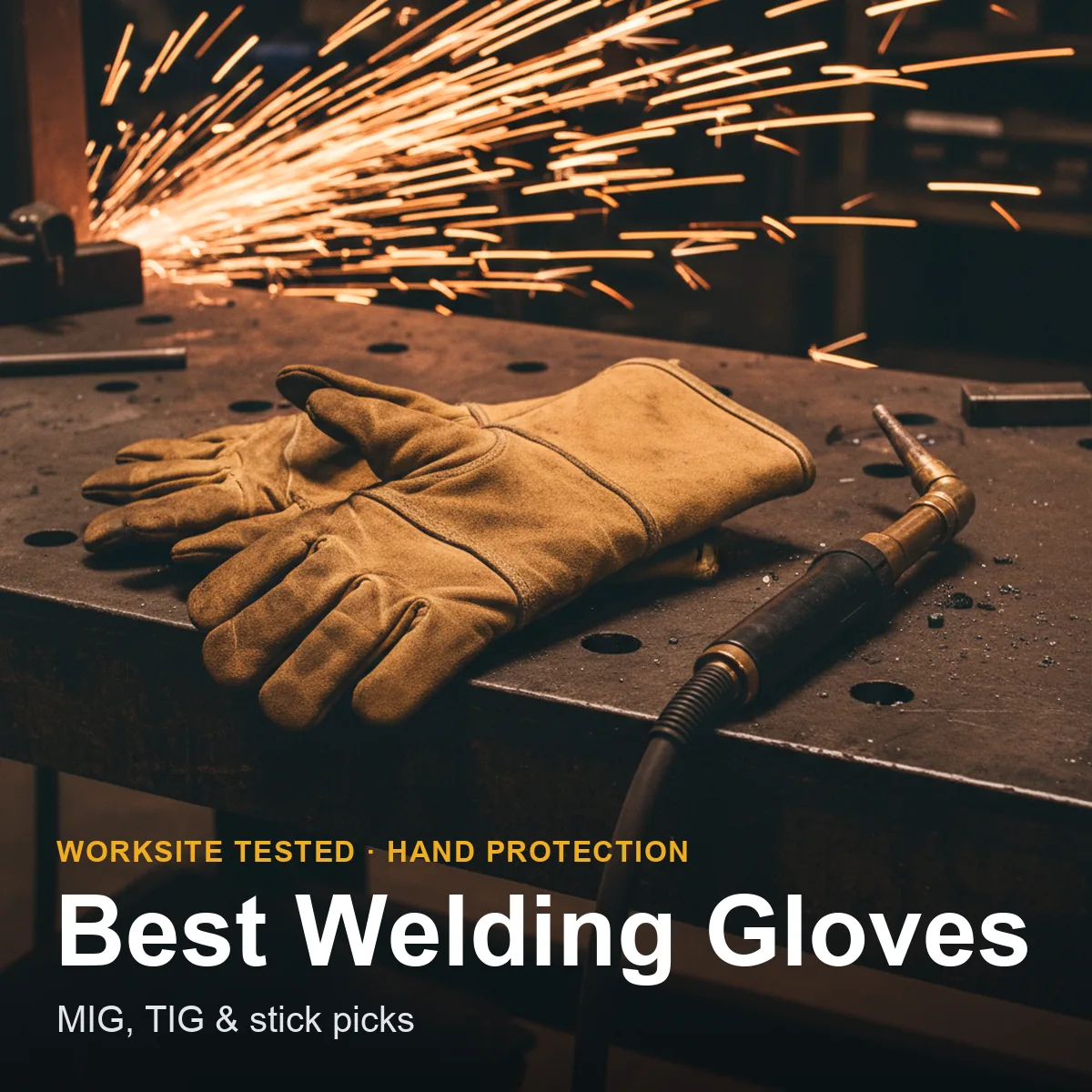
Short answer: for TIG, the Tillman 1328 goatskin glove at $9.99 gives you the finger feel you need for a filler rod without overpaying. For general MIG, the Black Stallion GM1510 ($20.99) balances feel and lined heat protection. For stick, the Black Stallion GS1321 long-cuff cowhide ($25.99) is my default, stepping up to the Revco 850 elkskin ($39.00) or the 21-inch Caiman 1878 ($70.16) when the heat and spatter get serious. All eight gloves below are real listings from real welding-supply retailers, with prices and stock pulled as of July 6, 2026.
Here is the rule I follow in a safety category: every spec in this guide traces back to the actual listing. Welding gloves are almost never sold with a published ANSI/ISEA 105 cut level — and not one of these eight lists one — because heat, flame and molten-spatter resistance is the hazard you are buying against, not blade cut. So I am not going to slap a cut rating on a glove that does not carry one. What drives the pick instead is the real trade-off in welding gloves: heat protection vs. dexterity.
Key Takeaways
- The whole game is heat vs. dexterity. Stick and MIG gloves use thicker, lined leather (split cowhide, elkskin, deerskin) and long cuffs to block heat and spatter. TIG gloves use thin, supple, often-unlined leather (goatskin/kidskin) with short 4–4.5-inch cuffs so you can feel the filler rod.
- None of these eight gloves carries an ANSI/ISEA 105 cut level or ASTM marking. That is normal for welding gloves — cut is not the primary hazard. Do not expect a cut score here, and be skeptical of any welding-glove listing that implies a boot-style safety rating. (Note: ASTM F2413 is a footwear standard and does not apply to gloves.)
- The European welding-glove standard is EN 12477, split into Type A (higher heat protection — general welding, cutting, stick/MIG) and Type B (higher dexterity — TIG). It is a useful mental model even for US buyers, and it draws on EN 388 (mechanical), EN 407 (thermal) and EN 420 (dexterity).
- Kevlar stitching is not marketing. Kevlar (an aramid) thread is flame-resistant, so the seams survive heat and sparks where ordinary thread burns through. Every glove here uses it; several add welted seams (a leather strip over the seam) for more protection.
- Cuff length is a process signal. A 21-inch Caiman 1878 gauntlet protects the forearm for overhead stick; a 4-inch Tillman cuff keeps the wrist free for precise TIG rod feeding. Match the cuff to the work.
- Internal links: for the glove cut-rating scale, see ANSI/ISEA 105 cut levels explained (A1–A9); for the US boot equivalent of a safety marking, see what the ASTM F2413 line on a boot label means — footwear-only, it does not transfer to gloves.
MIG vs TIG vs stick: why welding gloves split by process
Every pick below is chosen for a welding process, and the split is driven by one trade-off: heat protection vs. finger feel. Get this right and the rest of the buying decision falls into place.
- Stick (SMAW) and MIG (GMAW) throw more heat and spatter at your hands, so their gloves use thicker, heavier leather — split cowhide, elkskin, deerskin — with linings and longer gauntlet cuffs. In this guide that is the Lincoln K2979 (sock-lined shoulder split cowhide, $19.15), the Black Stallion GM1510 (lined goatskin/cowhide MIG, $20.99), the Black Stallion GS1321 (split cowhide stick, $25.99), the Revco 850 (elkskin stick, $39.00) and the 21-inch Caiman 1878 (deerskin/boarhide MIG/stick, $70.16).
- TIG (GTAW) is a precision process — you feed filler rod by hand and need to feel it. So TIG gloves use thin, supple leather (goatskin, kidskin), often unlined, with short 4–4.5-inch cuffs. That is the Tillman 1328 top-grain goatskin ($9.99) and the Black Stallion 25K kidskin ($21.99).
- The GS1715 BT ($65.99) is the exception — the listing does not tie it to a single process; it is an impact/knuckle-protection heavy-duty glove for fabrication work that happens to also weld.
The European welding-glove standard, EN 12477, formalizes this exact split: Type A gloves favor higher protection (general welding, cutting, stick/MIG) and Type B gloves favor higher dexterity and are more suitable for TIG. EN 12477 draws on EN 388 (mechanical risks), EN 407 (thermal risks) and EN 420 (general requirements including dexterity). It is a European standard, so US-market gloves like these may not carry it — but the A-vs-B mental model maps cleanly onto MIG/stick vs TIG. Source: SATRA — EN 12477 welders' gloves.
All 8 welding gloves at a glance
| Glove | Process | Leather | Cuff / lining | Cut level | Best for | Price |
|---|---|---|---|---|---|---|
| Tillman 1328 | TIG | Top grain goatskin/kidskin | 4-in cuff, unlined | None stated | Budget TIG dexterity | $9.99 |
| Black Stallion 25K | TIG | Premium kidskin/goatskin | 4.5-in cuff | None stated | TIG feel + XS-2XL fit | $21.99 |
| Lincoln K2979 | MIG/Stick | Shoulder split cowhide | 5-in cuff, sock-lined | None stated | Budget lined MIG/stick | $19.15 |
| Black Stallion GM1510 | MIG | Goatskin palms / cowhide backs | Fully lined | None stated | MIG feel + lined heat | $20.99 |
| Black Stallion GS1321 | Stick | Split cowhide | Long insulated cuff, CushionCore lined | None stated | Default stick glove | $25.99 |
| Revco 850 | Stick | Grain elkskin | Gauntlet, Nomex-lined backs | None stated | Premium stick / stays supple | $39.00 |
| Black Stallion GS1715 BT | Impact / heavy-duty | Split cowhide palms/fingertips | FR liner patches, knuckle guard | None stated | Fab work with impact risk | $65.99 |
| Caiman 1878 | MIG/Stick | Deerskin / boarhide | 21-in gauntlet, FR fleece sock-lined | None stated | Overhead / max forearm coverage | $70.16 |
1. Tillman 1328 — best TIG glove for the money
If you TIG weld, you need to feel the filler rod, and that means thin, supple leather. The Tillman 1328 is top-grain pearl goatskin/kidskin, unlined, with a 4-inch straight cuff and a seamless forefinger — the seamless forefinger keeps a seam out of exactly the spot where you pinch and feed rod. Lock-stitched with Kevlar thread and a wing thumb for movement. At $9.99 (regular $14.99) it is the cheapest glove here and the one I hand a TIG welder who just wants dexterity and does not want to overthink it. The honest catch: unlined leather and a 4-inch cuff are not a heat barrier — do not use these on a hot MIG or stick puddle.
- Pros: excellent finger feel, seamless forefinger, Kevlar-stitched, cheapest in the group at $9.99.
- Cons: unlined and short-cuffed (TIG only, not MIG/stick heat); M/L/XL sizing only; listing states no ANSI/ASTM rating.
See the Tillman 1328 listing at Weld Shop Supply →
2. Black Stallion 25K — TIG dexterity with a wider fit range
The 25K is the TIG glove I point people to when the Tillman's M/L/XL run does not fit their hands. It runs the full XS–2XL. You still get the thin kidskin/goatskin leather TIG demands, but the DragPatch side reinforcements and a cowhide cuff add durability where a plain goatskin glove wears first, and the 4.5-inch cuff is a touch longer than the Tillman's for a little more spatter coverage at the wrist. Flame-resistant Kevlar thread on the seams. At $21.99 it costs more than double the Tillman, and the extra money buys the size range, the reinforcement, and the cuff — not more heat protection.
- Pros: TIG-grade dexterity, XS-2XL sizing, DragPatch reinforcement, 4.5-in cuff, FR Kevlar thread.
- Cons: still a dexterity glove (not for MIG/stick heat); more than 2x the Tillman's price; listing states no ANSI/ASTM rating.
Check price at Working Person's Store →
3. Lincoln Electric K2979 — best budget MIG/stick glove
At $19.15, the K2979 is the cheapest lined MIG/stick glove here, and it comes from a brand welders already trust from the machine side of the shop. It is heat- and flame-resistant shoulder split cowhide with a full sock lining — that lining is what makes it a MIG/stick glove instead of a bare goatskin glove, putting a real layer between your hand and the heat. Welted seams (a leather strip sewn over the seam) with Kevlar thread survive sparks that would burn ordinary thread through, and there is a thumb pad in the high-wear area. The honest catch is the cuff: at 5 inches it is fine for MIG but a little short if you run heavy stick all day and want more forearm coverage — for that, jump to the GS1321 or Caiman below.
- Pros: sock-lined split cowhide, welted Kevlar seams, thumb pad, trusted brand, cheapest lined glove at $19.15.
- Cons: 5-in cuff is short for heavy stick; listing states no ANSI/ASTM rating.
See the Lincoln K2979 listing at Cyberweld →
4. Black Stallion GM1510 — best all-around MIG glove
MIG sits in the middle — you want more feel than a heavy stick gauntlet gives, but you still need a lined glove for the heat. The GM1510 splits the difference: grain goatskin palms for dexterity feeding wire and handling parts, split cowhide backs and a full lining for the MIG heat. The seamless index fingers matter more than they sound — a seam across the index tip is exactly where a MIG glove wears through and where you lose feel. DragPatch side reinforcements add life, and the SM–2XL run covers most hands. At $20.99 it sits right between a pure-dexterity TIG glove and a heavy stick gauntlet, which is what most MIG work actually wants.
- Pros: lined goatskin/cowhide MIG balance, seamless index fingers, DragPatch reinforcement, SM-2XL.
- Cons: not a dedicated stick glove (shorter than a gauntlet); listing states no ANSI/ASTM rating.
Check price at Working Person's Store →
5. Black Stallion GS1321 — best default stick glove
For stick you want three things — thick leather, lining, and a long cuff — and the GS1321 has all three. Split cowhide is the durable, heat-tolerant workhorse leather, and the CushionCore lining in the palms and backs takes the edge off radiant heat. The insulated long cuff is the reason this is a stick glove and not a MIG glove: it keeps spatter and heat off the wrist and lower forearm where a 5-inch MIG cuff leaves you exposed. Welted seams with Kevlar stitches, padded RestPatches for bracing your hand on hot work, and reinforced palms round it out. At $25.99 this is my default stick recommendation for anyone who does not need to step up to the heavier elkskin or deerskin gauntlets.
- Pros: split cowhide + CushionCore lining, long insulated cuff, welted Kevlar seams, padded RestPatches, reinforced palms.
- Cons: thicker leather means less finger feel (not for TIG); listing states no ANSI/ASTM rating.
Check price at Working Person's Store →
6. Revco 850 — best premium stick glove (elkskin)
Elkskin is the leather stick welders ask for by name, because it resists going stiff and board-like after it takes heat the way cowhide can. The Revco 850 pairs grain elkskin with a flame-resistant Nomex lining on the backs — Nomex is an aramid that holds up to heat, and the backs are exactly where radiant heat hits, so that is a smart place to put it. Rigid cowhide gauntlet cuffs, welted seams, Kevlar thread, and reversed-grain palms for grip on tooling. At $39.00 it is a real step up in leather quality over the $25.99 GS1321, and worth it if you run stick for a living and want a glove that stays supple. Straight thumb — this is a heat-and-durability glove, not a dexterity glove.
- Pros: premium elkskin that stays supple, Nomex-lined backs, welted Kevlar seams, gauntlet cuffs, grippy reversed-grain palms.
- Cons: priciest of the mid-tier at $39.00; straight thumb / thick leather means low dexterity; listing states no ANSI/ASTM rating.
Check price at Working Person's Store →
7. Black Stallion GS1715 BT — best for fab work with impact risk
I want to be straight about this one: it is the outlier in the group. The GS1715 BT is built around impact and knuckle protection — split cowhide palms and fingertips, FR liner patches on the backs, DragPatch palm inserts, a RestPatch at the wrists, and molded knuckle protection — for heavy-duty fabrication where you are banging your hands around, not for a specific MIG/TIG/stick process. The listing does not tie it to a single welding process. If your day is as much rigging, grinding, and material handling as it is welding, the knuckle armor earns the $65.99. If you just weld, you are paying for protection you do not need — one of the process-specific gloves above will serve you better and cheaper.
- Pros: knuckle/impact protection, split cowhide palms and fingertips, FR liner patches, DragPatch and RestPatch reinforcement.
- Cons: not a process-specific welding glove; overkill (and pricey at $65.99) if you only weld; listing states no ANSI/ASTM rating.
Check price at Working Person's Store →
8. Caiman 1878 — best for overhead stick and maximum forearm coverage
The Caiman 1878 is the maximum-coverage glove in this roundup — a 21-inch gauntlet that runs up past the forearm toward the elbow, with FR cotton fleece sock-lined insulation and a genuine leather heat shield patch. This is what you want for out-of-position stick and heavy MIG where spatter and radiant heat come at your forearms, not just your hands: overhead welding, tacking pipe, hot heavy work. Genuine American deerskin (tanned in the USA) gives you more suppleness than straight cowhide, while the boarhide and heavy-duty forearm/elbow padding handle the abuse, and there are reinforced palm, cuff and lean-on patches. At $70.16 it is the priciest here, and the 21-inch length is overkill for bench MIG — but for the welder working overhead all shift, the forearm coverage is the entire reason to buy it.
- Pros: 21-in gauntlet forearm coverage, FR fleece insulation, deerskin suppleness + boarhide durability, leather heat shield patch, reinforced everywhere.
- Cons: priciest at $70.16; the length is overkill for bench work; listing states no ANSI/ASTM rating.
See the Caiman 1878 listing at Good Earth Products →
Which welding-glove leather should you buy?
Leather choice tracks the process, and every glove here backs it up:
- Cowhide / shoulder split cowhide — the durable, heat- and flame-resistant workhorse for MIG and stick. Lincoln K2979 and Black Stallion GS1321.
- Elkskin — resists stiffening from heat, so it stays supple; a stick favorite. Revco 850.
- Goatskin / kidskin — thin, supple and abrasion-resistant, the TIG favorite for dexterity. Tillman 1328 and Black Stallion 25K.
- Deerskin / boarhide combos — balance suppleness with padding for heavier work. Caiman 1878.
One honest note that runs through all of them: I report only what each listing states, and none of these eight listings publishes an ANSI/ISEA 105 cut level or ASTM marking. That is not a gap in the products — it is how welding gloves are sold, because heat, flame and molten-metal spatter, not blade cut, are the hazards they are built for. If you want to understand the cut-rating scale itself (and why a cut glove is a different tool), read our ANSI/ISEA 105 cut levels explainer.
Frequently Asked Questions
What is the difference between MIG, TIG, and stick welding gloves?
The split is driven by heat vs. dexterity. Stick and MIG gloves use thicker, heavier leather (split cowhide, elkskin, deerskin) with linings and long gauntlet cuffs to block high heat and spatter — the Black Stallion GS1321 split cowhide stick glove ($25.99), Revco 850 elkskin stick glove ($39.00), Lincoln K2979 shoulder split cowhide MIG/stick glove ($19.15), and the 21-inch Caiman 1878 deerskin/boarhide MIG/stick glove ($70.16). TIG gloves use thin, supple leather (goatskin/kidskin), often unlined, with short 4–4.5-inch cuffs for finger feel to place filler rod — the Tillman 1328 goatskin TIG glove ($9.99) and Black Stallion 25K kidskin TIG glove ($21.99). Under EN 12477 this maps to Type A (higher heat protection, MIG/stick/cutting) vs Type B (higher dexterity, TIG).
Which leather is best for welding gloves?
It depends on the process. Cowhide (including shoulder split cowhide) is the durable, heat- and flame-resistant workhorse for MIG and stick, used in the Lincoln K2979 and Black Stallion GS1321. Elkskin (Revco 850) resists stiffening from heat and is popular for stick. Goatskin and kidskin are thin, supple and abrasion-resistant, making them the TIG favorite for dexterity (Tillman 1328, Black Stallion 25K). Deerskin/boarhide combos (Caiman 1878) balance suppleness with padding for heavier work. Report only what each listing states; none of these listings publishes an ANSI cut level.
What does Kevlar stitching mean on welding gloves, and why does it matter?
Kevlar (aramid) thread is flame-resistant, so the seams hold together under heat and sparks where ordinary thread would burn through — a key durability feature. Every glove in this guide states Kevlar stitching, and several add welted seams (strips of leather sewn over the seams) for extra protection, including the Revco 850, Lincoln K2979 and Black Stallion GS1321.
How long should a welding glove cuff be?
Longer cuffs protect the wrist and forearm from spatter and radiant heat, which is why stick/MIG gloves run long — the Caiman 1878 is a 21-inch gauntlet, and gauntlet cuffs are standard on heavy cowhide and elkskin gloves. TIG gloves keep cuffs short (about 4–4.5 inches on the Tillman 1328 and Black Stallion 25K) so the wrist stays free for precise rod feeding. Only cite cuff lengths a listing actually states.
Do welding gloves have an ANSI cut level or safety rating?
Many welding gloves are sold without a published ANSI/ISEA 105 cut level because heat, flame and spatter resistance — not blade cut — is the primary hazard; none of the eight listings in this guide states an ANSI cut level or ASTM marking. For reference, ANSI/ISEA 105 rates cut resistance A1 (200g) through A9 (6,000g+) by grams of force to cut through on a TDM-100 test, and the European welding-glove standard EN 12477 classifies welders' gloves as Type A (protection) or Type B (dexterity, for TIG). Note that ASTM F2413 is a footwear standard and does not apply to gloves.
Are these welding gloves in stock and where can I buy them?
The Black Stallion and Revco gloves are listed in stock at Working Person's Store (GM1510 $20.99, 25K $21.99, GS1321 $25.99, Revco 850 $39.00, GS1715 $65.99). The Lincoln K2979 ($19.15, in stock at Cyberweld), Tillman 1328 ($9.99, in stock at Weld Shop Supply) and Caiman 1878 ($70.16, in stock at Good Earth Products) are sourced from other real welding-supply retailers. Prices and stock reflect what each listing stated when researched and can change.
Why Trust This Guide
This guide is written and reviewed by Marco Reyes, an independent work-safety-gear reviewer. Every recommendation is built on the published standards (ASTM F2413 for footwear, ANSI Z359 for fall protection, ANSI/ISEA 107 for hi-vis, ANSI/ISEA 105 and EN 12477 for gloves, the OSHA rules), manufacturer spec sheets and product labels, hands-on handling, and what tradespeople actually report — and we tell you when a number is a manufacturer claim versus an independent standard, and when a glove is built for one hazard (heat and spatter) but carries no rating for another (blade cut). Product specs and prices in this guide were pulled live from Working Person's Store and other real welding-supply retailers on July 6, 2026, and verified against each listing — no ANSI cut level, ASTM marking, or spec was added that the listing does not state. We earn an affiliate commission if you buy through some of our links, at no extra cost to you, and we never rank by commission over safety — see our affiliate disclosure.