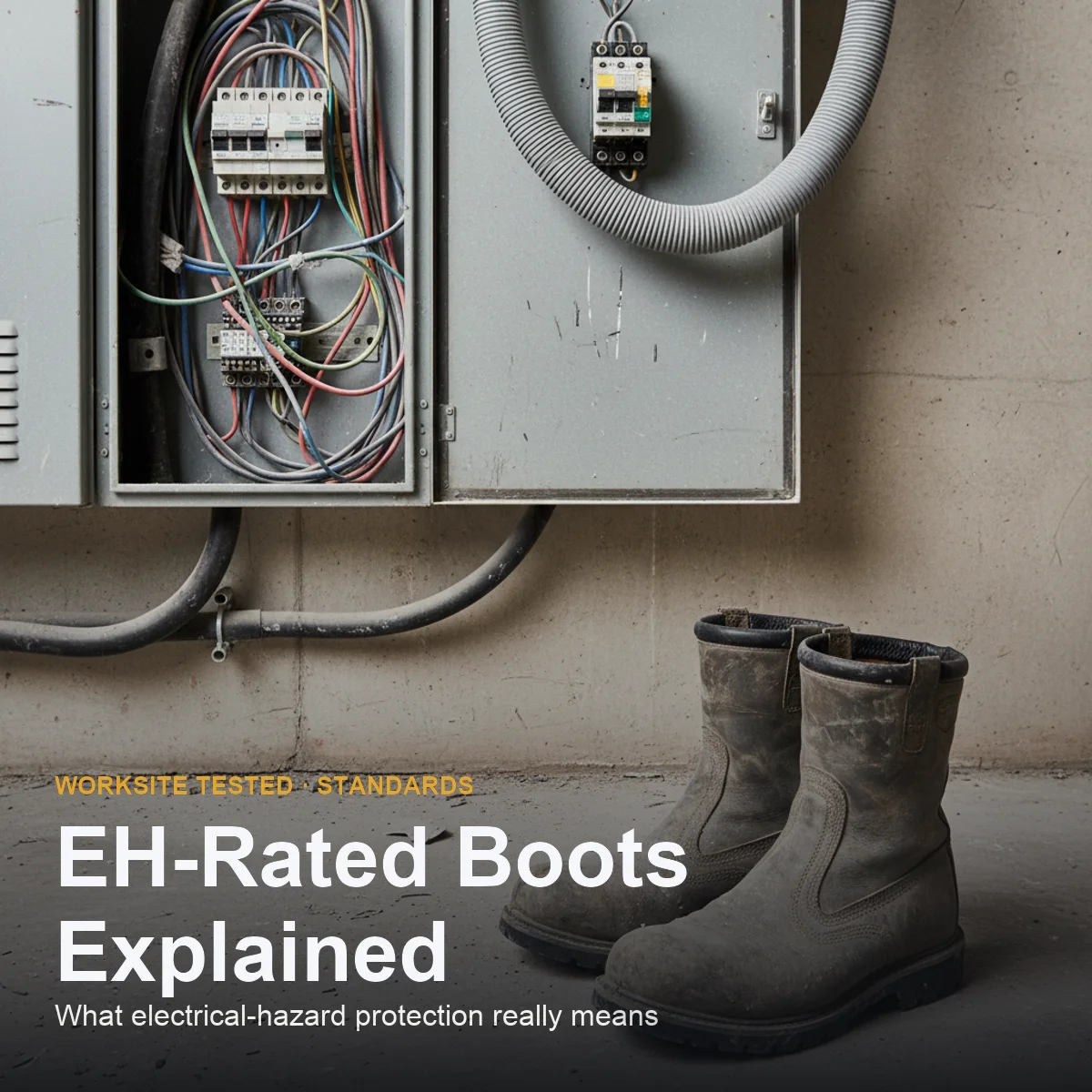

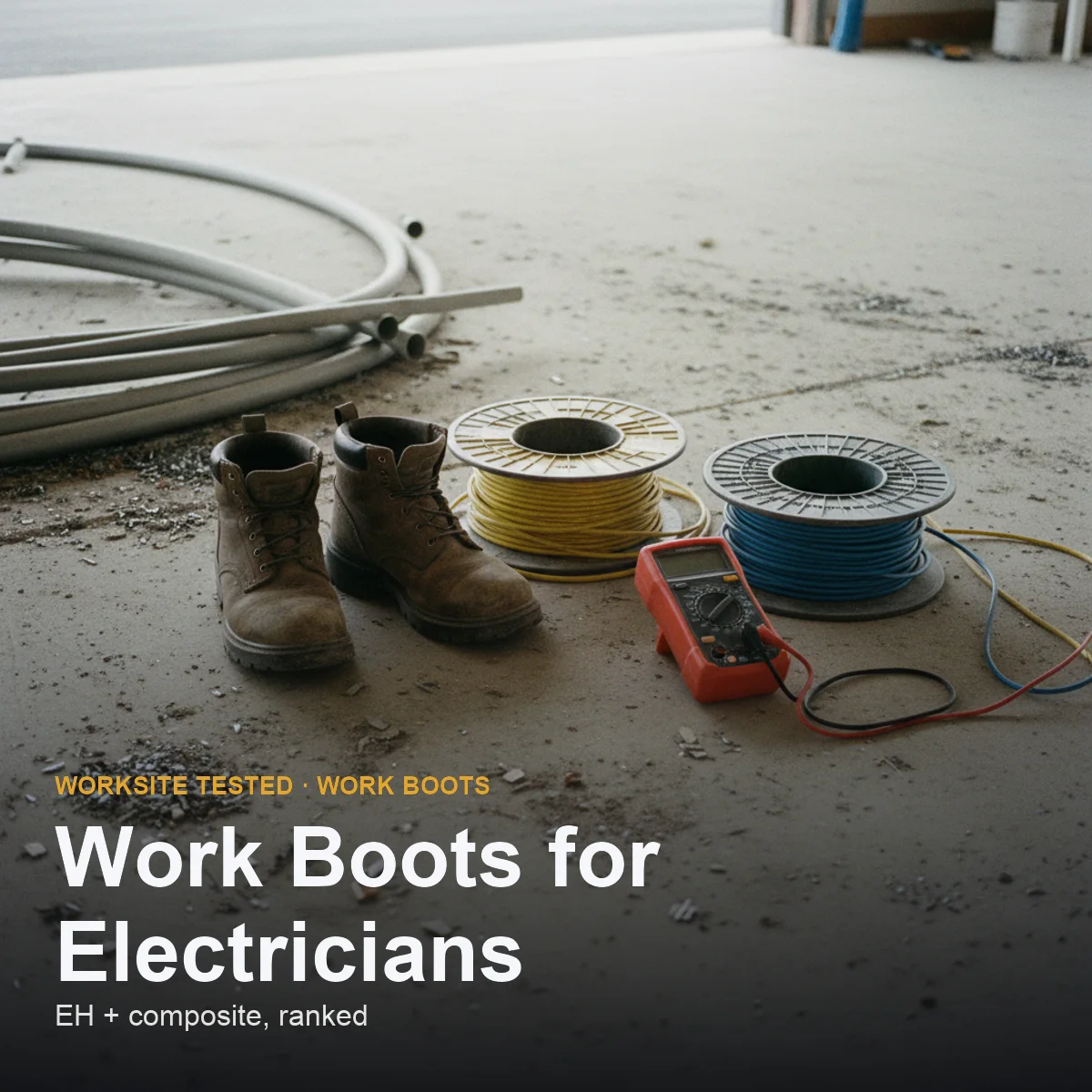
I want to get one thing out of the way upfront: EH-rated boots are secondary protection. They are not a substitute for rubber gloves, insulated tools, or de-energizing the circuit. They do not protect you when wet. They do not replace lockout/tagout. What they do is provide an insulating barrier between your outsole and the ground side of an open electrical circuit — which, in a fault scenario, can mean the difference between a jolt and a trip to the ER.
With that said, here are the six EH-rated boots I pulled from live listings at Working Person's Store on June 27, 2026. Every spec in this article traces back to the product page. Prices are point-in-time. No numbers were invented.
What You Need to Know First
- EH rating is tested at 18,000 V — but only when dry. Per ASTM F2413-18, the outsole and heel must withstand 18,000 volts (RMS) at 60 Hz for one minute with no more than 1.0 milliampere of current leakage under dry conditions. Source: workwaysafety.com and worknmore.com. A wet, oil-soaked, or contaminated boot may not maintain this protection.
- Composite toe is not mandatory for electricians — but many prefer it. No OSHA standard requires non-metallic toes for electricians across the board. OSHA 1910.333(c)(8) prohibits conductive articles that might contact exposed energized parts. An OSHA interpretation letter (1993-03-17) states steel-toe boots are not inherently hazardous provided the metal is not externally exposed. Source: osha.gov. But composite toe eliminates the question entirely — and many site safety plans require it.
- EH is not the same as dielectric (DI). Dielectric boots — governed by ASTM F1117 — are for workers with direct contact with energized lines. EH covers secondary/incidental contact. If you pull lines live or work on energized distribution equipment, talk to your safety officer about dielectric protection requirements, not just EH.
- NFPA 70E arc flash requirements add another layer. When incident energy exceeds 4 cal/cm², NFPA 70E Table 130.7(C)(15)(c) requires heavy-duty leather footwear. Category 1 (minimum arc rating 4 cal/cm²) lists leather as optional (AN); Categories 2 through 4 (8, 25, and 40 cal/cm² respectively) require it. Source: arcflash101.webflow.io. Most leather-upper EH boots in this guide satisfy the leather-footwear requirement — always confirm with your site's arc flash analysis.
- The "05" in ASTM F2413-05 is the standard edition year. Most boots listed here carry the 2005 edition marking — that is the edition stamped on existing inventory. OSHA 29 CFR 1910.136 references ASTM F2413-2005 by name; boots labeled to that edition are legally compliant. The current standard is F2413-18. Source: osha.gov/laws-regs/regulations/standardnumber/1910/1910.136.
Six boots at a glance
| Boot | Toe | Construction | EH Standard Cited | Waterproof | Price |
|---|---|---|---|---|---|
| Timberland PRO Boondock 92615 | Composite (non-metallic) | Goodyear welt | ASTM F2413-05 M I/75 C/75 + EH (listing) | Yes — guaranteed membrane | $230.00 |
| Timberland PRO TiTAN 85520 | Alloy (metallic) | Cement (flexible) | ASTM F2413-05 M I/75 C/75 + EH (listing) | Yes — guaranteed membrane | $175.00 |
| Timberland PRO Helix 89697 | Composite + non-metallic met guard (Mt 75) | Cement (flexible) | ASTM F2413-05 M I/75 C/75 + EH (listing) | No | $240.00 |
| Timberland PRO Stockdale TB01064A | Alloy (metallic) | Cement (flexible) | ASTM F2412-11 / F2892-11 EH (listing) | No | $170.00 |
| Carolina CA8049 | Soft toe (none) | Goodyear welt | Manufacturer claim only — no ASTM version cited (listing) | Not stated | $199.99 |
| Iron Age IA5081 | Steel (metallic) | Goodyear welt | ASTM F2413-05 M I/75 C/75 + EH (listing) | Not stated | $139.95 |
1. Timberland PRO Boondock Composite Toe 92615 — best overall for electrical work
This is the boot I would put on for a 10-hour commercial install day. Composite toe means no metal in the toe box. Fiberglass shank means no metal in the shank either. Goodyear welt means it can be resoled when the sole wears. The guaranteed waterproof membrane handles wet pours, standing water in unfinished spaces, and rainy days without soaking through. EH rated per the listing (ASTM F2413-05 M I/75 C/75).
At $230 it is not cheap. But Goodyear welt plus a guaranteed membrane plus non-metallic construction in a single boot is a hard combination to find. This is the boot you buy once and resole instead of replacing every 12 months.
- Grab these if: you want the most complete package — composite toe, EH, waterproof, resole-capable — without chasing three separate boots for three different conditions.
- Skip if: you need met-guard protection or are on a tight budget. The Helix (below) has the met guard; the Iron Age has the low price.
Check price at Working Person's Store →
2. Timberland PRO Helix Met Guard 89697 — best for electricians who need metatarsal protection
Most electricians don't think about metatarsal protection. Then something drops across the top of the foot and changes that opinion fast. The Helix 89697 adds an internal non-metallic met guard rated Mt 75 to an already composite-toe, EH-rated platform. That is 75 foot-pounds of impact protection against the metatarsal bones from the listing — same impact rating as the toe cap. And critically for electrical work, the listing specifies the met guard is non-metallic, so you are not adding a conductive element to deal with the safety-toe one.
The honest caveat: it is not waterproof. If your work stays in commercial interiors, covered industrial sites, or data centers, that is a non-issue. If you pull wire in open construction with wet floors or exterior work, the Boondock is the better call.
- Grab these if: your site hazard assessment includes dropped-object or crush risk on the top of the foot and you need a non-metallic toe box across the board.
- Skip if: you need waterproofing or your site does not require met-guard coverage — $240 for a dry-environment boot is hard to justify when the Boondock at $230 adds waterproofing.
Check price at Working Person's Store →
3. Timberland PRO TiTAN 85520 — best for a journeyman who moves fast
The TiTAN at $175 is lighter and more flexible than the Boondock. The cement construction breaks in faster and weighs less than a welt-built boot — which matters if you are moving between panels, climbing ladders, and overhead work all day. It is EH-rated with a guaranteed waterproof membrane and a molded EVA midsole.
One thing to say clearly: the toe is alloy, not composite. Alloy is lighter than steel but it is still a metallic material. Most site safety plans that specify non-metallic toe will not accept an alloy toe. If your site or inspector requires non-metallic/composite specifically, the Boondock or the Helix is the right call. If alloy is acceptable, the TiTAN gives you EH plus waterproofing at $55 less than the Boondock with a boot that flexes more freely out of the box.
- Grab these if: alloy toe is acceptable on your site and you want EH plus waterproofing at a lighter, more flexible price point.
- Skip if: your site requires non-metallic/composite toe or you want a resole-capable Goodyear welt construction.
Check price at Working Person's Store →
4. Timberland PRO Stockdale TB01064A — best for inside commercial work on a budget
The Stockdale is the $170 entry point. Alloy toe, non-marking rubber outsole, no waterproofing. Built for indoor commercial work — the non-marking GripMax outsole is the tell. The EH citation on the listing is worth reading carefully: it states ASTM F2412-11 and ASTM F2892-11. F2412 is the test method document (the companion to F2413); F2892 governs soft-toe EH footwear specifically. A compliance officer may read a F2892 boot differently than an F2413 boot. I am not saying this boot fails EH — I am saying the label is worth verifying against your site's specific compliance requirements before you walk through the gate.
- Grab these if: you work inside commercial buildings, the non-marking sole matters, and alloy toe clears your site PPE requirements.
- Skip if: you need composite/non-metallic toe or waterproofing, or if your site compliance officer is strict about F2413 labeling specifically.
Check price at Working Person's Store →
5. Carolina CA8049 — for residential electricians who want a soft-toe 8-inch EH boot
The CA8049 is a soft-toe boot. No safety toe cap at all. The listing states EH protection against open circuits up to 600 volts in dry conditions. Here is what the listing does not state: a specific ASTM standard version. That is a manufacturer claim — not a confirmed F2413-05 or F2892 label from the listing. I am calling that out because in a safety article, the difference between "manufacturer claims EH" and "listing cites ASTM F2413-18 EH marking" is material.
For a residential electrician who works in single-family homes, where toe impact risk is lower and the flexibility and comfort of a Goodyear welt 8-inch soft-toe boot is appealing — this is a legitimate tool. Just check the physical boot label for the ASTM marking before relying on it for site compliance. The steel-toe variant is model CA8549 if you need the toe cap.
- Grab these if: you do residential work, toe impact risk is low, and you want an 8-inch EH-rated Goodyear welt boot with maximum comfort and flexibility.
- Skip if: your site requires a safety toe, or if your safety officer needs a specific ASTM standard citation they can trace on the listing.
Check price at Working Person's Store →
6. Iron Age IA5081 — cheapest EH wedge sole in the group, but read the steel-toe note
$139.95. Goodyear welt. Wedge sole. EH rated. Eight-inch steel toe. That is a combination that does not exist at this price anywhere else in this group. The memory foam BootBed footbed is comfortable for all-day wear on flat surfaces — same logic as the carpenters who prefer wedge sole over lug for concrete standing.
The steel toe is the conversation. I put this boot last not because it is a bad boot but because on an electrician roundup, steel toe deserves to be called out explicitly. OSHA 1910.333(c)(8) says no conductive articles that might contact energized parts. OSHA has clarified steel toes are not inherently prohibited — but many electrical contractors, site safety plans, and foremen still require non-metallic toe as a default. If your workplace allows steel toe and you want a budget wedge-sole EH boot with Goodyear welt, the IA5081 delivers it. If there is any ambiguity on your site, check before you buy.
- Grab these if: steel toe is cleared for your site, you want a wedge-sole EH boot with Goodyear welt, and $139.95 is the right price point.
- Skip if: your site requires non-metallic or composite toe for electrical work. This is not the boot for that requirement.
Check price at Working Person's Store →
What EH actually does — and what it doesn't
Every listing in this group says "EH rated." Here is what that actually means, sourced from ASTM F2413-18 test parameters corroborated by workwaysafety.com and worknmore.com:
- The outsole and heel of the boot must withstand 18,000 volts (RMS) at 60 Hz for one minute with no more than 1.0 milliampere of current leakage — under dry conditions.
- That 18,000 V test parameter is the ASTM standard. Some listings state field application guidance like "up to 600 volts in dry conditions" — that is the manufacturer's practical application note, not a different test. The boot passed at 18,000 V; the 600 V is the stated use case.
- Wet, oil-soaked, or contaminated boots may not maintain EH protection. The standard is clear: dry conditions only.
- EH footwear is secondary protection. It is not rated for intentional direct contact with energized conductors. For line workers making direct contact, ASTM F1117 dielectric boots are the correct PPE category.
Source: workwaysafety.com, worknmore.com, tyndaleusa.com, 70econsultants.com (all fetched June 27, 2026).
NFPA 70E footwear requirements: when arc flash changes the equation
If you work on or near electrical equipment where an arc flash hazard analysis has been performed, your footwear requirements may go beyond just EH rating. NFPA 70E 2024 adds two relevant requirements:
- Article 130.7(C)(8): EH footwear provides secondary protection from shock hazards under dry conditions. This is the EH-rating requirement most electricians are familiar with.
- Article 130.7(C)(16) and Table 130.7(C)(15)(c): When arc flash incident energy exceeds 4 cal/cm², heavy-duty leather footwear is required. Category 1 (minimum 4 cal/cm²) lists leather footwear as optional; Categories 2, 3, and 4 (8, 25, and 40 cal/cm² respectively) require it.
Five of the six boots in this guide have leather or leather-like uppers. The Stockdale TB01064A uses Raptek microfiber — verify with your safety officer whether that satisfies the leather-footwear requirement on your site's arc flash PPE plan.
Source: arcflash101.webflow.io, 70econsultants.com, e-hazard.com (fetched June 27, 2026).
Composite vs steel vs alloy toe: what it means for electricians specifically
In a general work-boot article this is a comfort-and-temperature discussion. On an electrician article it is a conductivity discussion.
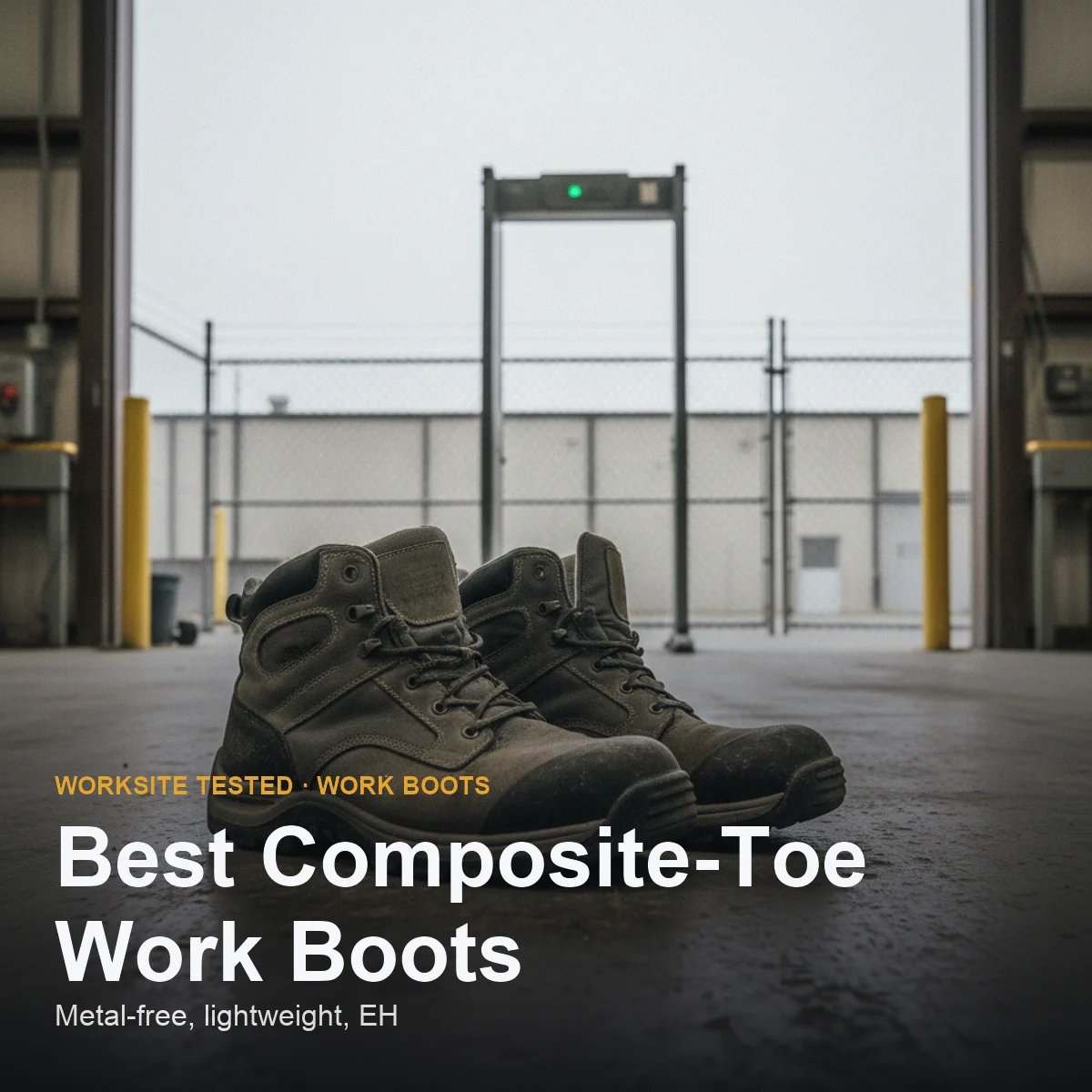
Composite toe: Made from fiberglass, carbon fiber, Kevlar, or plastic. No metal. No conductive pathway in the toe box. Will not set off metal detectors. Tends to be wider in profile for the same protection rating than steel. This is what the Boondock 92615 and the Helix 89697 use.
Alloy toe: A lightweight metal alloy — still metallic. Thinner profile than composite for equivalent protection, lighter than steel. Still sets off detectors. The TiTAN 85520 and the Stockdale TB01064A use alloy toes.
Steel toe: Standard steel. Heavier, thinner profile than composite, sets off detectors. The Iron Age IA5081 is the only steel-toe boot in this group.
OSHA has not issued a blanket prohibition on steel or alloy toes for electricians. What OSHA 1910.333(c)(8) prohibits is wearing conductive articles that could contact exposed energized parts. In practice, a steel or alloy toe cap is recessed inside the boot — it is not the part contacting the energized equipment. But the conservative interpretation, and the one many electrical contractors use, is non-metallic toe as a default. Know your site policy before you buy.
Frequently Asked Questions
What is the best work boot for electricians overall?
The Timberland PRO Boondock Composite Toe 92615 at $230. Composite (non-metallic) toe, EH rating, guaranteed waterproof membrane, Goodyear welt construction (resole-capable), and a fiberglass shank — no metal in the toe box or shank. It covers the widest range of electrical jobsite conditions in a single boot. If you need metatarsal protection alongside the composite toe and EH, look at the Helix 89697. If budget is the constraint and steel toe is acceptable on your site, the Iron Age IA5081 at $139.95 is the cheapest EH boot in the group with Goodyear welt construction.
Do electricians have to wear composite toe boots?
No OSHA standard universally requires composite toe for electricians. OSHA 1910.333(c)(8) prohibits conductive items contacting exposed energized parts, and an OSHA interpretation letter (1993-03-17) states steel-toe boots are not inherently hazardous provided the metal is not externally exposed. Source: osha.gov. However, many electrical contractors and site safety plans require non-metallic (composite) toe as a default. Check your employer's PPE requirements and your site's safety plan before selecting a boot.
Do EH boots protect me in wet conditions?
No. The ASTM F2413-18 EH test is conducted under dry conditions. A wet, oil-soaked, or contaminated boot may not maintain the EH protection rating. Source: tyndaleusa.com, 70econsultants.com. If you work in wet environments near electrical hazards, keeping your boots dry is part of the PPE protocol — not optional.
What is the difference between EH boots and dielectric boots?
EH (Electrical Hazard) boots, rated under ASTM F2413 or F2892, provide secondary protection against open electrical circuits — incidental contact with the ground side of a fault. Dielectric boots, governed by ASTM F1117, are designed for workers who make direct contact with energized conductors, such as line workers. EH is not a substitute for dielectric protection when direct contact with energized lines is possible. Talk to your safety officer about which category applies to your specific work tasks.
What does NFPA 70E say about work boots?
NFPA 70E 2024 Article 130.7(C)(8) requires EH-rated footwear as secondary shock protection. Table 130.7(C)(15)(c) additionally requires heavy-duty leather footwear when arc flash incident energy exceeds 4 cal/cm² (PPE Category 2 and above). Category 1 lists leather footwear as optional (AN); Categories 2, 3, and 4 require it. Source: arcflash101.webflow.io. If your workplace has performed an arc flash hazard analysis, your PPE requirements are defined by that analysis — the category assignments in that document govern your footwear selection.
About this guide
Marco Reyes is a bilingual (EN/es-US) field reviewer who covers PPE and workwear for WorkSite Tested from the tradesman's side of the job. Every product in this guide was pulled live from Working Person's Store on June 27, 2026, confirmed in stock, and verified against the listing — no specs were inferred, extrapolated, or borrowed from other models or manufacturer websites beyond what appears on the listing page. ASTM F2413-18 EH test parameters were cross-checked against workwaysafety.com, worknmore.com, wcsafety.com, and tyndaleusa.com. NFPA 70E footwear requirements were sourced from arcflash101.webflow.io, 70econsultants.com, and e-hazard.com. OSHA requirements from osha.gov. All sources fetched June 27, 2026. We earn an affiliate commission on purchases through links in this guide at no extra cost to you. Ranking is by protection fit for the trade — never by commission rate. See our affiliate disclosure.