
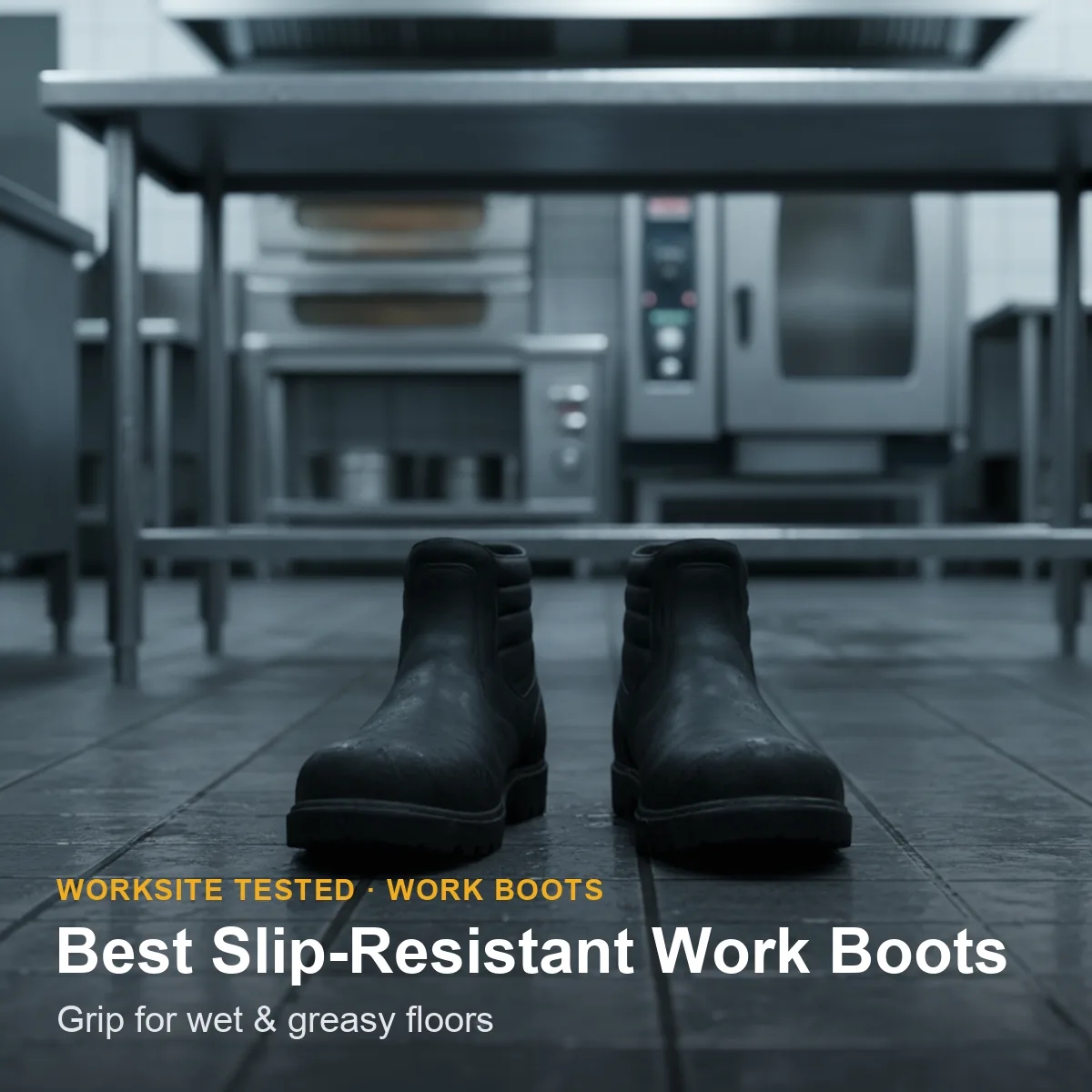
Short answer: for a wet, greasy floor, the boot I trust most on the spec sheet is the Shoes For Crews ACE Defender Mid — it is the only pick here whose listing states its outsole meets ASTM F3445-21, the U.S. slip-resistance specification. If you need a genuinely waterproof boot (the Shoes For Crews is only water-resistant), the KEEN Flint II Mid is the pick. And if you want waterproofing plus a metal-free safety toe, the Reebok RB4606 covers it. Everything in this guide is a real listing — the four Working Person's Store boots were pulled live and confirmed in stock on July 6, 2026, with prices and specs read straight off each product page; the Shoes For Crews boot is sourced from the brand's own site.
Here is the rule I follow in a safety category: every number traces back to the actual listing. The single most important thing to understand about "slip-resistant" boots is that most listings never cite the standard that gives the phrase a measurable meaning. So I'll tell you exactly which boot's listing states an ASTM F3445-21 / F2913 pass (one of five) and which four just say "slip resistant" as a manufacturer claim. I don't rank by commission, either — the boot at the top is the one I earn nothing on.
Key Takeaways
- "Slip resistant" has a real definition — ASTM F3445-21. To be labeled slip resistant under that spec, a boot must hit at least a 0.40 coefficient of friction at BOTH the heel and forefoot in the ASTM F2913 whole-shoe test. The 2024 F2913 revision tightened the "oily wet" test condition (e.g. corn oil) — the one that matters for greasy kitchen floors.
- Only one of these five boots' listings cites that standard. The Shoes For Crews ACE Defender Mid states its TRACTIONiQ outsole meets ASTM F3445-21. The Timberland PRO Irvine, KEEN Flint II, Reebok RB4606, and Skechers Holdredge all mark "Slip Resistant: Yes" but do not cite an F2913/F3445 number — that's a manufacturer claim, not a stated standards pass.
- The injury data is real and large. Per NIOSH, in a cluster randomized trial of about 17,000 food-service workers across 226 school districts, districts given highly-rated (5-star) slip-resistant shoes at no cost saw a 67% reduction in slip-injury claims — the slipping-injury rate fell from 3.54 to 1.18 per 10,000 months worked. No decline in the group that didn't get the shoes.
- EH ratings are unreliable on wet/greasy floors. Per Tyndale's ASTM F2413 explainer, electrical-hazard protection is "severely diminished in wet conditions or where footwear can be contaminated with conductive materials." Four of these boots are EH-rated — don't treat that as protection on a wet line.
- Waterproof ≠ slip-resistant, and not every pick is both. The KEEN Flint II and Reebok RB4606 are waterproof; the Shoes For Crews is water-resistant; the Timberland Irvine's listing doesn't state waterproof; the Skechers Holdredge is marked Not Waterproof.
- Internal links: Best work boots (ranked by job) | ASTM F2413 explained | Best waterproof work boots
What actually makes a boot "slip-resistant" for wet and greasy floors
The U.S. spec that gives "slip resistant" a measurable meaning is ASTM F3445-21 — the "Standard Specification for Performance Requirements when Evaluating Slip Resistance of Protective (Safety) Footwear using ASTM F2913 Whole Shoe Test Method." It sets one universal bar: a footwear sample must achieve at least a 0.40 coefficient of friction at both the heel and the forefoot (flat) contact under the F2913 whole-shoe test to be labeled slip resistant. It applies to protective footwear including ASTM F2413 (protective-toe) and ASTM F2892 (soft-toe) footwear. Source: ASTM store, F3445-21.
ASTM F2913 is the whole-shoe test method that F3445 references. It measures the dynamic coefficient of friction of a complete shoe against a floor surface (such as quarry tile) under wet and other contaminant conditions. The 2024 revision more tightly specifies the "oily wet" test condition (for example, corn oil) — which is exactly the condition relevant to greasy kitchen and food-processing floors. Source: ANSI webstore, ASTM F3445-21.
Here's the practical catch. Most work-boot listings mark "Slip Resistant: Yes" and describe an "oil- and slip-resistant" outsole, but they do not cite an F2913 or F3445 number. Among the five boots below, only the Shoes For Crews ACE Defender Mid explicitly states its outsole meets ASTM F3445-21. The Timberland PRO Irvine, KEEN Flint II, Reebok RB4606, and Skechers Holdredge all mark "Slip Resistant: Yes" without an F2913/F3445 number. I cite exactly what each listing states — nothing more.
All 5 slip-resistant boots at a glance
| Boot | Slip claim on listing | Toe | EH | Waterproof | Best for | Price |
|---|---|---|---|---|---|---|
| Shoes For Crews ACE Defender Mid | States ASTM F3445-21 | Nano-composite (F2413-18, I75/C75) | Yes | Water-resistant | Greasy floors, spec-backed grip | $107.98 |
| KEEN Flint II Mid | "Passes safety tests" (no F2913/F3445 no.) | Soft toe (not safety) | Yes (18,000 V dry) | Yes (KEEN.DRY) | Genuinely wet floors, no drop hazard | $170.00 |
| Reebok RB4606 | "Slip-resistant" (no F2913/F3445 no.) | Composite F2413-05 I/75 C/75 | Yes | Yes | Waterproof + metal-free safety toe | $159.95 |
| Timberland PRO Irvine | "Slip-resistant" (no F2913/F3445 no.) | Alloy F2413-05 I/75 C/75 | Yes | Not stated | All-day comfort, greasy (not soaked) | $165.00 |
| Skechers Holdredge | "Slip-resistant traction" (no F2913/F3445 no.) | Steel F2413-05 I/75 C/75 | Yes | No | Budget, mostly-dry warehouse | $84.99 |
1. Shoes For Crews ACE Defender Mid — the only pick with a stated ASTM F3445-21 outsole
In a slip-resistance roundup, the boot whose listing actually cites the slip-resistance standard should win on merit — and this is the only one of the five that does. The ACE Defender Mid's TRACTIONiQ outsole is stated to meet ASTM F3445-21, the spec that requires at least a 0.40 coefficient of friction at both heel and forefoot in the F2913 whole-shoe test. For a wet or greasy floor, that stated pass is exactly the piece of information the other four listings don't give you. It also meets ASTM F2413-18 (I75/C75, EH) with a Nanotube Carbon Fiber safety toe the brand describes as lighter and stronger than a standard composite, plus SPILL GUARD upper technology, a GLADIATOR 4HD abrasion-resistant outsole with Ladder Grab, and it weighs 22.4 oz per shoe. Full disclosure: this is the one boot in the guide I earn no commission on, and it still ranks first.
- Pros: the only listing here that states an ASTM F3445-21 slip pass; F2413-18 safety toe with EH; light nano-composite toe; ladder-grab tread built for greasy floors.
- Cons: water-resistant, NOT fully waterproof — standing water will eventually get through; on my fetch the listing showed inventory still loading, so stock status was not confirmed. Verify availability before you count on it.
See the ACE Defender Mid at Shoes For Crews →
2. KEEN Utility Flint II Mid — best genuinely waterproof pick
If your floor is actually wet — not just greasy, but standing water, wash-downs, drains — the Flint II Mid is the pick, because the KEEN.DRY membrane backs a real guaranteed-waterproof claim where the Shoes For Crews boot is only water-resistant. KEEN describes an oil- and slip-resistant non-marking rubber outsole and the listing says it "passes safety tests for slip resistance," but it does not cite an ASTM F2913 or F3445 number, so I won't assign one it doesn't carry. The bigger caveat: this is a soft toe — a General Toe, not an ASTM F2413 safety toe. If anything can drop or roll onto your feet, this is the wrong boot. The listing states EH secondary protection up to 18,000 volts under dry conditions; on a wet or greasy floor, treat that EH rating as unreliable.
- Pros: genuinely waterproof (KEEN.DRY membrane); non-marking oil- and slip-resistant outsole; comfortable KEEN.ReGEN midsole and stability shank; good for wet wash-down environments.
- Cons: soft toe — no ASTM F2413 impact/compression protection; slip claim carries no F2913/F3445 number; EH rating (18,000 V dry) shouldn't be relied on once the floor is wet.
Check price at Working Person's Store →
3. Reebok RB4606 — best waterproof boot with a metal-free safety toe
If you need all three things at once — waterproofing, a slip-resistant outsole, and an actual safety toe — the RB4606 is the pick. It's a 6-inch waterproof boot with a composite (XTR, metal-free) safety toe rated ASTM F2413-05 M I/75 C/75, which is a real 75 ft-lb impact and 2,500 lb compression rating on the toe cap, plus EH. The 100% non-metallic construction means it won't trip a metal detector — useful at food-processing plants with detector entry — and the 90-degree heel wedges bite ladder rungs cleanly. On the slip side, be precise: the listing says "The outsoles are slip-resistant, too, to prevent slips and falls at your workplace," but it does not cite an ASTM F2913 or F3445 number. That's a manufacturer claim, not a stated standards pass.
- Pros: waterproof; metal-free composite safety toe (F2413-05 I/75 C/75); EH-rated; MemoryTech Massage footbeds and Sublite cushioning; extra-wide toe area.
- Cons: slip claim carries no F2913/F3445 number (manufacturer claim); EH protection is unreliable once the floor is wet or greasy.
Check price at Working Person's Store →
4. Timberland PRO Irvine — best all-day comfort for greasy (not soaked) floors
The Irvine is the comfort-and-durability pick: premium full-grain leather, Anti-Fatigue Technology polyurethane footbeds, a fiberglass shank with ExoSpine, and a lightweight alloy safety toe rated ASTM F2413-05 M I/75 C/75 with EH. Its outsole is marked heat-, oil-, slip-, and abrasion-resistant, which covers a lot of the greasy-kitchen and light-industrial bases in one boot. Two honest catches for wet-and-greasy work: the listing does not state waterproof, so for a genuinely wet floor go with the KEEN or Reebok; and, like the other WPS picks, the "slip-resistant" mark carries no ASTM F2913/F3445 number. The alloy toe is lighter than steel and lighter-profile than most composites.
- Pros: full-grain leather and Anti-Fatigue footbeds for all-day standing; lightweight alloy toe (F2413-05 I/75 C/75) with EH; outsole marked heat-, oil-, slip- and abrasion-resistant.
- Cons: waterproof NOT stated on the listing — not for a soaked floor; slip mark carries no F2913/F3445 number (manufacturer claim).
Check price at Working Person's Store →
5. Skechers Holdredge — best budget pick with a real safety toe
At $84.99 the Holdredge is the budget pick, and it doesn't cut the toe to hit the price: it carries a steel safety toe rated ASTM F2413-05 M I/75 C/75 (the listing also cites the 2011 edition, I/75 C/75) plus EH. The gel-infused Memory Foam insoles make it an easy boot to stand in all day, and the aggressive tread is genuinely grippy on dry and lightly-wet surfaces. Read the two limits plainly for wet-and-greasy work, though: it's marked Not Waterproof, so standing water gets through, and its "slip-resistant traction" mark carries no ASTM F2913/F3445 number. For a mostly-dry warehouse or a helper's first pair, it's a lot of boot for the money; for a soaked kitchen line, spend up.
- Pros: cheapest pick by a wide margin ($84.99); real steel safety toe (F2413-05 I/75 C/75) plus EH; gel Memory Foam comfort; aggressive tread.
- Cons: marked Not Waterproof — wrong boot for standing water; slip mark carries no F2913/F3445 number (manufacturer claim).
Check price at Working Person's Store →
How to read a "slip-resistant" boot listing without getting fooled
Boot listings mix a certified standard with marketing language, and on slip resistance it's easy to confuse the two. Here's how to read them:
- "Meets ASTM F3445-21" (Shoes For Crews ACE Defender Mid) — this is the real thing: the spec that requires at least a 0.40 coefficient of friction at both heel and forefoot in the F2913 whole-shoe test. If a listing states this, "slip resistant" has a measurable meaning behind it.
- "Slip Resistant: Yes" with no ASTM number (Timberland PRO Irvine, KEEN Flint II, Reebok RB4606, Skechers Holdredge) — this is a manufacturer claim. It may well be true, and the outsole may pass F2913 in a lab, but the listing isn't telling you it does. Don't upgrade it in your head to "F3445-certified."
- "Oil- and slip-resistant non-marking rubber" (KEEN) — describes the compound, not a test result. Non-marking matters in food service (no black scuffs on floors); oil-resistant matters for greasy floors — but neither is a slip-resistance standard.
- "EH — up to 18,000 volts under dry conditions" (KEEN) — an electrical-hazard characteristic, not a slip spec, and note the words "dry conditions." On a wet or greasy floor, per Tyndale's F2413 explainer, EH protection is "severely diminished." Don't let an EH line reassure you about slipping.
Frequently Asked Questions
What actually makes a work boot "slip-resistant" for wet and greasy floors?
Look for the ASTM F3445-21 slip-resistance specification, which requires at least a 0.40 coefficient of friction at both heel and forefoot in the ASTM F2913 whole-shoe test; the 2024 F2913 revision tightened the "oily wet" test condition that matters for greasy kitchen floors. Note that many Working Person's Store listings (Timberland PRO Irvine, KEEN Flint II, Reebok RB4606, Skechers Holdredge) describe an "oil- and slip-resistant" outsole and mark "Slip Resistant: Yes" but do NOT cite an F2913/F3445 number, whereas the Shoes For Crews ACE Defender Mid explicitly states ASTM F3445-21. Cite exactly what each listing states.
Do slip-resistant shoes really reduce injuries in kitchens and food service?
Yes, per NIOSH. In a cluster randomized trial of about 17,000 food-service workers across 226 school districts, workers given highly-rated (5-star) slip-resistant shoes at no cost had a 67% reduction in slip-injury workers' compensation claims, with the rate falling from 3.54 to 1.18 slipping injuries per 10,000 months worked; no decline was seen in the group that did not receive the highly-rated shoes. Source: CDC/NIOSH.
What does "EH" (electrical hazard) mean, and does it work on wet floors?
EH-rated footwear (per ASTM F2413) has an outsole and heel that give a secondary source of protection against electric shock. Important caveat: per Tyndale's ASTM F2413 explainer, EH protection is "severely diminished in wet conditions or where footwear can be contaminated with conductive materials" — so an EH rating should not be treated as reliable protection on wet or greasy floors. The KEEN Flint II listing states EH secondary protection up to 18,000 volts under dry conditions.
Do I need a safety toe (steel/alloy/composite) for kitchen slip-resistant boots?
Not always — it depends on the hazard. Among these boots, the Skechers Holdredge has a steel toe (ASTM F2413-05 M I/75 C/75), the Timberland PRO Irvine an alloy toe, and the Reebok RB4606 and Shoes For Crews Defender Mid a metal-free composite/nano-composite toe, while the KEEN Flint II Mid is a soft (non-safety) toe. ASTM F2413 toe caps protect against a 75 ft-lb impact and up to 2,500 lb compression. For pure wet-floor kitchen work with no drop hazard, a soft-toe slip-resistant boot may suffice; where objects can fall or roll, choose an ASTM F2413 safety toe.
Does Working Person's Store carry SR Max or Shoes For Crews slip-resistant boots?
Based on this research, Working Person's Store carries slip-resistant work boots from Timberland PRO, KEEN Utility, Reebok Work, and Skechers Work (all confirmed in stock). SR Max and Shoes For Crews boots were NOT found on Working Person's Store and are sold through their own sites (specialist / non-monetized sourcing). The Shoes For Crews ACE Defender Mid explicitly states ASTM F3445-21. Don't assume a WPS listing exists for SR Max or Shoes For Crews.
Why Trust This Guide
This guide is written and reviewed by Marco Reyes, an independent work-safety-gear reviewer. Every recommendation is built on the published standards (ASTM F2413 for footwear, ASTM F3445-21 and F2913 for slip resistance, the OSHA rules), manufacturer spec sheets and product labels, hands-on handling, and what tradespeople actually report — and we tell you when a number is a manufacturer claim versus an independent standard, and when a boot is rated for one hazard but not another. The four Working Person's Store boots were pulled live and confirmed in stock on July 6, 2026; the Shoes For Crews boot is sourced from the brand's own site. We earn an affiliate commission if you buy through some of our links, at no extra cost to you, and we never rank by commission over safety — the top pick here is the one boot we earn nothing on. See our affiliate disclosure.