
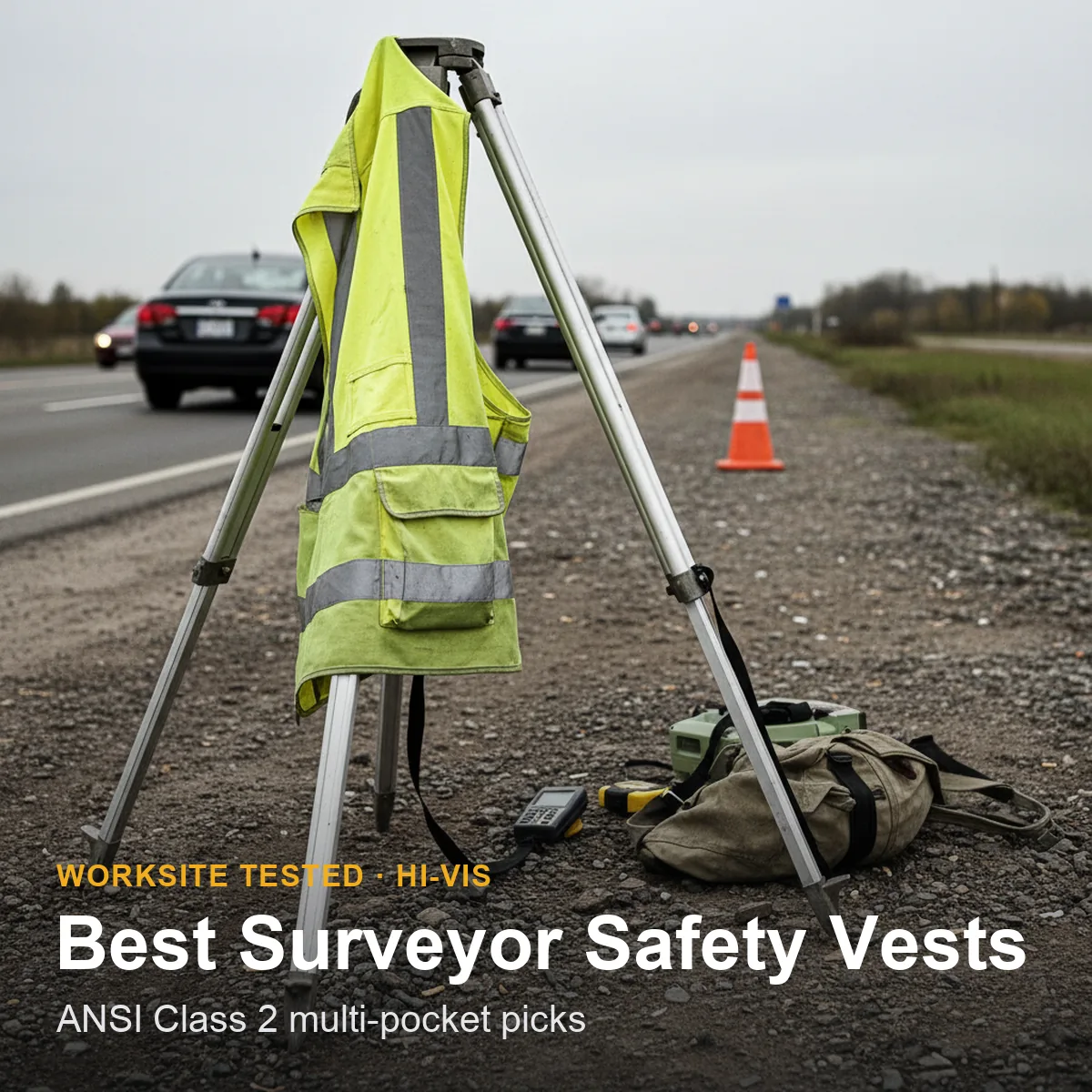
Short answer: the Radians SV6G is the vest I would put on most survey crews — six real pockets, an all-mesh body that breathes in summer heat, and a $16.99 price. If you haul a full field kit and a radio, the Tingley V73859 gives you eight pockets and a solid-front / mesh-back build. And the Radians SV272-2ZG at $15.00 is the cheapest way to get a Type R Class 2 vest with a real oversized tablet pocket. All six are real vests from real listings — everything here is priced and stocked at Working Person's Store as of July 1, 2026, with specs pulled directly from each product page.
One rule I follow in a safety category: every number in here traces back to the actual listing or the standard. If the listing doesn't say it, I don't say it. All the picks are labeled Type R Class 2 under ANSI/ISEA 107 — the class most workers on or near public roadways are legally required to wear. I'll tell you which vests are labeled to the older 2015 edition versus the current 2020 edition, and I won't quote a spec I couldn't verify on a fetched page.
Key Takeaways
- Surveyor vests are Type R Class 2. Under ANSI/ISEA 107, a Type R Class 2 vest requires a minimum of 775 square inches of fluorescent background material and a minimum of 201 square inches of retroreflective material. All six picks are labeled Type R Class 2 (the Tingley listing states its reflective layout meets Class 2 minimums).
- Reflective tape has a minimum width. For a Class 2 garment, the retroreflective tape must be at least 1.38 inches wide (or 1 inch for split-trim designs). The Radians mesh vests use 2" tape; the MCR SURVL uses 3" tape — both clear the minimum.
- Pocket count is what makes it a "surveyor" vest. Type R surveyor vests add chest, lower flap-covered, radio/mic, and inside tablet pockets so crews carry tools hands-free. Counts here run from 3 (Radians SV27) to 8 (Tingley V73859). Rows in the table below sum to the count each vest states.
- Mesh vs solid front is a comfort trade, not a compliance one. Mesh (Radians SV6G, SV27, SV272) breathes for hot-weather field work; solid polyester (MCR SURVL) or solid-front/mesh-back (Tingley V73859) blocks wind and is more durable. Both meet Class 2.
- OSHA and the FHWA rule drive the requirement. OSHA requires hi-vis garments for workers exposed to public vehicular traffic near excavations (29 CFR 1926.651(d)) and for flaggers (29 CFR 1926.201); the FHWA Worker Visibility Rule (23 CFR 634) requires hi-vis for all workers in a Federal-aid highway right-of-way exposed to traffic or equipment.
- Internal links: ANSI/ISEA 107 classes explained | Class 2 vs Class 3 | Best hi-vis safety vests
What ANSI/ISEA 107 Type R Class 2 means on a surveyor vest
Every vest in this guide is labeled Type R Class 2. Here is what that designation actually requires, based on the standard and verified against the sourced research:
- Type R: ANSI/ISEA 107 defines three garment types. Type O is a single Performance Class 1 for off-road use. Type R covers Performance Class 2 and Class 3, designed for use on roadways with more fluorescent background material and additional retroreflective square inches. Type P covers Class 2 and Class 3 for public safety, typically shorter length for quick access to waist-carried equipment. Surveyor vests are Type R.
- Class 2: A Type R Class 2 vest requires a minimum of 775 square inches of background (fluorescent) material and a minimum of 201 square inches of retroreflective material. That is the visibility floor for most workers on or near public roadways.
- Reflective tape width: The retroreflective material on a Class 2 garment must be at least 1.38 inches wide (or 1 inch for split-trim designs). The Radians mesh vests here use 2" tape; the MCR SURVL uses 3" tape — both exceed the minimum width.
- The current edition is ANSI/ISEA 107-2020, updated from the former ANSI/ISEA 107-2015 by ISEA's High Visibility Products Group. Two of these vests (Radians SV6G, MCR SURVL) carry the older 2015 edition on the listing — both are legally recognized Class 2 garments; the difference is an administrative revision, not a protection gap.
OSHA does not certify or approve specific vest models — compliance is demonstrated by the ANSI/ISEA 107 label on the garment. For a full breakdown of how the classes and types stack up, see our ANSI/ISEA 107 classes explainer. Sources: reflectiveapparel.com and ergodyne.com (ANSI/ISEA 107 requirements), fetched July 1, 2026.
All 6 surveyor vests at a glance
| Vest | Class / Type | Material | Pockets | Reflective tape | Best for | Price |
|---|---|---|---|---|---|---|
| Radians SV6G | Type R Class 2 (107-2015) | 100% polyester mesh | 6 | 2" | Most crews / hot weather | $16.99 |
| Radians SV27-2ZGM | Type R Class 2 | 100% polyester mesh | 3 | 2" silver | Minimalist tablet/radio carry | $15.99 |
| Radians SV272-2ZG | Type R Class 2 | 100% polyester mesh | 4 | 2" silver | Cheapest w/ oversized tablet pocket | $15.00 |
| MCR Safety SURVL | Class 2, Type R (107-2015) | Solid polyester | 6 | 3" orange/silver | Solid front / windy conditions | $17.99 |
| Tingley V73859 | Class 2 (per listing) | Solid front, mesh back | 8 | 2" silver | Full-kit crew leads | $20.99 |
| Radians SV6WG (women's) | Type R Class 2 | Knit front, mesh back | 7 | 2" silver | Women's-cut fit | $13.78 |
Every spec in this table was pulled from the individual Working Person's Store product page for each vest on July 1, 2026. All five Radians and the Tingley listings state a 2" silver reflective tape; the MCR SURVL uses wider 3" orange/silver stripes.
1. Radians SV6G — best surveyor vest for most crews
Six real pockets — two deep inside pockets, a split pad/pencil pocket, a dedicated radio pocket, and two lower flap-covered pockets — on an all-mesh 100% polyester body, for $16.99. That combination is why this is my default recommendation for a survey crew. The mesh breathes in July heat where a solid vest cooks you, the radio pocket keeps your handheld off your hip, and the two-tone hi-vis green pattern helps you stay visible against green summer vegetation where a plain lime vest can wash out. It uses 2" reflective tape, comfortably above the 1.38" Class 2 minimum. The listing labels it to the 2015 edition of ANSI/ISEA 107 rather than the current 2020 edition — both are recognized Class 2 garments, so this is an administrative note, not a downgrade.
- Grab this if: you want the best all-around pocket layout and hot-weather breathability at a fair price.
- Skip if: you work in cold or windy conditions where a solid front blocks more wind (see the MCR SURVL).
Check price at Working Person's Store
2. Tingley V73859 — most pockets for full-kit crew leads
Eight pockets — three interior, five exterior, plus two mic tabs — is the most carry capacity in this roundup. If you are the crew lead who hauls a data collector, a phone, flagging, a pad, and a radio, this is the vest that swallows all of it hands-free. The build is a solid-front / mesh-back hybrid, which is the smart compromise: the solid front blocks wind and gives the reflective tape a clean, uninterrupted canvas, while the mesh back dumps heat so you don't overheat carrying everything. The fluorescent orange/yellow two-tone is the most conspicuous color combination here. At $20.99 it is the priciest pick, but it is the most vest for the money if you actually fill every pocket. The listing states the reflective-tape layout meets Class 2 minimum requirements — I take that from the listing and don't assign a Type designation it doesn't state.
- Grab this if: you carry a full field kit and want maximum pockets plus wind-blocking front and a breathable back.
- Skip if: you run a light carry — you're paying for pockets you won't use (look at the SV27 or SV272).
Check price at Working Person's Store
3. MCR Safety SURVL — best solid-front vest for windy or cold work
When mesh feels drafty — cold mornings, wind on an exposed grade — you want a solid front, and the SURVL is the solid-front pick here. It's a solid fluorescent-lime polyester body with 3" orange/silver contrast stripes. That 3" tape is wider than the 2" tape on the Radians mesh vests, which reads as more retroreflective area at distance, and the orange-on-lime contrast helps you stand out against both pavement and green vegetation. Six pockets (four outer, two inner) plus a left-chest mic tab covers a full survey kit. It's labeled ANSI/ISEA 107-2015 Class 2 Type R — same recognized class as the rest, on the older edition. At $17.99 it sits right in the middle of the price range and earns it for cold-weather and windy-site crews.
- Grab this if: you work in wind or cold and want a durable solid front with the widest (3") reflective tape here.
- Skip if: you work in sustained heat — an all-mesh vest like the SV6G will keep you cooler.
Check price at Working Person's Store
4. Radians SV272-2ZG — cheapest vest with a real oversized tablet pocket
At $15.00 this is the lowest-priced men's vest in the roundup, and it earns the spot with an inside oversized tablet pocket that actually fits a full-size data collector or a ruggedized tablet without a fight — the thing survey techs care about most. Four pockets (one upper-left chest, two lower flap-covered, plus that inside tablet pocket) is the sensible middle ground between the three-pocket SV27 and the six-pocket SV6G. All-mesh 100% polyester construction keeps it cool in the heat. There's no dedicated radio pocket, so if you carry a handheld all day, size up in pockets. But if your carry is "tablet plus a couple of small items" and you want to spend as little as possible while staying Type R Class 2, this is the value play.
- Grab this if: your main carry is a full-size tablet or data collector and you want the lowest price on a Type R Class 2 vest.
- Skip if: you need a dedicated radio pocket or maximum carry capacity.
Check price at Working Person's Store
5. Radians SV27-2ZGM — best minimalist vest for light carry
Three pockets — an upper chest pocket, two lower flap-covered pockets, and an inside tablet pocket — plus 2" silver reflective tape, at $15.99. This is the honest minimalist choice. If you run a data collector or a phone and not much else, a six- or eight-pocket vest is just extra fabric flapping around. The SV27 keeps it lean while staying fully Type R Class 2 on an all-mesh 100% polyester body. You give up carry capacity, not compliance — the reflective tape and background material still meet the Class 2 requirement. Crews hauling flagging, a pad, a radio, and a tablet at the same time will run out of pockets fast, so this is specifically for the light-carry field tech.
- Grab this if: you carry a tablet or phone and little else, and you find multi-pocket vests bulky.
- Skip if: you carry a full kit — you'll want the SV6G (6) or Tingley V73859 (8).
Check price at Working Person's Store
6. Radians SV6WG — best women's-cut surveyor vest
The only women's-cut vest in this group, and the lowest listed price here at $13.78. A vest cut for a woman's frame sits better across the chest and shoulders — and that matters more than people think when you wear it eight hours a day. A poorly fitting unisex vest rides up, bunches, and puts the reflective tape in the wrong place, which quietly undercuts the visibility you bought it for. The SV6WG is Type R Class 2 with seven pockets and 2" silver reflective tape, the same legal category as everything else in this roundup. Its build is a solid-front / mesh-back hybrid — a 100% polyester knit front that blocks some wind, with a 100% polyester mesh back that vents heat — so it splits the difference between the all-mesh Radians men's vests and the fully solid MCR SURVL. At $13.78 it is the cheapest vest here, and for a woman on a survey crew it is the clear value pick.
- Grab this if: you want a vest cut for a woman's frame at the lowest price in the group.
- Skip if: you specifically need an all-mesh vest for sustained heat — the knit front runs a touch warmer than the SV6G or SV272 (look at those instead).
Check price at Working Person's Store
Mesh vs solid front: which surveyor vest material to buy
Mesh (100% polyester): The Radians SV6G, SV27, and SV272 are all-mesh. Mesh runs cooler and breathes, which is what you want for hot-weather field work where you're moving all day under the sun. The trade-off is that mesh blocks less wind and generally takes abrasion less gracefully than a solid weave.
Solid polyester front: The MCR SURVL is a solid fluorescent-lime body. A solid front blocks wind, is more durable, and gives the reflective tape an uninterrupted background. The trade-off is heat — a fully solid vest is warmer in summer.
Solid front, mesh back: The Tingley V73859 splits the difference — a solid front for wind-blocking and a clean tape canvas, a mesh back to dump heat. For crews who work across seasons, the hybrid is the most versatile build.
All three constructions meet Class 2 when the reflective layout qualifies — this is a comfort and durability decision, not a compliance one. Pick mesh for heat, solid for wind and durability, hybrid if you want both.
Frequently Asked Questions
What ANSI class should a surveyor vest be?
Surveyor vests are Type R Class 2 under ANSI/ISEA 107 — the legal minimum for most workers on or near public roadways. Class 2 requires at least 775 square inches of fluorescent background material and at least 201 square inches of retroreflective tape, with the tape a minimum of 1.38 inches wide (1 inch for split-trim). All the picks in this guide are labeled Type R Class 2 (the Tingley listing states its reflective layout meets Class 2 minimums). If you work on high-speed roadways or in low light, your site may require Class 3 instead — see our Class 2 vs Class 3 guide.
What makes a vest a "surveyor" vest versus a regular safety vest?
Surveyor (Type R) vests add multiple pockets — chest, lower flap-covered, radio/mic tabs, and an inside tablet or plan pocket — so field crews can carry tools, radios, and a tablet hands-free. A plain safety vest is mostly just the reflective shell. Pocket counts among the picks here range from 3 (Radians SV27) to 8 (Tingley V73859), with 4-pocket (SV272) and 6-pocket (SV6G, MCR SURVL) options in between. Match the pocket count to what you actually carry.
Solid front or mesh — which surveyor vest material is better?
Mesh (Radians SV6G, SV27, SV272) runs cooler and breathes for hot-weather field work. A solid polyester front (MCR SURVL) or a solid-front-with-mesh-back (Tingley V73859) is more durable and blocks wind. Both meet Class 2 when the reflective layout qualifies, so it's a comfort and durability call, not a compliance one. Pick mesh for sustained heat, solid for cold and wind, and the hybrid if you work across seasons.
Does OSHA require surveyors to wear a hi-vis vest?
OSHA requires high-visibility garments for workers exposed to public vehicular traffic near excavations under 29 CFR 1926.651(d), and for flaggers under 29 CFR 1926.201 (which incorporates the MUTCD). For other highway and roadway workers exposed to traffic, OSHA applies the General Duty Clause, Section 5(a)(1). Separately, the FHWA Worker Visibility Rule (23 CFR Part 634) requires all workers within the right-of-way of a Federal-aid highway who are exposed to traffic or to construction equipment to wear high-visibility safety apparel. Check your site's specific requirements, but for most surveyors near roadways a Class 2 vest is the floor.
How many pockets do these surveyor vests have?
Among this roundup: the Tingley V73859 has 8 (3 interior, 5 exterior, plus 2 mic tabs); the Radians SV6G and MCR SURVL each have 6; the Radians SV272 has 4 including an oversized inside tablet pocket; and the Radians SV27 has 3 including an inside tablet pocket. Pocket count is the main thing that separates these vests, so buy for the kit you actually carry — a tablet-only field tech doesn't need eight pockets, and a full-kit crew lead will run out of three fast.
About this guide
Marco Reyes is a bilingual (EN/es-US) field reviewer who covers PPE and workwear for WorkSite Tested from the tradesman's side of the job. Every product in this guide was pulled live from Working Person's Store on July 1, 2026, and verified against the individual product-page specs — no numbers were inferred, extrapolated, or borrowed from other models. ANSI/ISEA 107 standard facts were cross-checked against reflectiveapparel.com and ergodyne.com; OSHA and FHWA requirements against OSHA's own standard interpretation letter (all fetched July 1, 2026). We earn an affiliate commission on purchases made through links in this guide, at no extra cost to you. Ranking is by pocket layout, material, and field fit — never by commission rate. See our affiliate disclosure.